Native Son
His fingers grip the string and weave it through the mesh. Quick knot. Loosen. Tighten. He strokes the netting, his fingers pluck it like guitar strings.
This lacrosse stick is, after all, his instrument. Stringing it comes naturally, a part of him like the changing seasons his people live by.
When Drew Bucktooth learned to string lacrosse sticks at age 5, his father, Freeman, asked, “What took you so long?”
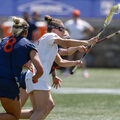
Growing up on the Onondaga Reservation, 15 minutes south of Syracuse, Bucktooth started playing lacrosse at age 3. Now, after stops in Ontario and Maine, Bucktooth, 22, is where he feels he belongs — playing lacrosse at Syracuse, where his father played.
Sometimes, he feels distanced from the reservation. Junior hockey sent him to Ontario, at age 16, and he later attended prep school in Maine.
But whenever he picks up that stick and strokes the mesh, he’s home, back on that little patch of sacred land, where lacrosse weaves together a culture.
Every spring, the Onondaga Nation gathers in the field in front of the reservation’s longhouse for The Medicine Game. It’s one of several celebratory lacrosse games the Native Americans play every year to ensure health.
Two lacrosse sticks on each end of the field form makeshift goals. Up to 60 men, ages 2 to 70, play on each team. Wood sticks are mandatory. Pads are outlawed. It’s lacrosse in the purest form, played the way its Native American inventors intended.
“It goes a lot deeper than just lacrosse,” Bucktooth says. “It’s weaved in and out of our culture. It basically is our culture. It is our life, because it’s part of it. Our God is the Creator. And our religion, he created it for his enjoyment. When we play, we’re supposed to play knowing we’re entertaining him.”
So the Onondagans play for fun. No fighting. No frowns.
Last summer, Bucktooth traveled to an Ontario tournament with one of the Nation’s teams. He remembers an opposing player trying to pick a fight with a Nation player, who refused to brawl.
“Our player was just standing there, smiling and laughing,“ Bucktooth says. “He took at least 10 bombs right to the face. He was just standing there with his arms down, laughing at the guy.”
Bucktooth is the latest in a line of Onondagans to play at SU. Defender Marshall Abrams played on SU’s 1999 and 2000 national-champion teams. Goaltender Oren Lyons won All-America honors in 1957 and 1958 and played alongside Jim Brown. Freeman estimates 75 percent of Onondaga men play lacrosse.
“It means more (to our people), there’s no doubt about that,” says Lyons, 73, now one of the Nation’s 26 chiefs. “There’s a depth here that you just can’t get on another field.”
Lacrosse is so ingrained in Onondaga culture that the Native Americans honor it during their February Mid-Winter Ceremonies of renewal, in which they also name babies. For Medicine Games, teams are divided based on membership in the Nation’s nine clans. Bucktooth is in the turtle clan, inherited, per tradition, from his mother, Joni. Though Onondaga society is matrilineal, women are forbidden from playing lacrosse.
“When a girl is born, you have a landowner,” Lyons says. “When a boy is born, you have a lacrosse player.”
When Bucktooth was born, his parents placed a small lacrosse stick in his hand and snapped a photo. A similar shot of a newborn clutching a miniature wooden stick hangs on a wall in the Nation’s new indoor lacrosse facility.
And, it seems, the game weaves from birth to death.
Years ago, when Bucktooth’s grandfather, Freeman, passed away, Bucktooth reached into the casket and laid a lacrosse stick beside the old man’s body.
“It’s the Creator’s game,” Bucktooth says. “So when you’re in Heaven, you’re going to play for him, too. So I was thinking he needed a stick.”
Route 11A, a desolate stretch of pavement, weaves through the Onondaga Nation’s rolling hills. Trailers and small homes dot the landscape. A large house perches on a distant ridge.
“A white man lives there,” Lyons says. “They always like to build on top of hills.”
This four-and-a-half-square-mile patch of land is what remains of about 7,800 square miles of Onondaga territory, Lyons says.
While many of the Nation’s 2,000 people hold jobs off the reservation — Drew’s father works at Niagara Mohawk — the Nation’s sole money source is a one-room smoke shop down the road from the reservation. Bucktooth’s mother, Joni, works at the Nation-owned shop, where a tax-free carton of Newport cigarettes sells for $26.50. Before the shop was built in 1996, the Nation “just didn’t have much,” Lyons says.
With profits from the smoke shop, the Onondagans in 2001 constructed a $7 million hockey arena, which they also use for indoor lacrosse. The shop funded a multimillion-dollar waterline and a community-watch unit to guard against people dumping on Nation territory (earlier this month, a body was found in a creek). The Nation’s athletic programs get a cut of the shop’s profits, too.
Still, problems persist. The Nation is embroiled in a land-claim dispute with New York State over territory the Onondagans say the state acquired illegally. Children at the Nation’s elementary school, which emphasizes Native culture, often struggle with the transition to public schools, says Bob Tarbell, the hockey arena’s general manager.
Save a state-run health center, the reservation is free of government influence. The Onondagans remain one of a handful of sovereign Native tribes, meaning they refuse government funding. Onondagans don’t vote, Lyons says, and the Nation plays separate from the United States in international lacrosse tournaments.
“There’s only one citizenship,” Lyons says.
Bucktooth’s parents and grandparents lived their whole lives on the reservation and are products of its communal lifestyle.
“It’s really one big family,” Joni says.
So much of one that Joni and Freeman leave their keys in their cars and never lock their house. A week after Freeman built the family’s house, 21 years ago, he lost the key and never bothered to get a new one.
Given the open-access comfort, Bucktooth tries to return to the reservation as often as possible. Every Sunday, he goes back for breakfast at his family’s house. But his schedule conflicts with day-long Native American ceremonies. So when he wants to weave himself back into the reservation’s sacred silence, he clutches his stick — his instrument — and, in a moment, he’s at peace.
Bucktooth was 16 when he packed up his stuff, left the reservation and headed to Oshawa, Ontario, to play junior hockey for the Oshawa Generals. Though he’d spent weekends during his youth playing with club hockey teams in Ontario, Bucktooth missed the reservation.
One of his first days in Oshawa, Bucktooth, searching for a reminder of home, picked up his lacrosse stick and started playing catch with a teammate.
When a coach found Bucktooth’s stick in back of the locker room, the team fined Bucktooth. Bucktooth spent two seasons playing for the Generals, rarely returning home. In 1999, Bucktooth left the Generals and came back to the reservation for his senior year at Lafayette High. The following spring, he formed a Lafayette starting lineup composed solely of his half brother, brothers and cousins.
Though Bucktooth’s lacrosse talents may have landed him a Division I scholarship, he chose, instead, to spend a year at Maine’s Bridgton Academy, brushing up on academics. He played hockey and lacrosse there and committed to SU during his one-year stint.
Bucktooth, a midfielder, redshirted last season because he was academically ineligible. His credits failed to transfer properly from Henry Street High, his school in Oshawa, he says. Even as Bucktooth sat, he managed to stay close to lacrosse, stringing nearly every Orangeman’s stick.
“He was given a large amount of talent,” says Bucktooth’s half brother, Brett, who is a freshman midfielder on the Orangemen. “With a lot of talent, he’s been able to play around with each hand (hockey and lacrosse). Now, he’s here at Syracuse, and I think, in his heart, this is where he wanted to be in the first place.”
This year, Bucktooth’s teammates noticed more tricks he learned on the reservation. He picked up a unique shot while playing box lacrosse — 5 on 5, with a goalie, like hockey. Since box lacrosse’s cages are smaller than field lacrosse’s, Bucktooth draws his stick back and does a double-pump windup to fake goalies. The Orangemen coined the move The Buck’s Windup.
“He has a real understanding of the game, a real understanding of where other players are,” SU head coach John Desko says. “A lot of times, the ball will be loose on the ground, and he’ll swat it out to an open player without even looking. He just has that sense. It’s his savvy of the game.”
That savvy goes a long way in winning over a people. After Abrams, the defenseman from the Nation, finished his SU career in 2000, fewer Onondagans traveled Interstate 81 to watch the Orangemen, Freeman says. Bucktooth’s presence may draw nearly 500 Onondagans, Freeman estimates.
“Every generation has its heroes,” Lyons says. “Drew is a hero of his generation.”
And soon, the hero will wield his stick and dodge through traffic like he did in those Medicine Games. Perhaps as he picks up that instrument and toys with the mesh, he’ll realize that he, too, is a thread.