Opinion: Don’t rely on efficiency of AI. It can’t replace creativity.

AI’s rise is overwhelming the digital art world, our columnist writes. They encourage Syracuse University students to demand authenticity within our creative industries and acknowledge the ethical concerns with growing AI use. Joe Zhao | Senior Staff Photographer
Get the latest Syracuse news delivered right to your inbox.
Subscribe to our newsletter here.
As students try to navigate the rapidly changing workforce, the prevalence of artificial intelligence poses a unifying question for almost every field: “How long before AI takes away my job?”
For those in creative industries, this unsettling question is no longer a mystery – it’s a pervasive reality. Syracuse University is no exception to the dwindling value of human-made art.
The emergence and almost instant acceptance of AI in art is startling and impossible to avoid in our digital world. Instagram Reels and TikTok For You Pages are flooded with AI-generated content, sometimes including realistic and outlandish prompts.
Users must recognize that AI itself isn’t inherently intelligent or artistic, though. It relies on an implausible amount of data to train itself past any emotional input, omitting the imperative human spirit altogether. In fact, many image-generating companies train their models by stealing artworks from the internet without any consent from the original artists at all.
By removing the human experience from our work, we move toward a world that neglects talent, perseverance and skill – the essence of our work. AI has quickly evolved as our demand for efficiency and speed has taken over every aspect of our lives.
We must start in our own spaces to combat the threat of AI in our creative industries, pushing organizations, especially those with the resources, to employ artists and designers instead of opting for cheap “AI slop.”
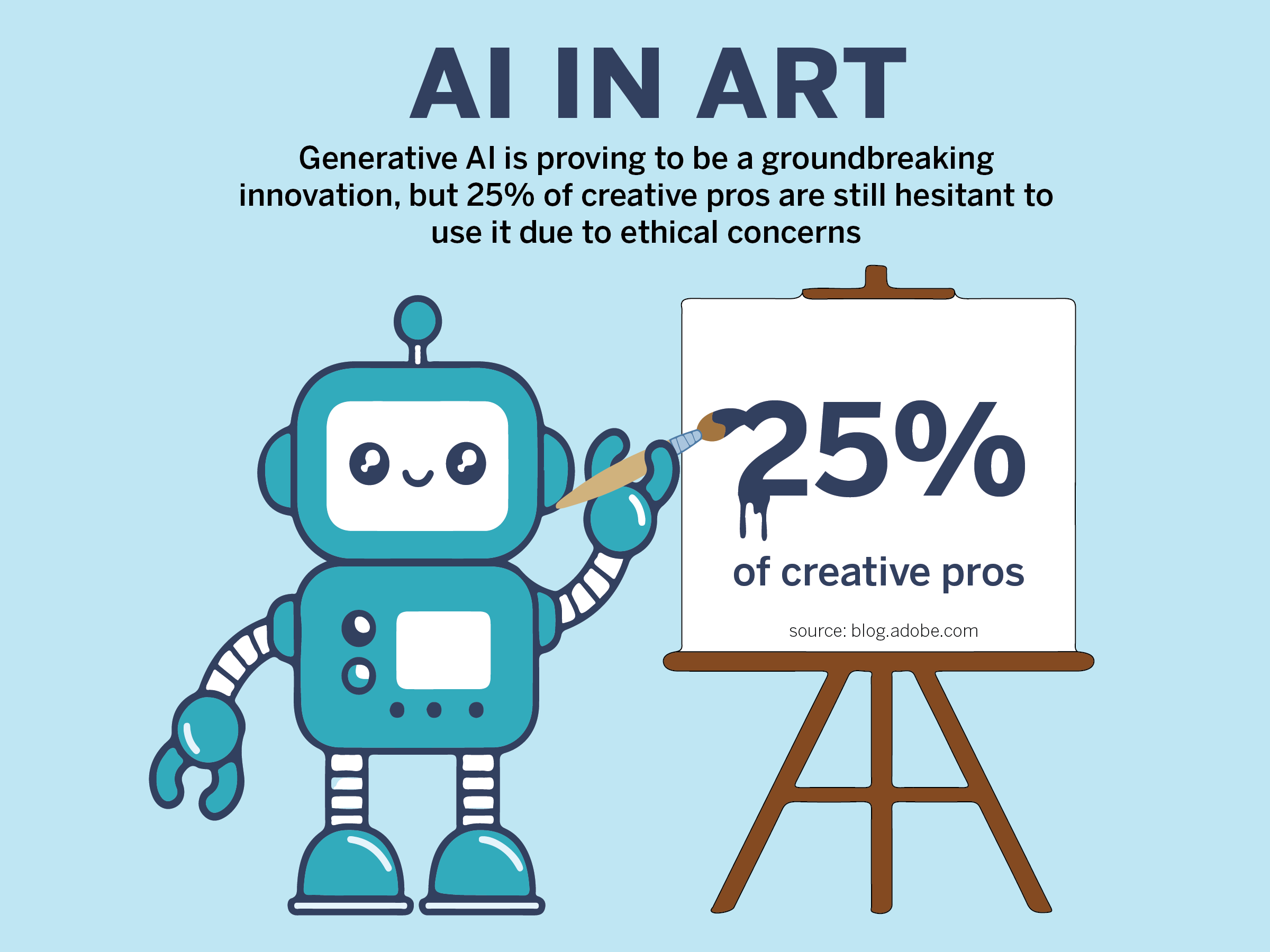
If the university wants to prove its confidence in its students and art programs, it’s essential to create opportunities for students and listen to them. At SU, we must pressure our marketing departments to utilize student illustrators and animators instead of machines. And if the university does use AI, it should admit to and credit it.
Katie Crews | Design Editor
Though on a smaller scale, demanding authenticity in our own communities aids us in addressing it universally. Even minor moments of accountability can equip us with the tools necessary to combat AI where it has larger, more influential and controversial implications for our art students.
Vogue’s August print issue, for instance, advertised a Guess campaign featuring an AI-generated model created by the AI marketing agency Seraphinne Vallora, the first of its kind for the magazine.
When asked about the lack of diversity on their Instagram page, which mainly features slim, white women, the founders responded that their posts with women of color don’t get as much traction and their “technology is not advanced enough” to include plus-sized women.
For Teja Nara, a senior at SU and the Director of Hair and Makeup at the Fashion and Design Society, this decision by Vogue was extremely disappointing.
“To claim the technology is not advanced enough is lazy. They should be adapting it before pushing out content. There are already so many instances of algorithmic biases in AI,” Nara said.
Sasha Degtiareva, a junior international student from Russia in the School of Design, voiced concerns that these biases extend far beyond creativity in the classroom. They’ve led her to further distrust Russian media and fear falling victim to the state-backed propaganda that continues to fuel the Russia-Ukraine war.
With our current administration in the U.S., we’re no strangers to government-sponsored AI art. The White House, in a new collaboration with conservative children’s network PragerU, has created the Founders’ Museum, a project that seeks to fight “woke” media and distort the voices of historical American figures with propaganda using generative AI.
As many states start to repeal art requirements in schools, it’s crucial to emphasize the benefits that arts education provides beyond aesthetics and profitability.
Many entertainment writers acknowledge that AI is a helpful tool, but disagree with it being used as source material or in place of a human writer. In 2023, the Writers Guild of America protested against labor concerns, including the attempt to replace writers and actors with generative AI. WGA’s 148-day strike led to a deal stating “writers can use AI if the company consents. But a company cannot require a writer to use AI software.”
There’s no denying that AI has genuine practical value, like for addressing global healthcare concerns and disaster prevention. But the issue lies in how we use it: as a mere instrument or as a ubiquitous catch-all and crutch.
In a world of instant gratification, the ability to concentrate on tedious tasks and longer-form content has become a special skill. Creating art of any kind is a form of protest against the technologies that seek to make us slaves to our screens.
We’re indoctrinated to believe that our work should hold economic or functional value to be truly worthwhile. Our everyday usage of AI only adds validity to this notion, as we’ve emphasized efficiency and perfection over the things that make us human: imperfection, discipline and heterogeneity — all qualities that art creation forces us to practice.
Ultimately, collective action may be the most effective way to protect artists from being replaced by AI. SU students must remember the process of creating is just as important as the final product, and continue pursuing authenticity over convenience in their creative disciplines. Otherwise, they too will fall to AI’s forceful omnipresence.
Christy Joshy is a junior International Relations and supply chain major. She can be reached at cjoshy@syr.edu.