Opinion: TS12 proves cult following enables mediocre work, cash grabs
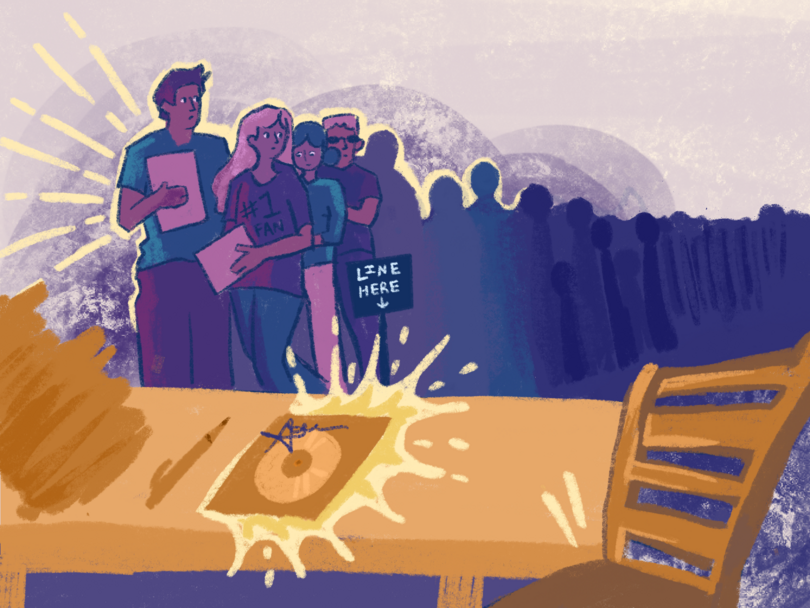
Taylor Swift’s recent release disheartened our columnist. Beyond its cringeworthy lyrics, Swift’s cash-grab tactics are a reminder that musical cult followings ruin art. Instead, fans should hold artists accountable, she argues. Hannah Mesa | Illustration Editor
Get the latest Syracuse news delivered right to your inbox.
Subscribe to our newsletter here.
I, along with many others, waited with bated breath for the release of Taylor Swift’s newest album, “The Life of a Showgirl.”
Swift has been a relatively controversial figure in the music industry with a huge die-hard fanbase. But recently, she’s been facing near-constant backlash for her declining musical quality and cash grab tactics.
Though I’ve been an avid fan since elementary school, Swift’s recent release was disheartening. Between cringeworthy lyrics like, “I’m not a bad bitch, and this isn’t savage,” and over 23 releases of hard copy variants of the album, it’s time to face the music. Cult followings of artists don’t support their production — they ruin it.
Although Swift is an easy example to point to, she’s far from the only artist releasing music seemingly for the sole purpose of making more money.
When the Weeknd released his semi-autobiographical film, “Hurry Up Tomorrow,” fans flocked to watch. They were sorely disappointed upon realizing that the film lacked any real quality or emotional depth. Many cited the only reason they watched the film was because of their love for The Weeknd’s music.
Stars like Taylor Swift and The Weeknd can afford to get away with releasing poor-quality products because of “star power.” The knowledge that superfans will consume anything they release, regardless of the quality, allows them more leeway for lazy artistry.
Of course, experimentation across genres can be a good thing for artists of any medium, but it shouldn’t come at the expense of quality. The purpose of listening to music or watching a film is not just for entertainment, but also for the sake of feeling like the media that you’re consuming is meaningful.
We want to feel emotional resonance with the media we selectively absorb – to laugh, cry and marvel at art makes it so powerful. That becomes impossible when society’s “top quality” artists inundate the industry with lackluster products.
For instance, after the wild success of Sabrina Carpenter’s innuendo-filled “Short n’ Sweet,” she released the thematically similar “Man’s Best Friend.”
Repeating a similar style gets tired, but because Carpenter’s huge following is derived from the breakthrough success of “Short n’ Sweet,” she can afford to stray away from experimenting with new styles.
The industry’s best and brightest set the tone for what others produce. Thus, if an artist’s cult following manages to promote an objectively bad album, others will feel inclined to copy that style later on.
The track “Wood” on Swift’s new album, for example, sounds almost like it came directly from Carpenter herself. This turns music into an echo chamber beyond singular artists, plaguing the entire industry.
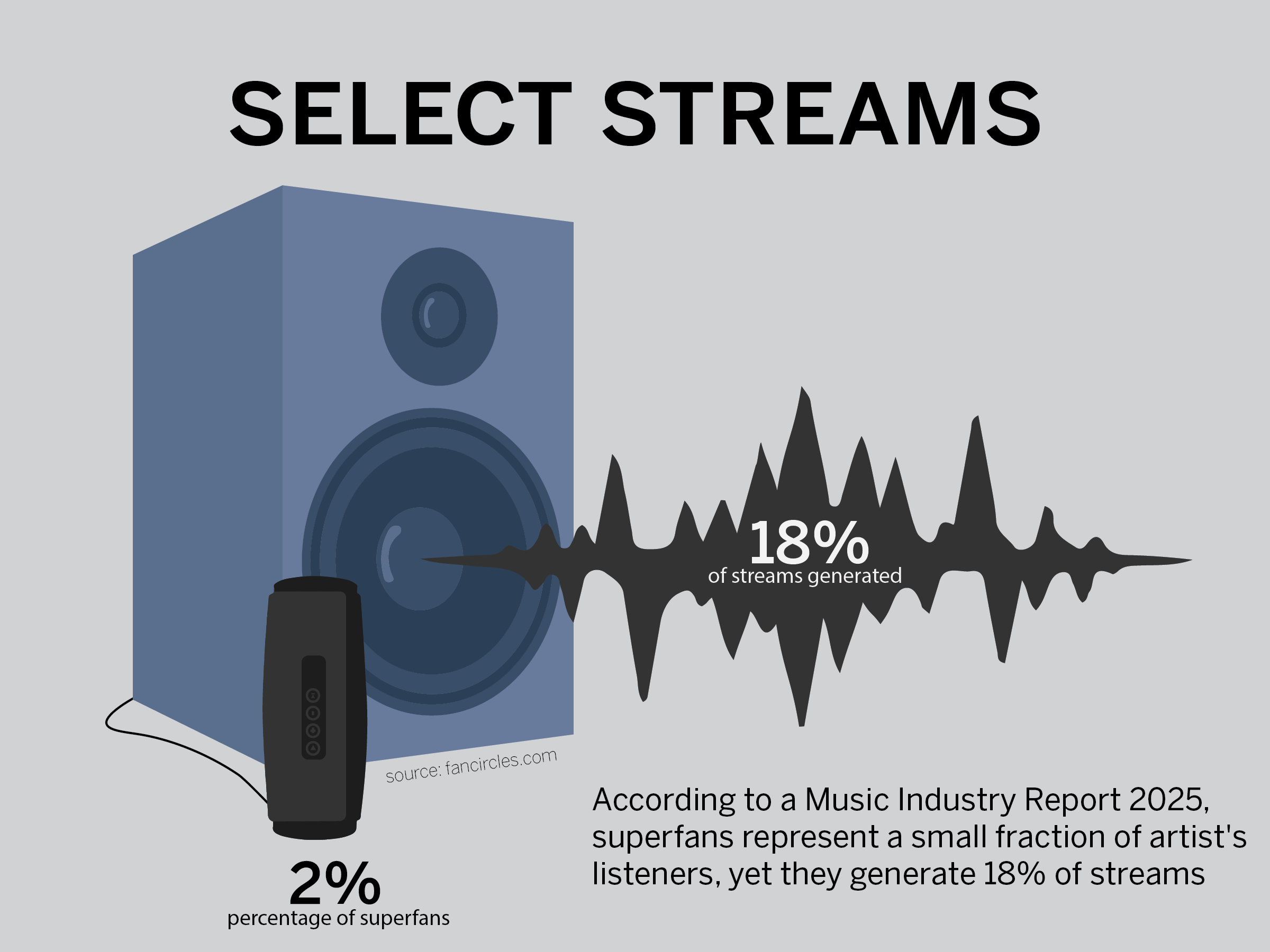
Katie Crews | Design Editor
Furthermore, cult followings turn the production of art into a game of consumerism. Having a large and devoted fanbase allows big artists to throw out large volumes of content, good or bad, with a guarantee that the music will climb the charts.
For example, Charli xcx capitalized on “brat” and released “brat and it’s completely different but also still brat.” While “brat” was novel and a breakout hit, there was undeniable safety in releasing a sister album instead of something new.
Notably, Swift released the 31-track “Tortured Poet’s Department” and “The Anthology,” which almost doubled the length of the initial 16-track album simply by setting the same themes and messaging to slightly different production. The effect was redundant and drawn out, nullifying the emotional album that Swift was aiming for.
The game of trying to capitalize on releases to maximize the number of hits achieved has caused the music industry to be flooded with subpar content. Yet, there is little pushback on the artist, as cult-followings cause fans to be more infatuated with the artist than the content they produce.
Grateful for any release, poor quality music doesn’t cause artists to lose fans and followers in the way that it should.
Although cult followings are an inescapable part of modern pop culture, they shouldn’t cause music and media to fall into flat, lifeless cycles and spare little thought for deeper meanings.
When they do, it’s the job of fans to hold artists accountable, rather than blindly following and consuming whatever is released. At the end of the day, consuming media is an investment of your own time, money and support, and it should be wisely extended to the art itself, not just the artist.
Varsha Sripadham is a freshman majoring in journalism and law, society and policy. She can be reached at vsripadh@syr.edu.