Trump’s tax targets universities, but SU’s $2B endowment is exempt
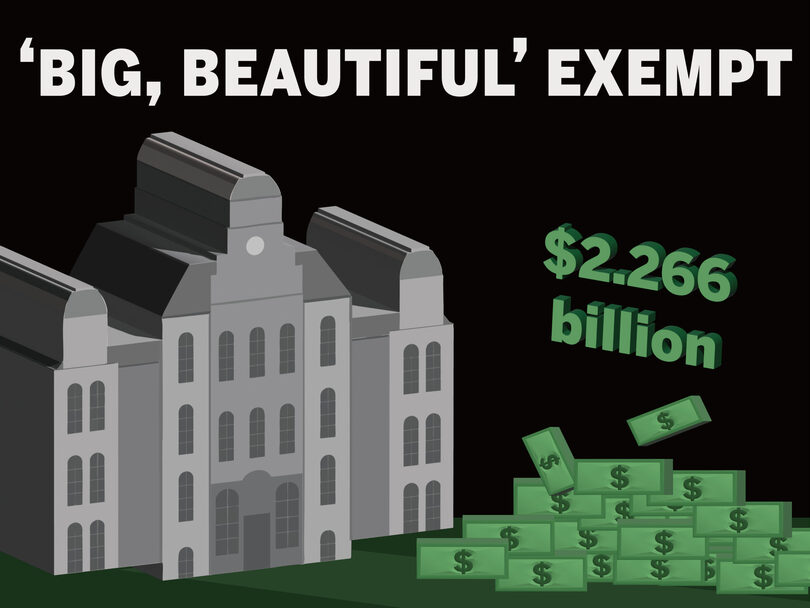
As President Trump leverages funding to pressure higher education, SU is confirmed to remain unaffected by federal endowment taxes on wealthy universities. The Daily Orange outlines the political and academic impacts of the new tax criteria. Joe Zhao | Senior Staff Photographer
Get the latest Syracuse news delivered right to your inbox.
Subscribe to our newsletter here.
Amid growing financial pressures on higher education institutions nationwide, Syracuse University’s Chancellor Kent Syverud confirmed that the university’s financial future will remain unaffected by the expanded federal endowment tax targeting wealthy, elite institutions.
During a Sept. 18 speech at the first University Senate meeting, Syverud said despite SU’s endowment of $2.266 billion, as of July 1, the university remains under the tax threshold as its endowment-per-student ratio remains below federal regulations.
“We worried a lot about federal laws, government endowments and particularly taxation endowments – we watched that closely,” Syverud said. “But the so-called ‘Big, Beautiful Bill’ does not apply to Syracuse, and it doesn’t in this area, because our endowment per student remains below the threshold.”
What is the federal endowment tax?
The federal endowment tax was first announced in 2017 as part of President Donald Trump’s tax plan, a federal effort to tax institutions and gain revenue from universities. The administration’s original plan was to apply a 1.4% tax levy to universities with at least 500 students and a $500,000 per student endowment, the Associated Press reported.
Eight years later, the Trump administration passed its sweeping reconciliation bill on July 4. The bill keeps elements of the original 2017 plan, including the 1.4% rate per $500,000. The bill will increase the tax rate to 4% for colleges with ratios exceeding $750,000 per student, and 8% for $2 million per student.
The enrollment requirement also increased from 500 to 3,000 students. John Cawley, an SU economics professor, wrote in a statement that this change exempts many liberal arts colleges, leaving only 11 universities meeting the new criteria.
Only a small number of universities fall into these upper levels – including Harvard University, Yale University, Stanford University and Princeton University in the 8% range. University of Notre Dame, Dartmouth College, University of Pennsylvania, Washington University in St. Louis and Vanderbilt University will pay the new 4% rate, PBS reported.
What are university endowments?
Endowments are primarily made up of donations from alumni and other sponsors to a university. These funds are often put into investment portfolios to maintain and increase the money over time. Endowments are mostly allocated toward scholarships for students and research positions for faculty, along with a small portion that is reinvested into the university budget, PBS reported.
SU’s endowment is over 2 billion dollars, but its endowment-to-student ratio is $91,500 – well below the federal taxation threshold.
How will the tax affect universities?
The endowment tax is part of the Trump administration’s broader effort to systematically target universities’ finances and reshape the United States educational landscape.
“This is just one way in which some universities’ finances are being hit. In addition, many federal grants to universities have been cancelled,” Cawley wrote. “Even if some grants haven’t been cancelled, in practice, many universities aren’t being reimbursed for the costs of doing the contracted work.”
Due to tax costs, many universities affected by the endowment tax are now scrambling to adjust their budgets to pay the rising costs. Yale said it would have to pay a $280 million endowment tax and would subsequently be forced to implement a hiring freeze on campus, citing the new tax as the reason, PBS reported.
Stanford also announced plans to lay off 363 members of its staff and reduce its budget by $140 million to afford the new taxes and “navigate a challenging fiscal landscape,” the Stanford Daily reported.
With the Trump administration’s push to end diversity, equity, inclusion and accessibility-related programs on campuses, many universities’ finances are being impacted.
Harvard possesses the largest endowment in the country and will be forced to reallocate its budgets. Some of the university’s funding was also frozen due to the ongoing battle with the administration over DEIA policies, PBS reported.
Cawley noted that certain universities have been asked to pay “hundreds of millions of dollars” to settle claims related to antisemitism or race-based admissions, which would impact their budgets as well.
What are the political impacts of the tax?
Sarah Hamersma, an associate professor of public administration and international affairs, wrote in a statement that through the Trump administration, there’s been a “long push” to reduce government funding for public universities.
Efforts to dismantle the U.S. Department of Education and eliminate funding programs have also made strides toward funding cuts, but these policies do not affect private universities.
Hamersma said private universities, including SU, have been able to rely on other sources of funds, including their large endowments, in a way that reflects their “history of large philanthropic gifts.”
“Because these kinds of gifts are not taxed, there is a sense in which the government is giving up funds it would have collected if the person had spent the money in some other way,” Hamersma wrote. “So there is always some pressure to get those tax dollars. The concern that the use of those tax dollars could be indoctrination instead of education provides easy cover for taking steps to collect some of that money.”
Universities have historically been a place where a variety of viewpoints are explored, Hamersma wrote, but institutional commitments have enforced “certain ideological perspectives,” which can cause tension on campuses.
Hamersma said commitments to philosophies such as inclusion have turned into a controversial topic, creating “ironic impacts of exclusion.” Institutions pushing the administration’s values can reduce “tolerance” for these ideologies on campuses, she wrote.
“When students and faculty feel silenced, it reduces the healthy debate and tolerance that should characterize a place where people are working through ideas together,” Hamersma said. “I think it is the impression that this issue is widespread that has led to political scrutiny.”
What are the academic impacts?
Beyond budgets, the tax could also reshape how universities operate academically, Cawley wrote.
Universities could follow in Yale and Stanford’s footsteps, imposing faculty layoffs and hiring freezes, he wrote. He warned of the tax’s impact on Ph.D. program admissions, departmental eliminations or degree programs with “modest” enrollments, reducing financial aid and cutting research support.
Cawley said many universities could even be forced to reshape student services, including reducing the hours of libraries and gyms and stopping maintenance on dorms and classroom buildings.
“Each affected university will be making its own choices, but it seems reasonable to assume that in the future the affected universities may have somewhat fewer majors and classes to choose from,” Cawley wrote. “And that each class will be a bit larger, have less TA support, and be in classrooms that are a bit less nice.”
Even with SU’s exemption from the endowment tax, professors say the federal tax marks growing signs of the administration’s scrutiny of higher education policies.
“All of this is negatively impacting the finances of U.S. colleges and universities, especially the large, well-funded ones,” Cawley wrote.