


A
s a self-taught German student, Cooper Childres never expected to fall in love with the language — let alone declare a major in it.
Childres, a Syracuse University sophomore, said he was anxious after testing into a high level on the language placement exam. But after meeting with one of the program’s professors, his nerves faded.
His first German class freshman year ultimately convinced him to declare it as a second major.
A similar feeling returned earlier this semester, he said, when he heard admissions to his second major, along with 17 others in SU’s College of Arts and Sciences, had been paused.
“At first it was kind of a blow, like, ‘Ouch, that’s how you feel about us,’” Childres said. “That really speaks volumes to how low on the totem pole we may be to you.”
In September, SU paused admissions to 18 majors as part of an ongoing academic portfolio review, an effort ordered by Vice Chancellor and Provost Lois Agnew to evaluate the university’s academic offerings.
While major-specific courses continue and current students can still enroll in these paused programs, the Arts and Sciences majors no longer appear on the Common Application. All students currently enrolled in affected programs will be able to complete their degrees, Sarah Scalese, SU’s vice president for communications, wrote in a Wednesday statement to The D.O.
Across faculty, students and alumni, The D.O. spoke with 35 people involved with these programs. Many in the paused majors described similar feelings as the fall 2025 semester ends: confusion, frustration and a growing uncertainty about the future of their programs.
Arts and Sciences Dean Behzad Mortazavi referred The D.O. to a university spokesperson following a request for comment, as did a member of the college’s communications team.
The D.O. reached out to faculty involved with all 18 programs. Faculty from music history and cultures, chemistry and fine arts majors declined to comment or did not respond to an interview request.
Department chairs must submit plans by mid-December outlining how they can stabilize or increase major enrollments. In January, Agnew will review these plans and “report on next steps,” Scalese wrote.
“It’s sort of like waiting for the other shoe to drop,” said Christopher Hanson, an associate professor of digital humanities, another paused program. “You’re not sure what’s going to be the next step and what decisions have already been made.”
Many questioned whether the decisions were politically motivated, citing efforts by President Donald Trump to reshape higher education and attack humanities programs. Trump has also dismissed members of the National Endowment for the Humanities.
“The goal of this exercise is not to eliminate departments or people. Higher education is facing significant demographic shifts, changing student demand and financial pressures,” Scalese wrote. “Regular portfolio reviews are a recognized best practice in higher education, undertaken by universities nationwide regardless of political climate.”
Admissions to the following 18 majors were put on pause:
- African American Studies
- Applied Mathematics B.A.
- Chemistry B.A.
- Classical Civilization
- Classics (Greek and Latin)
- Digital Humanities
- Fine Arts
- French and Francophone Studies
- German Language, Literature, and Culture B.A.
- History of Architecture
- Italian Language, Literature, and Culture B.A.
- Latino-Latin American Studies
- Middle Eastern Studies
- Modern Jewish Studies
- Music History and Cultures
- Religion
- Russian Language, Literature, and Culture B.A.
- Statistics B.A.
The Earth Science B.S. is also in a voluntary phase-out period to make way for B.S. programs in Environmental Geoscience and Geology, the chair of the Department of Earth and Environmental Sciences previously told The D.O.
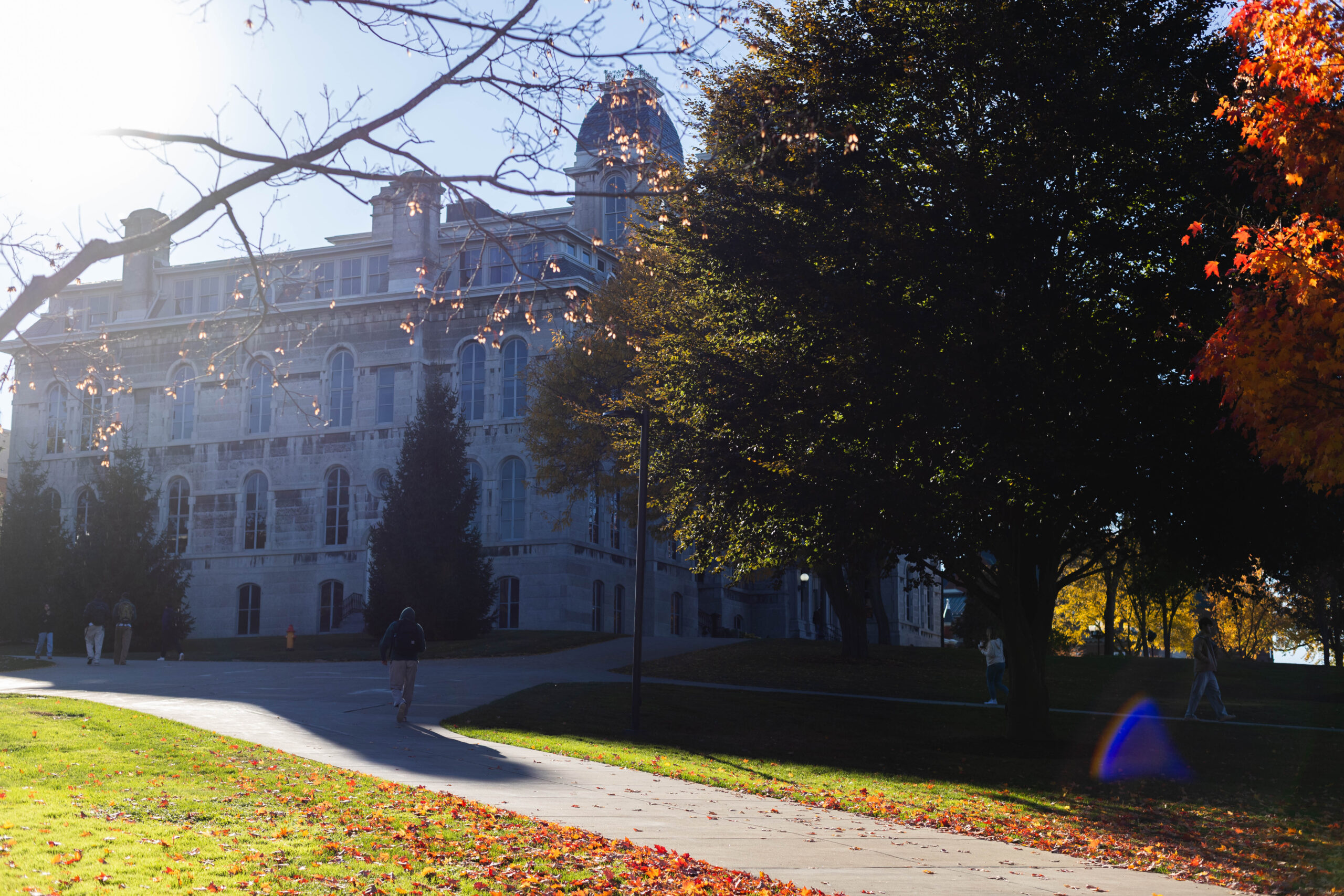
While major-specific courses continue and current students can still enroll in these paused programs, the College of Arts and Sciences majors no longer appear on the Common Application. Tara Deluca | Asst. Photo Editor
Several Arts and Sciences faculty members said they’re unsure how their program’s plans will be evaluated or whether the pause will become permanent.
For German program coordinator Karina von Tippelskirch, the decision to pause humanities programs was disappointing but not shocking. She said she wishes SU administrators would “unite” and “stay strong” in the face of these challenges, rather than pausing programs without considering faculty input or student impact.
“We know that Syracuse is not an exception. These are discussions and developments that are going on in the country,” von Tippelskirch said. “My concern is that the university is giving up much more than they will win.”
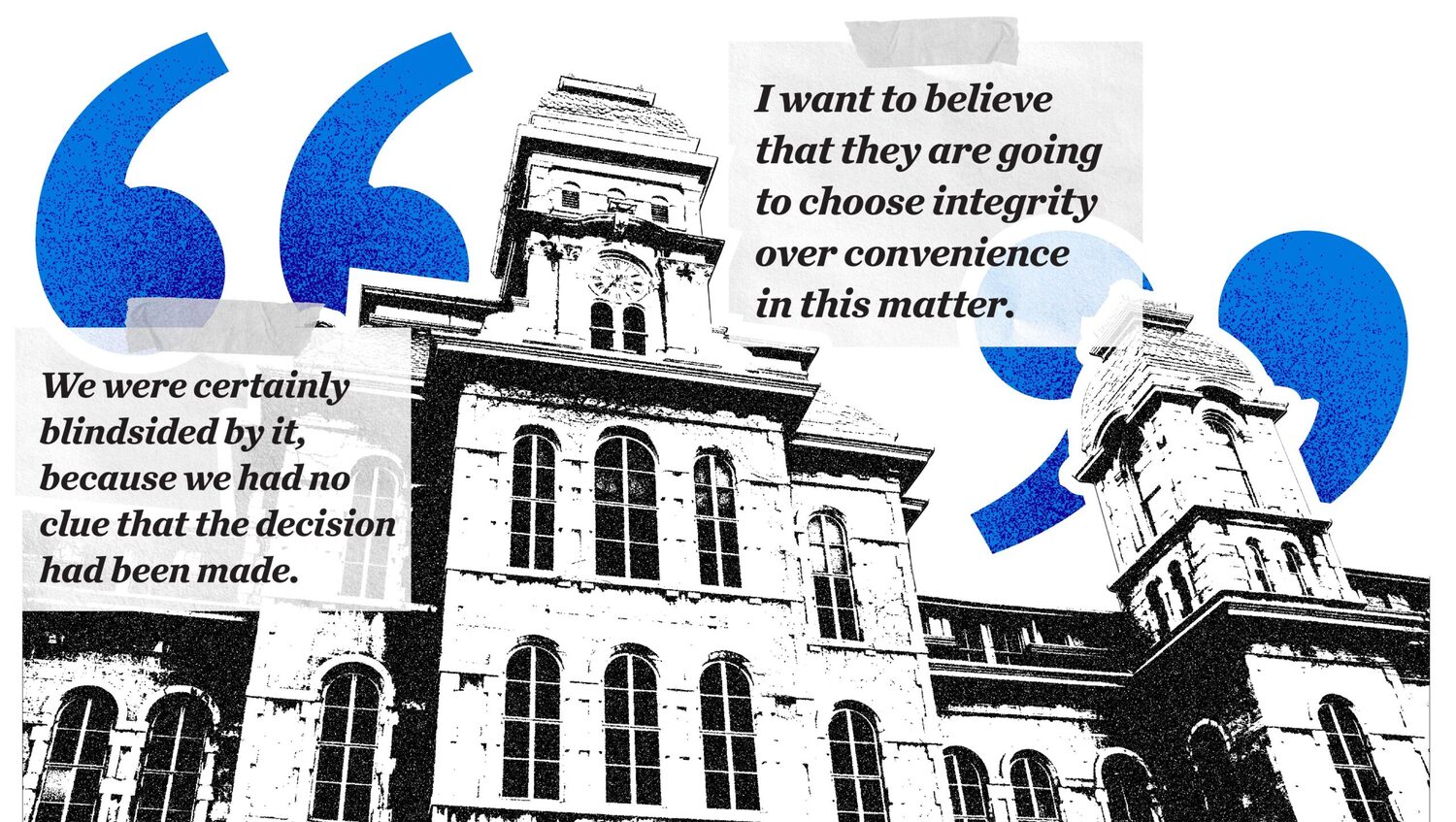
Von Tippelskirch learned of the decision on Sept. 15 — the same day department chairs were asked to present their own review materials. Other faculty members said they were “blindsided” when the list of paused majors appeared on screen.
Since then, program leaders have scrambled to show administrators why their disciplines should remain part of SU’s academic landscape.
For Middle Eastern studies and religion chairs Yael Zeira and Gareth Fisher, this meant hosting listening sessions with current students and getting feedback on their respective programs. Von Tippelskirch’s program surveyed German major alumni, and Italian Program Coordinator Lauren Surovi’s program is looking for ways to make lower-level language classes more compatible with students’ schedules.
Julia Boehning
Enterprise Editor
In 2005, while Lauren Surovi explored colleges offering majors in Italian language, Syracuse University quickly caught her eye.
Whether it be for SU’s large Department of Language, Literature and Linguistics, study abroad options or proximity to her home in Pennsylvania, Surovi felt like the university “checked all (her) boxes.”
Now, almost two decades after her days as a student, she finds herself back at SU leading the very Italian program that shaped her college experience.
Three years after working for her alma mater, Surovi said she still feels like “the luckiest person on campus.” But now, after SU unexpectedly paused admissions to the Italian program, she said she’s holding onto hope that her luck won’t get cut short.
“I came to Syracuse to study Italian. That’s part of the reason why I chose Syracuse,” Surovi said. “So it’s been particularly devastating for me now that I am a professor here to find out that our program is paused and the future is uncertain.”
Italian is one of multiple language majors to have its admissions paused — something Surovi and other program affiliates described as a “shocking” shift from SU’s previous commitments to promoting global perspectives and expanding students’ worldview.
SU’s mission statement includes a clause about “encouraging global study,” according to its website. Within section 1.1 of the faculty manual, last updated online on April 17, 2024, the university states that it supports “close interaction and engagement with the world—locally, nationally, and globally.”
One Italian dual major, Frank Gambino, heard about the pause to his major through a professor involved with the University Senate. As a senior, the decision won’t impact his degree, but he thinks the decision may be harmful to future SU students.
Gambino said most of his peers didn’t initially enroll in SU as Italian majors, but after taking courses in the language, many “fell in love” with the program.
“Public schools give people this impression of, ‘Why would you spend money studying a language? What are you going to do with that?’” Gambino said. “Do you know how many corporations are out there that need people who speak Italian to work for them? There’s a lot of closed-mindedness when it comes to how crucial it is for people to learn other languages.”
While there are only three full-time faculty members affiliated with Italian, Gambino said the program’s small size makes everyone feel more connected — like they’re “all friends.”
Anne Leone, an assistant professor in Italian, said she wishes the campus community knew the program teaches not only language skills but also literature and culture classes, as well as communication skills.
As the university increasingly invests in its College of Engineering and Computer Science in preparation for the arrival of Micron Technology, Leone said she wants administrators to consider how a foreign language education fits into business priorities. Micron, for example, has several international locations — including four sites in Italy.
“A lot of our students will say, ‘Oh, I’m doing a major in aerospace engineering, and I also have a major in Italian. And actually, the recruiter said that’s what made my application stand out,’” Leone said. “It really helps to have that cultural and linguistic knowledge.”
However, Leone and Surovi said they don’t understand how the administration chose which majors to pause. When Leone saw the external review of the program, she felt it looked like the department was “doing great.” Surovi said Italian has increased its enrollment over the past couple of years and wanted to know more about how SU collected the data.
Throughout the semester, Surovi and the program have been pushing to boost enrollment and find ways to keep Italian alive at SU. Gambino was one of several people to speak at the student-led Humanities Town Hall, where students involved in the paused programs shared why they believe a humanities education is important.
Behzad Mortazavi, the College of Arts and Sciences dean, wrote in an email obtained by The Daily Orange that each of the paused majors had 10 or fewer students enrolled. Today, Surovi said Italian has 12 declared majors.
The Daily Orange couldn’t confirm Italian’s official current enrollment numbers.
Though the future of Italian remains unclear, current faculty and students said they’re hopeful they’ve demonstrated to administrators why the program — while small — has a large impact on its students.
“Italian has a place on this campus, and I’m proud of the work that we have done. I’m proud of my colleagues and my students,” Surovi said. “I hope to continue to support my students for the years to come. So I will hold out faith. I am not without hope.”
Most programs are working to boost enrollment, even when the effort feels like an “oxymoron,” von Tippelskirch said, given that SU has already paused admissions for at least the upcoming academic year.
While faculty worked to respond to the news, students were processing the change in real time.
While enrolled in AAS 112 — the course that first drew her to African American studies — Savannah Wilson said she learned of the pause during a shift at the department’s Martin Luther King Jr. Library, when a professor told her the major she viewed as a “pillar” on campus would no longer appear on the Common App.
The news felt personal.
“If the department goes away, will I be able to take these classes?” Wilson said. “It’s very important to take classes like these to understand history before we get it taken away.”
Wilson said the confusion aligned with what she’d heard from students. She recalled hearing from a student whose advisor questioned why he enrolled in an AAS course because it “wasn’t necessary” for his degree — a moment she said showed how easily students can be steered away from the program.
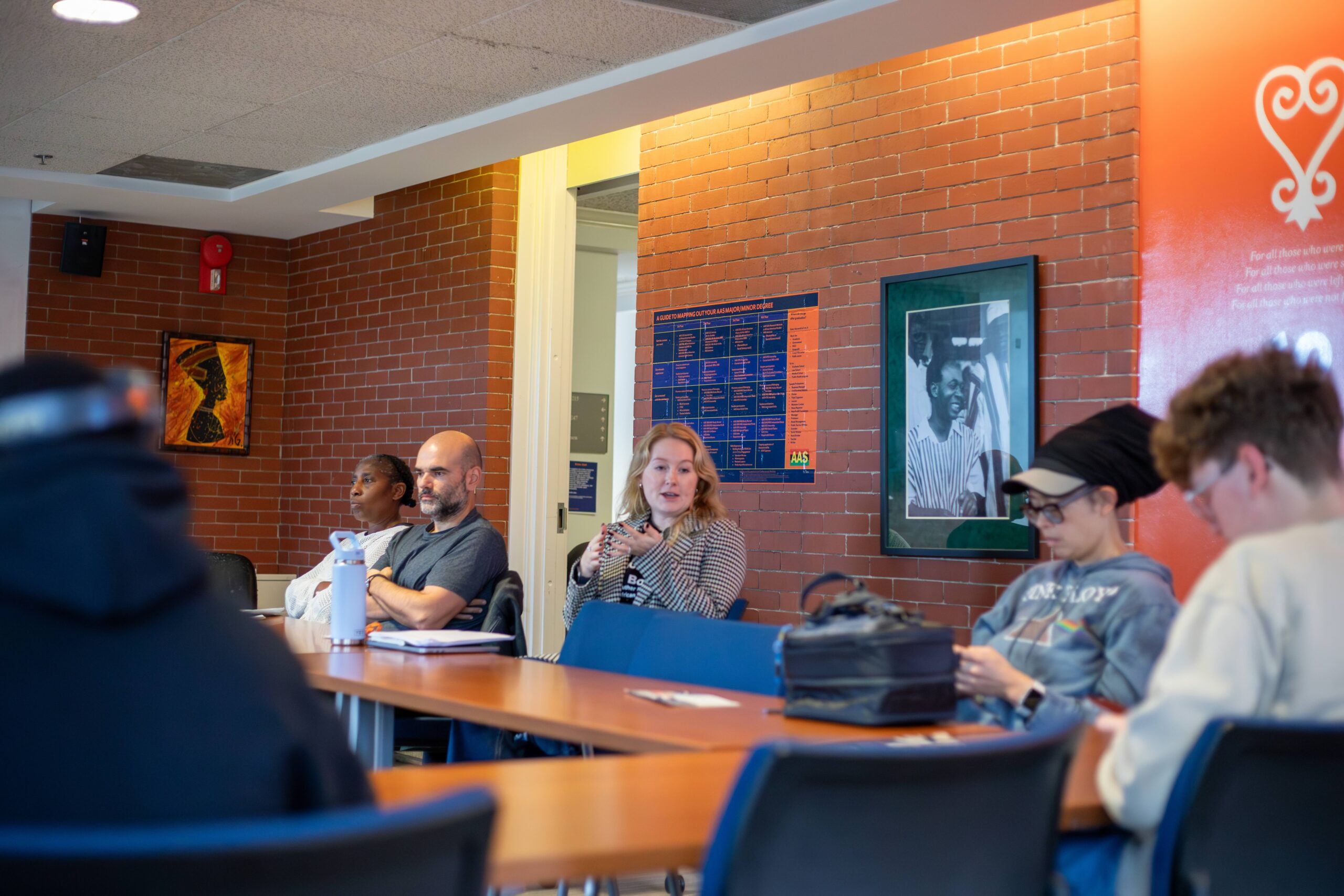
Students, faculty and alumni discussed the future of the African American studies major, which is currently paused, at a meeting on Oct. 9. Leonardo Eriman | Senior Staff Photographer
Concerns also arose about how SU justified the pause. The university has cited low enrollment numbers, but students, faculty and alumni across affected programs challenged what “low” entails and how the university measured it. Some faculty members have even questioned the accuracy of the enrollment numbers behind the decision.
During an Oct. 22 University Senate meeting, Agnew said SU’s 462 total academic programs far exceed the average of its peer institutions. She said reducing offerings may better serve students.
The university’s website boasts a 15-to-1 student-faculty ratio and small class sizes, with 64% of classes holding fewer than 20 students.
“Eighty percent of our enrollments are located in only 34% of our programs. So 51 programs have 80% of the students enrolled, while 66% of the programs, in other words, 100 programs account for just 20% of our enrollments,” Agnew said.
Scalese confirmed Agnew’s October numbers in Wednesday’s statement.
“However, when programs consistently have fewer than 6 majors – not by pedagogical design but due to limited student interest – we cannot provide the full range of courses, peer collaboration, and academic experiences students deserve,” Scalese wrote.
The pauses have come up in broader discussions about shared governance on campus, as well as in multiple senate meetings. During its Oct. 22 meeting, university senators overwhelmingly passed a resolution calling for faculty and the senate to be involved in the review process.
James Haywood Rolling Jr., AAS interim department chair, said the decision to pause relied on a single metric — declared majors — without considering a program holistically. He estimated AAS has about 10 to 15 enrolled undergraduates.
Samantha Olander
Enterprise Editor
When Darla Hobbs arrived at Syracuse University as an undergraduate, she didn’t feel like she had a place on campus.
She said she moved through SU without a sense of community until she walked into an African American studies course — a moment she described as finding the first space where she felt welcome.
Now, she’s a second-year graduate student in the Pan African studies program.
“This is where I found myself at SU,” Hobbs said. “It kind of brings all of the different pieces of me together.”
For many within the department, that feeling has made SU’s admissions pause especially painful. Some students and alumni said the move doesn’t just threaten a college program, but one of the few academic and cultural spaces grounded in Black history, identity and scholarship.
Hobbs said the department has long served as “the little piece of the university that we can call our own.” She said seeing it placed on hold was “disheartening.”
James Haywood Rolling Jr., the department’s interim chair, emphasized that while the major has been removed from the Common Application for incoming students, current undergraduates can still declare a major or minor in AAS — and, for now, “all the lights are on,” with courses running and programs continuing as usual.
Savannah Wilson, a sophomore who works in the Martin Luther King Jr. Memorial Library, said the department is a crucial support system for Black students on a predominantly white campus. According to 2023-24 SU enrollment data, white undergraduates outnumber Black undergraduates by roughly seven to one.
She fears the pause proves that SU does not view the field as essential and will make the program less visible.
“It reinforces what we already know,” Wilson said. “We are low on the totem pole. We are not high priority.”
Those fears draw heavily on the department’s history. AAS grew out of Black student activism in the late 1960s, when demonstrations over SU’s failure to support Black students led to the creation of the program. It also led to the creation of the MLK Library, which remains one of few dedicated spaces for Black scholarship on campus.
In recent years, the department has faced faculty turnover, stretches without stable leadership and staffing gaps, where students and faculty feel the program is already being asked to do more with less.
Rolling said that, despite these strains, AAS courses are often full, drawing far more interest at the class level than major enrollment alone reflects.
Alum Agyei Tyehimba — who helped lead protests to protect AAS in the late 1980s — said the pause fits into long-running tensions. He said he was initially “shocked” to see admissions halted, though not surprised, pointing to what he described as “a kind of corporate way of thinking.”
“These students won’t be students forever … What type of world will they inherit if the dominant theme is how much does that cost? How much do we save? How much do we make?” he said.
Tyehimba also tied the decision to national attacks on humanities and identity-based fields, noting the pause comes as diversity, equity and inclusion offices, ethnic studies programs and humanities departments at universities nationwide face heightened political pressure and funding cuts.
“If you’re in a nation that is fascist-leaning, what would be a very good political move? Definitely to attack humanities because they are typically the areas that produce the Dr. Kings,” he said.
Jeninya Holley, another Pan African studies graduate student, said she’s concerned about the program’s long-term stability, noting fewer majors in the future could weaken the intellectual community that drew them in. Holley called the program “enriching,” saying it exposes students to perspectives beyond dominant narratives.
Above all, many said the pause sends a clear message about who — and what kinds of knowledge — the university chooses to prioritize.
“It doesn’t matter what you think it’s about,” Tyehimba said. “It’s saying to them that you are unimportant, you are disposable, we can disregard you and we’re indifferent to your needs and your interests.”
In a September email obtained by The D.O., Mortazavi said each paused program had fewer than 10 enrolled majors.
The D.O. could not confirm official enrollment data.
“The metric that was being used was very, very narrow,” Rolling said. “Story wasn’t considered, legacy wasn’t considered … the fact that many of our courses were fully enrolled wasn’t considered.”
Hanson claimed many paused programs were already “under-resourced,” and that low enrollment can be a “self-fulfilling prophecy” when a university hasn’t invested in them.
In the Department of Mathematics, where the B.A. programs in applied mathematics and statistics were paused, geometry professor Steven Diaz said the B.A. and B.S. tracks are designed to function as one system — something that he said feels the review overlooked.
Though not all students view the B.A. pause with concern.
Junior Darren Murphy, an economics and B.S. applied mathematics major, said the distinction between the B.A. and B.S. tracks is minimal in practice, because of pathways in the broader mathematics major. Murphy added that he believes the shift may strengthen the department by emphasizing more rigorous coursework.
For religion, like many humanities, Fisher said it doesn’t follow the usual tiered structure of 101-level prerequisites and fixed progression — a difference he said makes the major harder to compare with other fields and difficult for academic advisors to explain to students.
“That’s the kind of college experience that (students) want here, to some extent, the college experience they were promised,” Fisher said. “They find that experience within our department.”
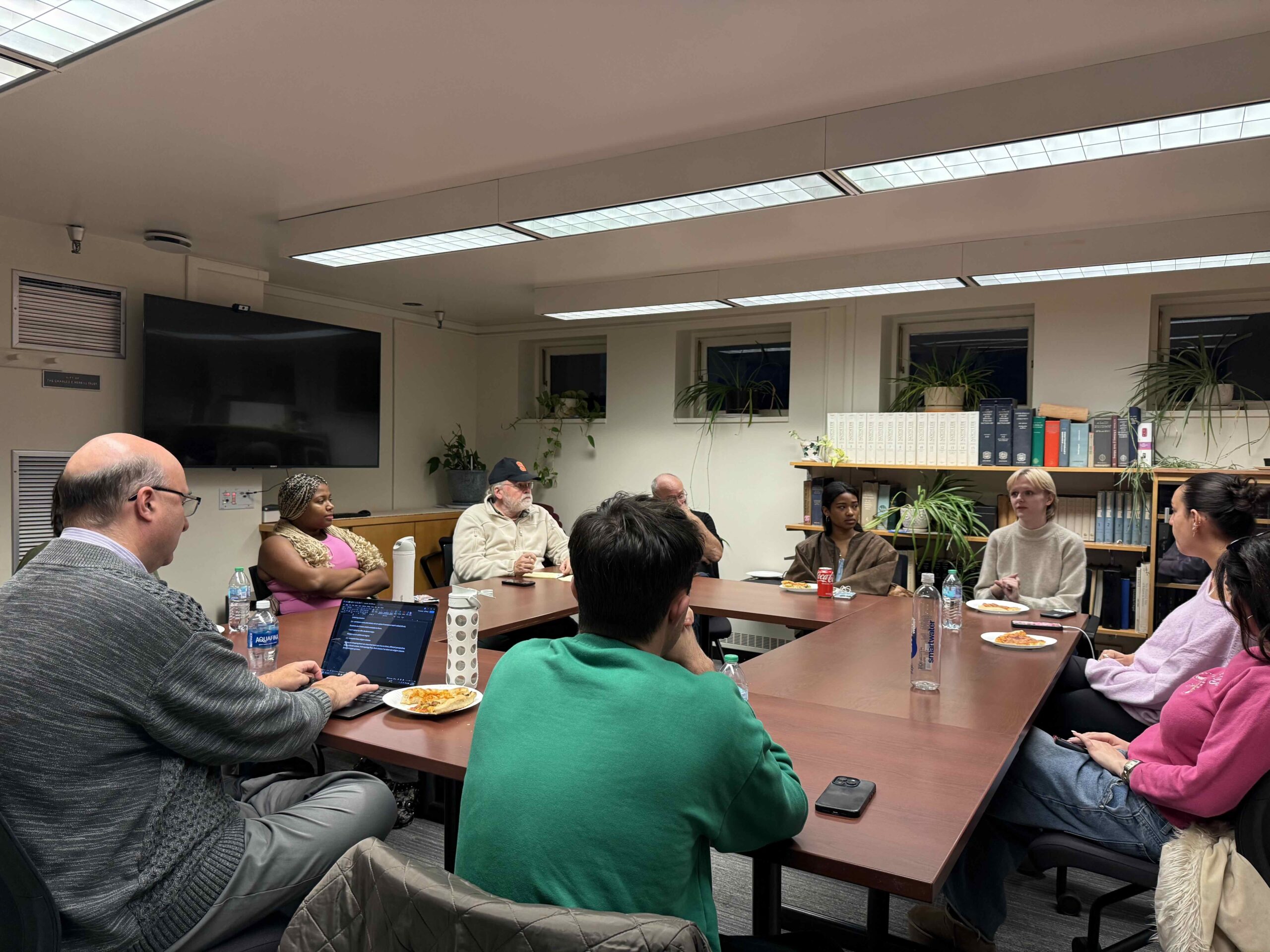
Students and faculty in the Department of Religion advocated for the religion major at an Oct. 17 informational session, hoping to regain its admission status. Isabel Meléndez-Rivera | Staff Writer
Griffin Uribe Brown
Social Media Editor
Religion courses have been offered since the founding of Syracuse University, and the Department of Religion was made a distinct department in 1895.
This fall, the department enacted structural changes to its religion major. Department chair Gareth Fisher, who joined the faculty in 2008, said the religion major’s restructuring — which simplified the major requirements — will hopefully save the department from being permanently cut.
“We’re hoping that we’ll survive the review process on the grounds that we’ve already been thinking about innovating and thinking about ways to attract new students,” Fisher said. “We just haven’t seen the fruits of that change yet.”
The new structure allows the department to bring students into the major or minor through “multiple gateways,” Fisher said. Rather than a standardized 101 course, a student’s first religion course could be at the 300-level course.
“Because of the size and just kind of the tight-knit closeness of the department, the professors are amazing,” Evan Fay, the department’s undergraduate chair and junior, said. “They’re all very interested in my interests and developing my skills and in my career.”
Fay, who studies both religion and broadcast and digital journalism, said it would be a “travesty” for SU and other colleges to lose their religion programs, potentially limiting religion education to theological schools, he said.
He said more students and more perspectives would strengthen the program.
“A major in religion helps with any profession that involves communication with other people, to study in comparative religion helps me understand people better and connect with people on a deeper level,” Fay said.
Fisher said that he agrees many SU programs, particularly “duplicates,” could benefit from being merged or modified, but majors that exist as a department’s only major, like religion or African American studies, should remain their “own thing.”
Students have different reasons for choosing religion, Fisher said, recounting a few examples: a pre-medical student seeking to better understand patients, a philosophy major interested in thought and critical thinking or an international relations major learning about global cultures.
“Religion is a topic, it is a phenomenon that exists in the world and has existed throughout human history,” Fisher said. “Then we study that phenomenon from many, many different disciplinary aspects.”
Fisher said he worries the review process is moving too hastily and will harm programs that SU needs, even if university administrators don’t realize it now.
“Normally, curricular processes don’t really go that fast,” Fisher said. “I’ve been here 18 years, and we’ve always been thinking about ways to better attract majors and minors.”
In other programs, the uncertainty extended beyond how SU measured enrollment. Terese Millet Joseph, a doctoral candidate whose research draws on Africana studies and Black feminist theory, said she was directly discouraged early on from taking AAS electives she saw as essential to her work.
To Joseph, the pause echoed the same message she experienced in advising earlier: her field was “dispensable.”
“This is not just an administrative shuffle,” Joseph said. “This is an ideological move.”
Across paused language programs, faculty and students said they were frustrated that SU didn’t appear to consider the broader value of bilingualism. Most students in these majors don’t necessarily want to enter academia, Surovi said, but plan to use their language skills in international or multicultural careers.
Beyond enrollment, several students, faculty and alumni described a growing sense that financial considerations, not academic values, are driving decisions about which programs survive.
Considering the university’s large Jewish population, B.G. Rudolph Professor of Judaic Studies Ken Frieden questioned where its priorities lie in pausing admission to the modern Jewish studies major.
Delia Sara Rangel
News Editor
Syracuse University sophomore Lily Facenda said that throughout her college search, she looked for a university with a lively Jewish community and a corresponding major.
In her hometown, she said she hadn’t been surrounded by many people who share her culture. Facenda, a dual modern Jewish studies and communication sciences and disorders major, said she arrived at SU hoping to learn more about her identity.
“This major was a perfect way for me to add a real part of who I am into my learning experience,” Facenda said. “I was really looking forward to furthering my academics in a setting that I could make as Jewish as I wanted to be.”
When she heard new admissions to her major had been paused, she was disappointed to see her identity-based program and others like African American studies now on hold.
“It’s really important to see yourself and see people like you in classes, especially in places where certain groups have been excluded historically,” she said. “I think that (the paused majors) are so incredibly crucial to inclusion and for people to feel important and to feel seen and to feel heard.”
When religion and modern Jewish studies professor and Director of Graduate Studies James Watts learned his program’s admissions were put on pause, he said he was “horrified.”
Watts said courses in the program have no prerequisites, allowing his classes to be filled with interested students. He fears that if the major is eliminated, the university will cut many of the classes serving the larger student body.
“SU will save no money by killing the majors, not one cent,” he said. “The majors are supported by people taking the courses out of general interest. So in that sense, it’s irrational.”
Throughout President Donald Trump’s second term, his administration has targeted higher education institutions for allegations of antisemitism, using it as justification to revoke federal funds.
B.G. Rudolph Professor of Judaic Studies Ken Frieden said the main function of the program is to teach the SU community about Judaism. He said many of his classes are made up of non-Jewish students.
“Especially at a time like this, when everyone says antisemitism is increasing, you would think that universities would care about Jewish studies,” Frieden said. “Especially if it means educating people to understand better what the Jewish tradition is and what Judaism is.”
As of September 2024, SU had around 2,500 undergraduate Jewish students, making up roughly 16% of its undergraduate student body. Hillel International — the largest collegiate Jewish organization in the world — ranked SU as number six in its list of top 60 private universities by Jewish population.
With a large Jewish population, faculty wonder where the university’s priorities lie.
“What kind of institution is Syracuse University? What does it want to be?” Modern Jewish studies and religion professor Zachary Braiterman said. “And what is the place of the humanities and what is the future of the humanities without these diverse portfolios?”
Braiterman would often boast the program’s offerings to community members and parents. Without a major, he said he can’t do that.
In keeping and offering the major, Braiterman said it’ll signal that modern Jewish studies “actually matters” to the university.
“It’s been a really rough year for lots of people in the community, the larger Jewish community, and the Syracuse Jewish community in particular,” he said. “And the very moment where the country is confused by race and religion and the Middle East and Jews, the university is deciding to cut back these programs?”
Amid the ongoing war in Gaza, he said modern Jewish studies courses have seen higher enrollment numbers.
While the program doesn’t have “many” majors and minors, Frieden said it’s interdisciplinary, affiliated with the English, religion and language, literatures and linguistics departments.
“This major was a perfect way for me to add a real part of who I am into my learning experience,” Facenda said. “It was really, really important to me to be involved religiously in college but also academically, in harmony with my identity.”
Russian Program Coordinator Erika Haber pointed to the university’s recent investments in STEM fields ahead of Micron Technology’s arrival in central New York. She said she feels SU has already “made (its) decision” about which programs to prioritize.
Alumnus Agyei Tyehimba, former Student African American Society president who graduated from SU in 1991, said he viewed the pause as part of a broader shift toward a “business-first” mindset in higher education.
For longtime observers of AAS, Tyehimba said the moment felt eerily familiar.
The alum, who led protests to protect the program in the late 1980s, connected the pause to a broader national push to weaken humanities and identity-based fields, which led to the instability of the AAS department decades ago.
Those parallels, Tyehimba said, showed him “the university has not learned.”
“It would not be any type of weird conspiracy theory that this is connected to erasing, silencing the African American studies department,” he said. “And not just that department, it’s a whole attack on humanities.”
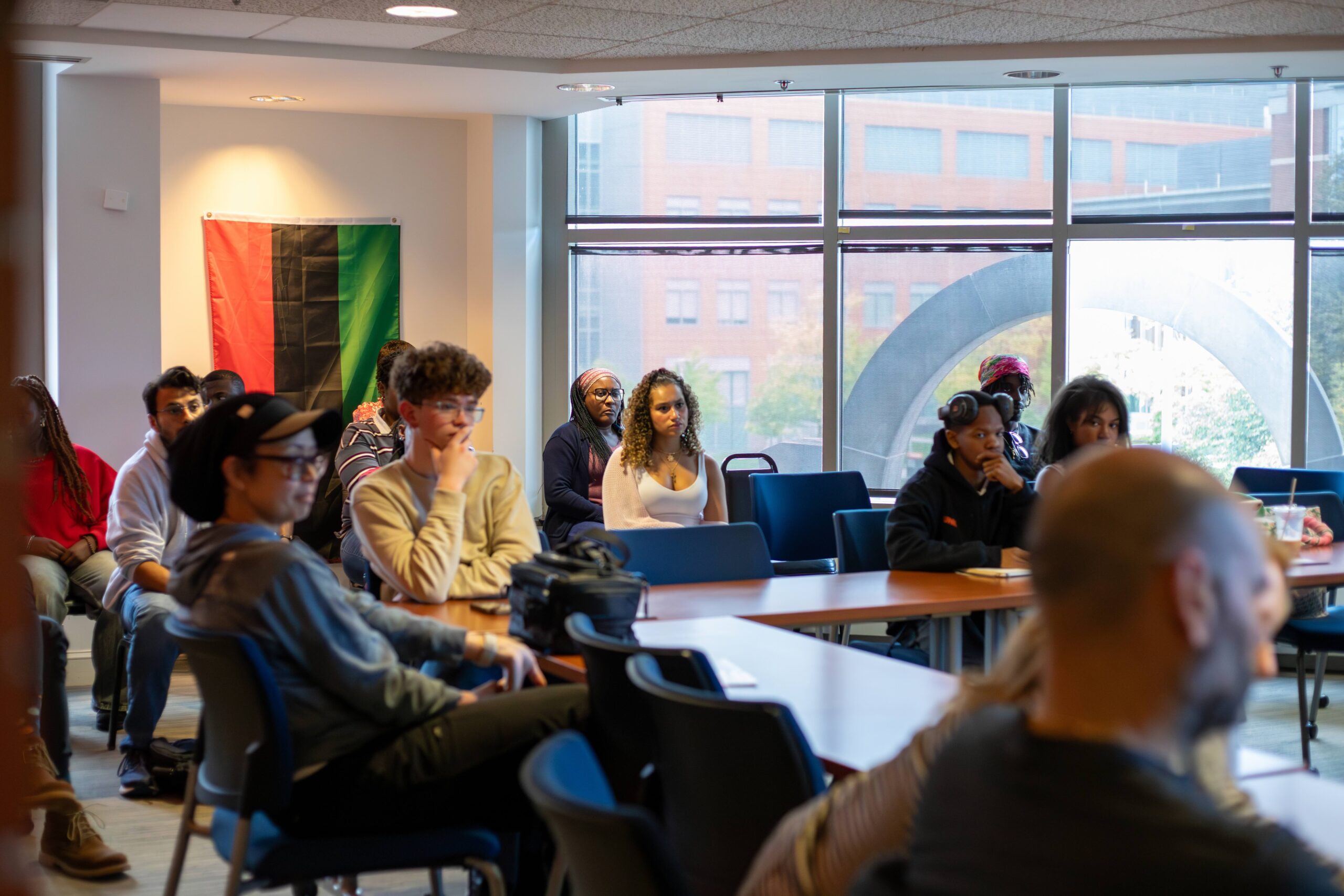
Attendees at the AAS info session offered explanations for low engagement with the program. Leonardo Eriman | Senior Staff Photographer
While some faculty, like Rolling, described the portfolio review process as an “opportunity” to strengthen their offerings, others said they remain unsure whether their departments will have a path forward.
In her statement, Scalese said the portfolio review has “no predetermined outcomes.” She said the university will make decisions based on the dean’s recommendations, which are expected to weigh the data and determine “what’s best for their school or college.”
Rolling said the university’s decision has galvanized many.
“It sort of lights a fire under folks,” Rolling said. “This is one of those, to me, lock arms, go shoulder to shoulder, kind of moments.”
Multiple students said having smaller programs is an asset that allows them to build closer connections with their professors and peers.
Lucy Lee-Moore, a sophomore majoring in classics, said due to the niche nature of the discipline, her professors’ passion often radiates through their teaching. She added that because the program has fewer resources than others on campus, professors will even bring in their own materials to help with instruction.
Kate Jackson
Asst. Copy Editor
After taking one Roman literature course, Bridget Barr switched her major from forensic science to classics. A year later, admissions to the major were paused.
Barr, now a sophomore also majoring in English, learned in mid-September that Syracuse University planned to pause admissions to 18 majors, including classics and classical civilizations.
“It is concerning that the pause majors all come from the arts and the humanities,” Barr said. “Especially because pausing them might be the first step in phasing them out entirely, when these are voices that we need to be introducing and hearing more from.”
Barr said not hearing the news directly from the department made students and professors feel like an “afterthought.” She said many felt “blindsided” by what was happening.
Classics and Classical Civilizations Department Chair Jeffrey Carnes said, between the two majors, around six to seven students are currently enrolled, and seven students are enrolled in the classics minor.
The Daily Orange could not confirm official enrollment data.
There are two faculty members in the department — Carnes and Associate Teaching Professor Matthieu Herman van der Meer. Both teach literature and language courses in Latin and Greek, which they said often fill up with non-classics majors.
Like faculty in the other paused majors, Carnes and van der Meer said they found out about the pause during the mid-September meeting with Arts and Sciences Dean Behzad Mortazavi.
Since then, Carnes said they’ve advocated to protect the classics major, but find it difficult without new students. The classics major doesn’t require many university resources, such as teaching assistants or labs, he added.
Van der Meer, an untenured professor, said he doesn’t think SU will renew his contract next year if the major is cut.
Both van der Meer and Carnes said they believe the decision to pause, and potentially cut classics majors, was made long before faculty were informed.
“Humanities have always been the decorative extra, and this marginalization just continues with the closing of these programs,” van der Meer said.
Despite the major’s small size, many classics students said they appreciated the individualized support and devoted professors. As a senior classics and biology major, Hannah Murphy said SU appealed to her because it offered both large programs and a liberal arts core.
She said removing humanities programs like classics could affect interest among incoming students. Many humanities students, in particular, often build community and are more involved on campus because of their smaller programs, she said.
Lucy Lee-Moore, a sophomore classics and anthropology dual major, agreed that having fewer humanities majors will hurt students’ overall learning. Smaller majors like classics, she said, curate a well-rounded education.
Lee-Moore said she applied to SU because it was a research-focused institution with many niche majors, alongside broader departments.
Despite enrolling as a freshman illustration major, Lee-Moore said she liked SU’s many offerings. She took an ancient Greek and Roman class her first semester, and it quickly became her favorite class.
Similar to Barr, she decided to switch to classics, planning to pursue a related career.
Lee-Moore, Murphy and Barr echo how passionate their classics professors are. They said having smaller programs helps them build stronger connections and feel supported.
Van der Meer said that, with little job availability in humanities or research positions, he might have to look for unconventional work — maybe even working at a Trader Joe’s.
“I think that losing those professors, losing these classes, would be a loss, not just for my department, but for the university overall,” Lee-Moore said.
Childres pointed to the size of the German major as a strength rather than a weakness. In his program, he said he’s particularly enjoyed hearing the life stories of the department’s two faculty members — like von Tippelskirch, who grew up in Communist-ruled East Germany before the end of the Cold War.
“There was such value in, at a big school, especially, being a part of a small department, and academically feeling like I was at a smaller school,” said John Calder, a 2018 alum of the paused history of architecture major who works at the Philadelphia Society for the Preservation of Landmarks. “I was able to get the best of both worlds.”
Many in the paused majors described similar feelings as the fall 2025 semester ends: confusion, frustration and a growing uncertainty about the future of their programs. Ike Wood | Video Editor
Some professors are also calling for the administration to consider what makes their program “unique.”
Gail Bulman, a Spanish professor and chair of SU’s Department of Languages, Literatures, and Linguistics, said the Latino-Latin American Studies major gives its students the opportunity to learn about “the cultures of underrepresented sectors of the world.”
Romita Ray, the director of undergraduate studies in art history — which cross-lists courses with the history of architecture program — said the major contextualizes the unique architectural landscape on campus and at several SU Abroad programs.
As Arts and Sciences departments prepare proposals and administrators weigh next steps, many students and faculty members are still asking what SU wants its academic future to look like.
Fisher said the plan may backfire in making SU “less competitive,” noting that once programs are cut, restoring them could be difficult. He said the university should look to consolidate duplicated programs that can be merged or cut, rather than single-major departments like religion or AAS.
“I wanna believe that they are going to choose integrity over convenience in this matter. Will you stand with institutions that shrink when they are pressured? Or will you stand with those that defend what is right?” Joseph said. “This is a watershed moment.”
Design by Ilana Zahavy | Presentation Director
More stories on Syracuse University’s portfolio reviews:
- College of Arts & Sciences pauses admission to 20 majors amid portfolio review
- Low African American studies enrollment doesn’t justify admission pause, faculty say
- Students, faculty praise Department of Religion’s size, hope for admission reinstatement
Published on December 4, 2025 at 8:15 am