‘Agamemnon’ comes to life in Department of Drama, Mexico’s CENTRO collaboration
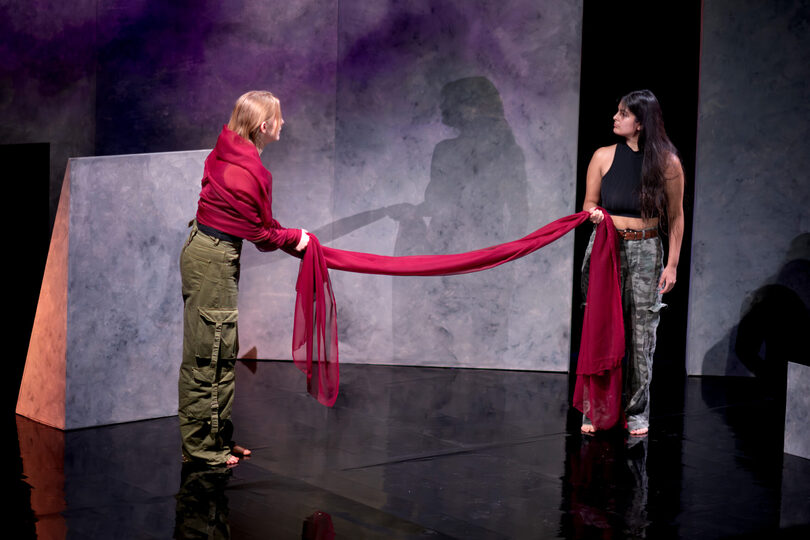
Syracuse drama students traveled to Mexico to perform “Agamemnon” over Thanksgiving break. CENTRO and SU’s Department of Drama created a fresh take on the Greek play, actors said. Courtesy of Mariana Rodriguez Alguilera
Support The Daily Orange this holiday season! The money raised between now and the end of the year will go directly toward aiding our students. Donate today.
When Katie McGerr traveled to Mexico City to visit CENTRO, a university, in 2023 to guest-teach a weeklong mock production, she began to wonder how she could bring international collaboration to her drama students at Syracuse University.
“How could we get our students in the same room, working together, on a real project?” McGerr said.
The College of Visual and Performing Arts professor first showed her students photos of designs from CENTRO’s students, and they were interested. The next step was to go from sharing those images to actually bringing the students from the two universities together.
McGerr partnered with the head of CENTRO’s scenography program, Edyta Rzewuska, last year to bring the collaboration to life, and the second year of the partnership concluded last week with a bilingual production of “Agamemnon” (“Agamenón” in Spanish). SU and CENTRO’s iteration consisted of two SU drama students taking on five character roles while CENTRO students designed the entire set. SU drama students travelled to Mexico City and performed “Agamemnon” during Thanksgiving break.
The story of “Agamemnon,” set in the 13th century B.C.E., concerns the titular character returning home from the Trojan Wars, only to be murdered by his wife, Clytemnestra, in retaliation for sacrificing their daughter, Iphigenia, to win the gods’ favor at war.
The collaborative process wasn’t the only unique aspect to the production. McGerr said the themes of the story have always struck a wrong chord with her.
“Why isn’t Clytemnestra allowed to be angry over losing her daughter, or Cassandra angry that nobody listens to her?” McGerr said.
These questions resonated with senior SU drama student Eva Spaid. Spaid said SU’s Department of Drama and CENTRO’s iteration of the production is theirs.
“We really focused on reclaiming the narrative of specifically the female characters in the show, so our show has that kind of lens,” Spaid said.
It’s a sentiment that’s also shared by CENTRO design student Ana Reed, who said these themes are applicable both here in the United States and in Mexico.
“Women have always played a very specific role, a role in which historically the woman has always been overlooked and never taken seriously,” Reed said.
The collaboration is a point of intersectionality between American and Mexican cultures at a time where tensions appear to be escalating, particularly after President Donald Trump’s tariffs were placed on Mexico. Reed said the tensions can be felt by Americans on social media and on the ground in Mexico where there are “very strong stereotypes toward Americans.”
However, Reed said there were no tensions between SU and CENTRO. The relationship blossomed throughout the trip.
“The fact that they could understand Spanish [made] communication pretty fluid on that side, and it was incredible,” Reed said.
McGerr said the student cast was well received in Mexico, but also wanted to ensure they were “respectful guests.” The mutual respect between the two programs came all the way down to the languages; all the SU drama students on the trip had familiarity with Spanish at varying levels. Meanwhile, the culture in Mexico City surrounding English is much different than mainstream American culture surrounding Spanish, McGerr said.

Only two performers, both from SU Drama, took the stage during “Agamemnon.” The crew behind the scenes was made up of CENTRO students.Courtesy of Mariana Rodriguez Alguilera
“It’s much more expected in Mexico City that people will have education in English than it is expected here that people will have education in Spanish,” McGerr said. “So even if I could work with them in Spanish, it was seen as a show of respect for their education and knowledge to use English.”
The show is entirely bilingual, with Spaid taking on the English-speaking role and the other performer, Sofia Peralta, playing the Spanish-speaking role.
The environment the two universities shared was really the ultimate goal of the project, McGerr said. While the show was described as a success by members of the cast and crew, the experience of collaborating on the international level is what McGerr was aiming for the entire time.
“First and foremost, I hope students gained new friendships and will keep in touch with their international collaborators,” McGerr said.
Both Reed and Spaid said they formed friendships between the cast and crew. Reed said she wished the collaboration lasted longer, and she would love to see more collaborations like this.
For Spaid, even if this collaboration won’t affect the relations between the U.S. and Mexico, she found a way to make friends abroad.
“I’m not sure if this will change any sort of relationship that the United States has with Mexico, but I do know that it created relationships among people and fostered collaboration on a smaller, but very meaningful scale,” Spaid said.