Editor’s picks: The top opinion stories of 2025
The Daily Orange opinion staff picked the best reads from 2025. Read them below. Avery Magee │ Photo Editor
Get the latest Syracuse news delivered right to your inbox.
Subscribe to our newsletter here.
In 2025, The Daily Orange’s Opinion section columnists encouraged necessary conversations on Syracuse-specific issues, national affairs and global events. In a time when public confidence in journalism wavers and honest dialogue feels threatened, our columnists persistently shared perspectives, held institutions accountable and offered insights readers might not have considered.
This year’s must-read stories examined everything from analyzing a Syracuse Debate Club meeting in the context of the nation’s sharply divided political climate, to a five-day experiment befriending an AI chatbot. Our columnists put research and creativity into each article of the year, offering calls to action ranging from addressing issues within Syracuse University’s own community to highlighting global inequities.
Here are the opinion section’s 10 most noteworthy reads of 2025:

Julia English | Cartoonist
SU recognition puts campus over community
Our guest columnist critiqued Syracuse University’s current definition of success, arguing that institutional recognition favors high-achieving students with campus leadership roles while overlooking those who contribute in the broader Syracuse community.
He framed this imbalance as part of SU’s long-standing separation from the city, arguing that recognizing community-based impact would strengthen the university’s relationship with Syracuse.
“These students are often deeply committed and resourceful. However, from what I observe, their contributions don’t fit neatly into the university’s traditional molds of success, despite SU marketing itself as committed to community well-being,” the guest columnist wrote.
Leonardo Eriman | Senior Staff Photographer
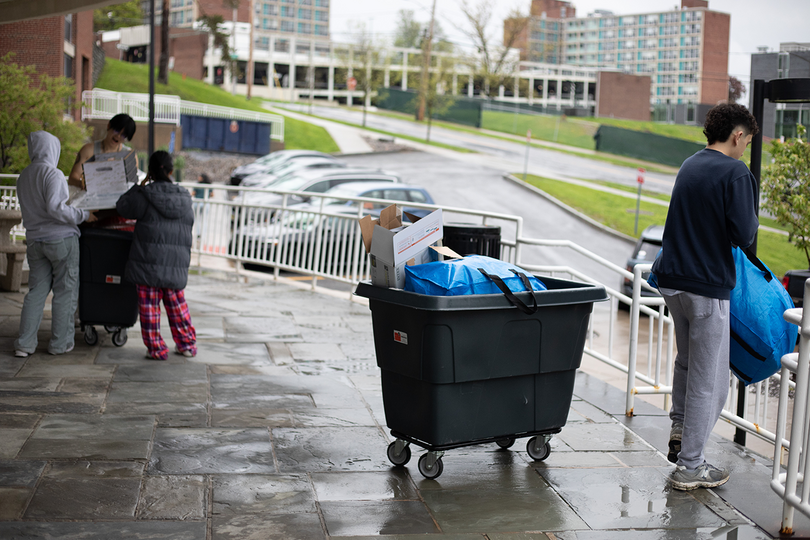
Move-out shows SU student consumerism, need for mindful purchasing
During Syracuse University’s move-out period, our columnist observed piles of discarded clothing, furniture and unopened food, highlighting a culture of student consumerism and disposability.
She argued students should be preemptively conscious of their spending habits, emphasizing fast fashion, microtrends and excessive dorm purchases contribute to landfill waste and reflect on indifference toward reuse and donation.
“Don’t buy something you can’t see yourself fitting into your car at the end of the year. Stop purchasing clothes you only see being worn at one event. Be mindful of your purchases because they make an impact, whether you see it or not,” our columnist wrote.

Madison Cox | Staff Photographer
There’s no right way to immigrate to America. The system proves that.
On Nov. 7, around 240,000 Venezuelans lost their Temporary Protected Status in one of the largest mass illegalizations in United States history. U.S. politicians used slight improvements in Venezuela’s economy to justify a return to dangerous conditions, our columnist argues, lamenting a system designed to fail immigrants pursuing immigration to America through legitimate, legal channels.
He situated this within a broader pattern, asserting the Trump administration’s actions are part of a racialized immigration project that leaves immigrant communities exposed and vulnerable.
“The very fact that immigration policy can be changed and enforced in parallel to the president’s personal ideology signifies that the system was designed not to integrate immigrants, but rather to restrict, contain, neutralize and expel those not of use to the government,” he wrote.
Leonardo Eriman | Senior Staff Photographer
What a debate club meeting taught me about our political discourse
Our columnist reflected on a Syracuse University Debate Club meeting, where debaters were randomly assigned positions by a roll of the dice, forcing participants to argue viewpoints they didn’t personally agree with. She used this experience to examine how modern political discourse has shifted toward ideology-driven battles focused on winning, viral moments and silencing opposition rather than understanding.
She argued that the U.S political climate in 2025 has reversed our maturation as effective debaters, our emotions so tightly bound to our worldviews that disagreements escalate to hatred and prejudice.
“When we reach this level of divisiveness, our argumentation is inherently weaker: we cherry-pick our facts to fit our narratives, and often end up contradicting our own value systems as we presume our opponent’s stance before hearing them,” our columnist wrote.

Kendall Thompson | Contributing Illustrator
I befriended an AI bot. Here’s what I learned about human companionship.
Our columnist has always been skeptical of artificial intelligence and averse to using it as a friend. But as the loneliness epidemic spreads, she admitted it could be time to accept necessity. So, she tested an AI friendship over the course of five days to see if a chatbot could prove her wrong.
As the chatbot’s tone shifts between friendly and flirtatious, she observed how easily AI enforces false ideals and unrealistic expectations for relationships, affirming users’ beliefs rather than challenging them.
“Depending on AI as a companion omits so many important elements of human connection. AI is far from the solution to the loneliness epidemic and reliance will only intensify the turn inward further than before,” she concluded.

Lars Jendruschewitz | Senior Staff Photographer
The D.O. stands with Indiana Daily Student, reaffirms independence
On Oct. 14, Indiana University cut the Indiana Daily Student print edition. As an independent, nonprofit newspaper, The D.O. empathized with the IDS, which relies on revenue to continue its publications.
We acknowledged how fortunate we are not to rely on editorial oversight or funding from Syracuse University. We recognized the difficulties our peer publications face and stand in solidarity with them as they encounter attacks on free speech.
Attacks on the press aren’t happening in a vacuum, even though they are buried in a constant stream of headlines. Student journalism is no exception to this reality, and our editorial board emphasized the importance of protecting it.

Madison Denis | Contributing Illustrator
Roe v. Wade’s overturn continues to actively threaten rights
Following the overturning of Roe v. Wade, our columnist reflected on the ongoing struggle for reproductive rights, citing the loss of bodily autonomy, executive orders limiting abortion access and the Supreme Court’s shift under Trump’s influence.
Our columnist emphasized women’s rights and democracy remain at risk, warning that safe and legal abortions continue to be under constant threat. She also highlighted Trump’s history of misogyny, including offensive comments about women, sexual assault allegations and the appointment of cabinet members with misconduct allegations, which further endangers women’s safety and rights.
“Every day, we as women wait for the current administration to push us further into the past while our president spews misogynistic comments,” she wrote.
Samantha Siegel | Contributing Illustrator
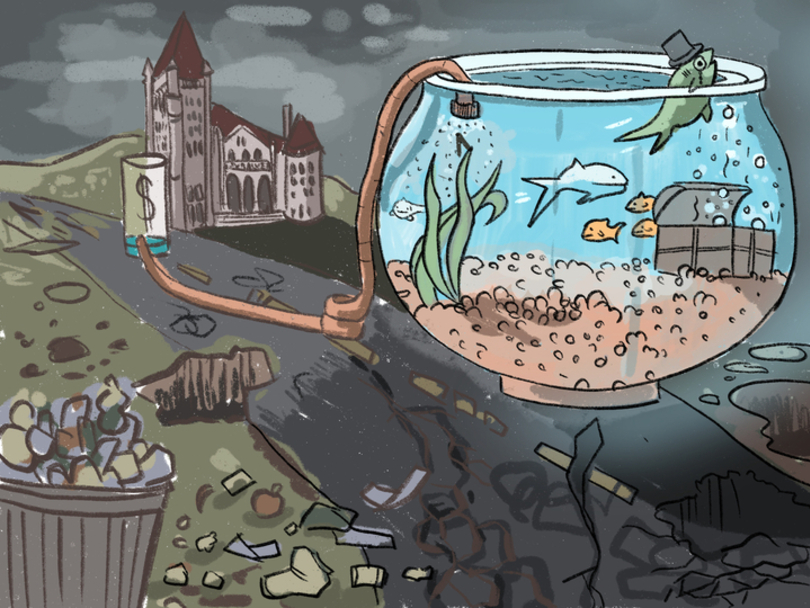
City of Syracuse isn’t putting residents’ wellness ahead of its own
Following polluted water and police misconduct, our columnist calls attention to system failures in Syracuse, citing lead-contaminated drinking water, carbon monoxide hazards in schools and instances of police misconduct.
Drawing from her experience as a youth activist representing the student population, she emphasizes the city’s future relies on visible accountability and open communication, ensuring residents feel their input genuinely influences decision-making.
“When leadership turns a blind eye to systemic failures, trust in public institutions deteriorates.
Residents don’t feel informed when the whole story isn’t provided. Without open communication, how can citizens trust that the city is working in their best interest?” she wrote.

Corey Henry | Daily Orange File Photo
Marked by indifference, Syverud’s tenure leaves the board to reckon with its failures
As Chancellor Kent Syverud prepares to step down this spring, our columnist critiqued his 12-year tenure as marked by indifference, leaving students of Syracuse University feeling overlooked and underheard. While Syverud achieved many things during this term, our columnist argued Syverud’s financial endeavors didn’t properly address the more emotionally tumultuous issues students face.
Our columnist noted instances such as the delayed response to racist graffiti and the contradictory handling of peaceful student protests demonstrated “his priorities lay in whatever will cause the least amount of effort or best preserve the university image,” rather than centering student safety and voices.
“A university’s leadership should reflect the values of the community. If SU truly wants to move forward, the role of the chancellor can’t be treated as a transition with simple passing of the torch,” she reflected.
Hannah Mesa | Illustration Editor
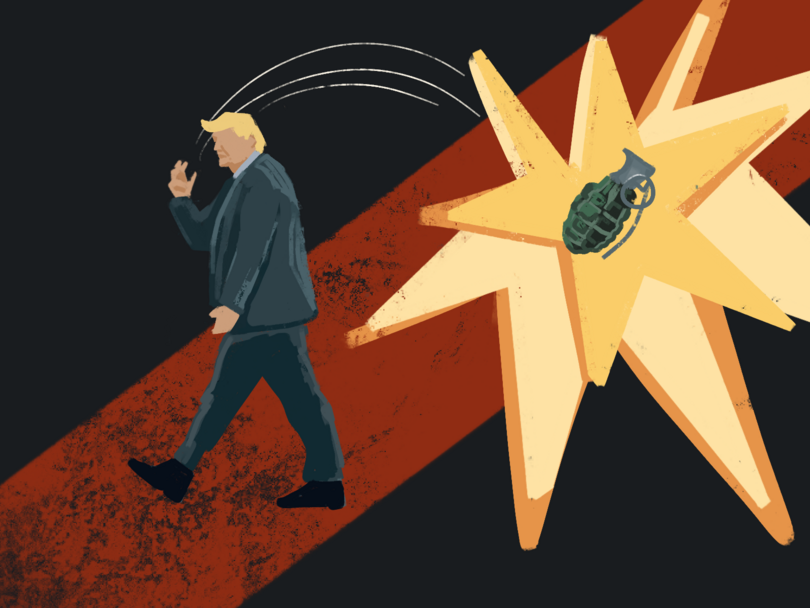
Trump’s impulsive language on nuclear weapons paints U.S. as careless
On Oct. 30, President Trump posted on Truth Social that he had “instructed the Department of War to start testing our Nuclear Weapons on an equal basis,” suggesting large-scale testing for the first time in 33 years. Our columnist posited that his naming Russia as a nuclear superpower carelessly strains an already delicate U.S.-Russia relationship.
He highlighted a concerning pattern of recklessness from Trump, ranging from offensive rants on the global stage to futile construction projects amid the longest government shutdown in U.S. history, noting this is the first time we’ve seen him speak on a topic that could invoke such devastating physical consequences in such a carefree manner.
“The best thing Trump could do now is put out a statement confirming the U.S. will not begin to test nuclear weapons of any sort, since that is likely the case. But of course, as we should all know by now, Trump is not one to admit his wrongdoings by any means, leaving our country in indefinite geopolitical limbo,” he added.