Guest Essay: Names carry more weight than we realize. They tell our stories.
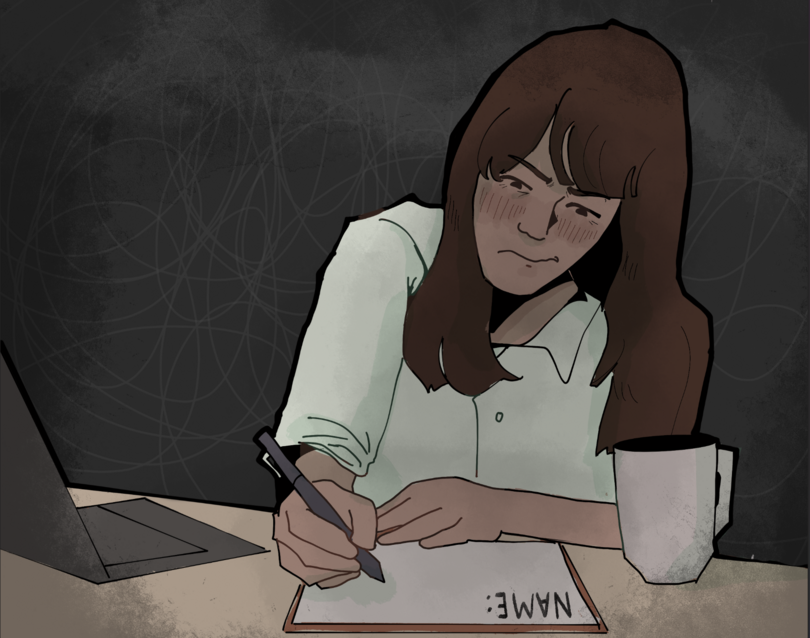
Our guest essayist reflects on her brother’s experience with his name and her own. Belonging shouldn’t come at the cost of reshaping names, they argue, and diversity starts with saying names correctly and fully. Jay Cronkrite | Contributing Illustrator
Get the latest Syracuse news delivered right to your inbox.
Subscribe to our newsletter here.
Growing up, the difference between my name and my brother’s shaped the way we learned how to exist in new spaces. His name became something he constantly had to defend and correct while mine slipped easily through people’s mouths.
I think it’s funny how something as simple as a name can carry the weight of a person’s
culture, identity and pride. In many cases, a name also carries the pressure of making
you feel smaller.
When my younger brother and I moved to Canada at the ages of 13 and 16, I
didn’t think much about my name at all – it’s common within my community. It’s also
very typical in Nigeria to shorten our full name for convenience, so I go by “Kemi.”
My full name is Oluwakemi Roseline Omowunmi Martins, rooted in Nigeria’s Yoruba tribe. Not only is my name beautiful in its own right, but it also holds a meaning many may not be familiar with: “Oluwa” means “GOD” and “Kemi” means “to care for.” Together, it translates to “God cares for me.”
Back home, it’s common for names to have deeper meanings and wishes for the person and their future. Our names are tied to our culture and religion. They are our hope.
Moving to the west, everyone naturally got my name. “Kemi” looks exactly like it sounds, which should be easy enough. Teachers never stumbled over it and my classmates never asked me to repeat it. Compared to other international students, I never had the experience of awkward pauses and forced nicknames.
However, I always found the fascination with my name strange. Compliments like, “That’s such a pretty name,” left me puzzled. When I told people my name in Nigeria, it would be a guessing game to find out its prefix, from Folakemi or Feyikemi.
But I never quite understood what made my name so “pretty.” Perhaps it sounded familiar, or, on the contrary, exotic. Once, someone even told me I didn’t “look like” any of the names on a roll call list.
I came to the realization that names aren’t just identifiers. They set expectations in job applications, on class rosters and even in friendships. Our names open some doors and keep others closed. My name happened to be easy in this part of the world, but my brother’s wasn’t.
My brother’s name is Oluwaseun Daniel Martins. “Oluwaseun” means “God, I thank you.”
Like other Nigerians, he goes by the shortened version of his name, Seun. But the real
intonation closer to “shay-woon,” never stood a chance here: People saw the letters and decided it must be pronounced as Shawn.
He was 13 years old when we moved to Canada. He was adjusting to a new environment, starting a new school, juggling a new culture and finding his own identity. However, instead of asking, his teachers and classmates just decided to rename him. They called him Shawn over and over until it just stuck. Moving to the U.S., he introduced himself as Daniel, his middle name, thinking it would be simple and safe.
At SU, we like to think of ourselves as a diverse, global campus, and diversity starts with something as simple as learning each other’s names and saying them correctly and fully.Kemi Martins, Guest Essayist
Seun didn’t change his name because he was ashamed. He’d tell me he “didn’t care” and “it
was no big deal,” but it was and still is. He was young and susceptible to the ideas of his new surroundings, conforming to the whims of those around him to fit in.
He was just tired of explaining. He was tired of being different and the burden of making others uncomfortable with his name. And his story isn’t unusual. All around campus, many other students whose names don’t fit neatly into English have different versions of it.
The pressure to conform is everywhere, and it starts with something as simple as roll call.
Seun and I had two different experiences: I was shielded by an “easy” name and he
was reshaped by a “hard” one. We need to realize that our names are our culture, history,
stories and families compressed into one word.
The pressure to conform shouldn’t sit only on the person with the “unique” name. To my
peers with names that carry stories: keep correcting. Be patient and gentle, but firm. Your name
matters. To the wider Syracuse University community: meet us halfway. Learn the intonations and repeat them until they feel natural. Don’t settle for “close enough.”
The truth is that sustaining and embracing your name is resisting the quiet erasure of
your culture. In a society that often silences marginalized voices, keeping your name intact
is one way of asserting that you are here and your story matters.
And every effort to get someone’s name right is an act of recognition. It tells the person that you both recognize and respect their identity. Every name you say right is a story you’re honoring.
I believe both my and my brother’s stories reveal the same truth: Each and every name carries weight, and belonging shouldn’t come at the cost of reshaping them.
Although you may not always be able to guess where I’m from by my name, that’s no longer
my burden to carry. I decide how I want to introduce myself and the way I want to be heard with
no pressure and no apologies. Our names are not inconveniences. They are our stories. And every story deserves to be spoken, fully. It matters.
Kemi Martins is a junior studying Economics. She can be reached at omartins@syr.edu