Lawmakers revoke permission for 2 SU-adjacent Flock readers, target other LPRs
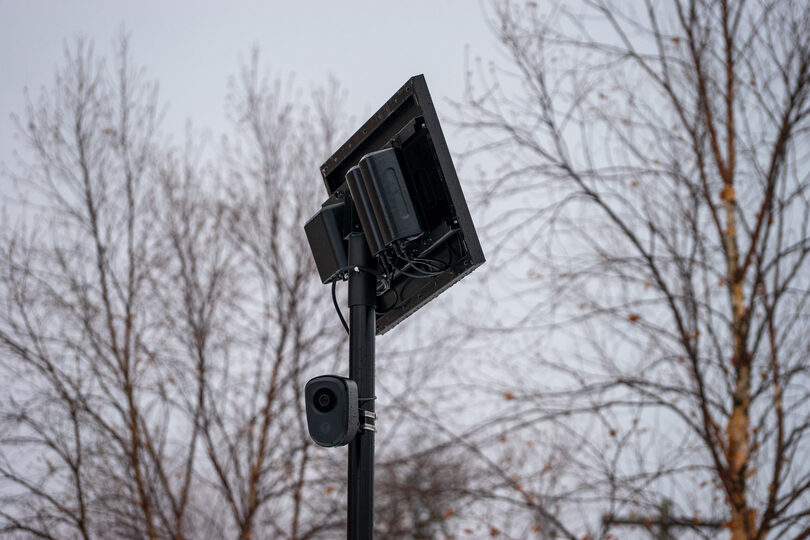
Syracuse Common Councilors voted to revoke Flock Safety’s permission to install two license plate readers on Waverly Avenue. SU, which has a handful of readers on campus, said it no longer plans to install readers on city-owned property. Quinn Postman | Asst. Digital Editor
Support The Daily Orange this holiday season! The money raised between now and the end of the year will go directly toward aiding our students. Donate today.
Flock Safety’s days in the city of Syracuse may be numbered as some Common Councilors push to rescind permission to install the company’s automated license plate readers – starting with two right outside of Syracuse University’s campus.
During a Nov. 24 meeting, the council voted to revoke an ordinance allowing Flock to “install, own, operate and maintain” two ALPRs on streetlight poles located on Waverly Avenue, which were approved in an agreement with SU.
“Flock is not a public safety partner — it is a private, for-profit surveillance company that built a nationwide vehicle tracking network,” resolution co-sponsor Councilor Jimmy Monto said at the meeting. “We as a city have to figure out how to deal with the civil rights fallout.”
Police use ALPR cameras to capture car information to assist in searches for stolen vehicles or missing persons. Beyond reading license plates, Flock ALPRs’ “Vehicle Fingerprint” technology identifies and stores information like a car’s make and color, according to the company’s website.
SU announced its Department of Public Safety would install eight license plate readers on campus in late August: the two city-approved ALPRs on Waverly Avenue and another six on university property, based on university “safety priorities.”
The two readers revoked by the Syracuse Common Council have not been installed, an SU spokesperson confirmed in a Tuesday statement to The Daily Orange. The spokesperson also said SU no longer has plans to install readers on city property.
The city of Syracuse began using Flock surveillance technology in 2023. Thirteen of the 26 readers the city contracted with the company are operating.
Because the two cameras on Waverly hadn’t been installed, they were a starting point for the Common Council legislation, Monto said.
The motion sponsored by Monto and Councilor Corey Williams “demands the removal” of cameras from city property because Flock collects personal data that may violate privacy rights and the data may be inappropriately shared, according to the meeting agenda.
“The cameras track people’s movements, store the data and then make it available far beyond the local community that supposedly controls it,” Monto added. “Flock’s business model depends on normalizing mass tracking of ordinary drivers.”
In a Tuesday statement to The D.O., a Flock spokesperson said comments accusing Flock of tracking individual persons “are simply not true,” given Flock cameras don’t track people’s personal data or share information “outside of a customer’s control.”
Syracuse is not alone in raising alarm bells about Flock’s data use. Though the company maintains that its ALPR products — which it advertises as the nation’s “Largest Fixed LPR Network” — do not violate the Fourth Amendment, legal experts and critics say otherwise.
While Flock says “customers own their own data,” investigative reporting across the United States shows that clients who opt into national data sharing effectively release their own data into a wider network. In some instances, the federal government, including U.S. Immigration and Customs Enforcement, and law enforcement agencies across state lines, accessed other entities’ Flock audits.
“Each agency that uses Flock technology fully owns and controls all of its data. Agencies decide if, when, and with whom to share information,” Paris Lewbel, a public relations manager at Flock, wrote in a Tuesday statement to The D.O. “Every search requires a documented reason and is permanently logged for audit and oversight.”
SU’s spokesperson similarly said the university maintains control of its data.
“Law enforcement agencies do not have automatic access to our data. All data is encrypted and stored securely for 30 days, after which it is permanently deleted unless preserved for an active DPS investigation,” SU’s spokesperson said. “Only authorized investigators within DPS have access to the system and data.”
Monto said “heavily concerning” immigration enforcement activity in Syracuse brought the Flock issue to the forefront.
ICE has arrested at least 162 people in Onondaga County since President Donald Trump was inaugurated, according to ICE data processed by the Deportation Data Project. Sixty-one percent of ICE arrests in New York state involved people with no criminal history, the highest rate of any U.S. state, according to the Deportation Data Project and SU professor Austin Kocher.
Beyond the two Waverly Avenue cameras, a similar resolution seeking to revoke Flock’s citywide deployment of ALPRs was tabled at the council’s Nov. 24 and Dec. 8 meetings. Syracuse Police Department is actively working to find replacements, while lawmakers push to remove Flock’s permissions city-wide “within the next couple months,” Monto said.
“We have given the Syracuse Police Department some room to do some research around replacing Flock with a different vendor,” Monto said.
The SU spokesperson did not provide updates on the status of Flock readers on campus. Monto said that the city has no control over SU’s contract with Flock.
“At the end of the day, this is not a problem with SPD. I think SPD is using the LPRs appropriately, but Flock’s efforts — what they do with the data they have — are not appropriate,” Monto said. “So if SPD can find a different vendor that is not acting like Flock is acting, then I think that’s something we can live with.”