

Opinion: Pop culture films demonstrate recession but should be recognized for community
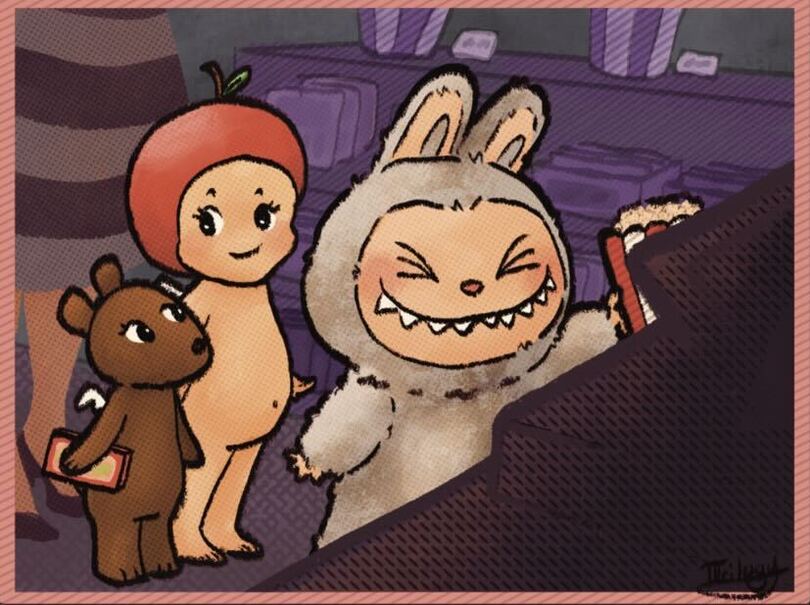
Pop culture-centered movies like the Labubu movie lack quality, but drive audiences to theaters and create events that encourage connectivity. These films help theaters stay afloat in the streaming era, our columnist argues. Sarah Yudichak | Contributing Illustrator
Get the latest Syracuse news delivered right to your inbox.
Subscribe to our newsletter here.
The sacred ritual of going to the movie theater has attracted viewers for over a century. Movies have the ability to captivate us, connect us with fictional characters and envelop us in make-believe worlds. Filmmakers are regarded as artists and their films as masterpieces.
As someone who appreciates all films, even those I don’t personally enjoy, I can’t imagine anyone will regard the newly announced Labubu movie as art. In fact, there seems to be a trend in Hollywood of studios putting out low-quality movies that revolve around pop culture references and objects.
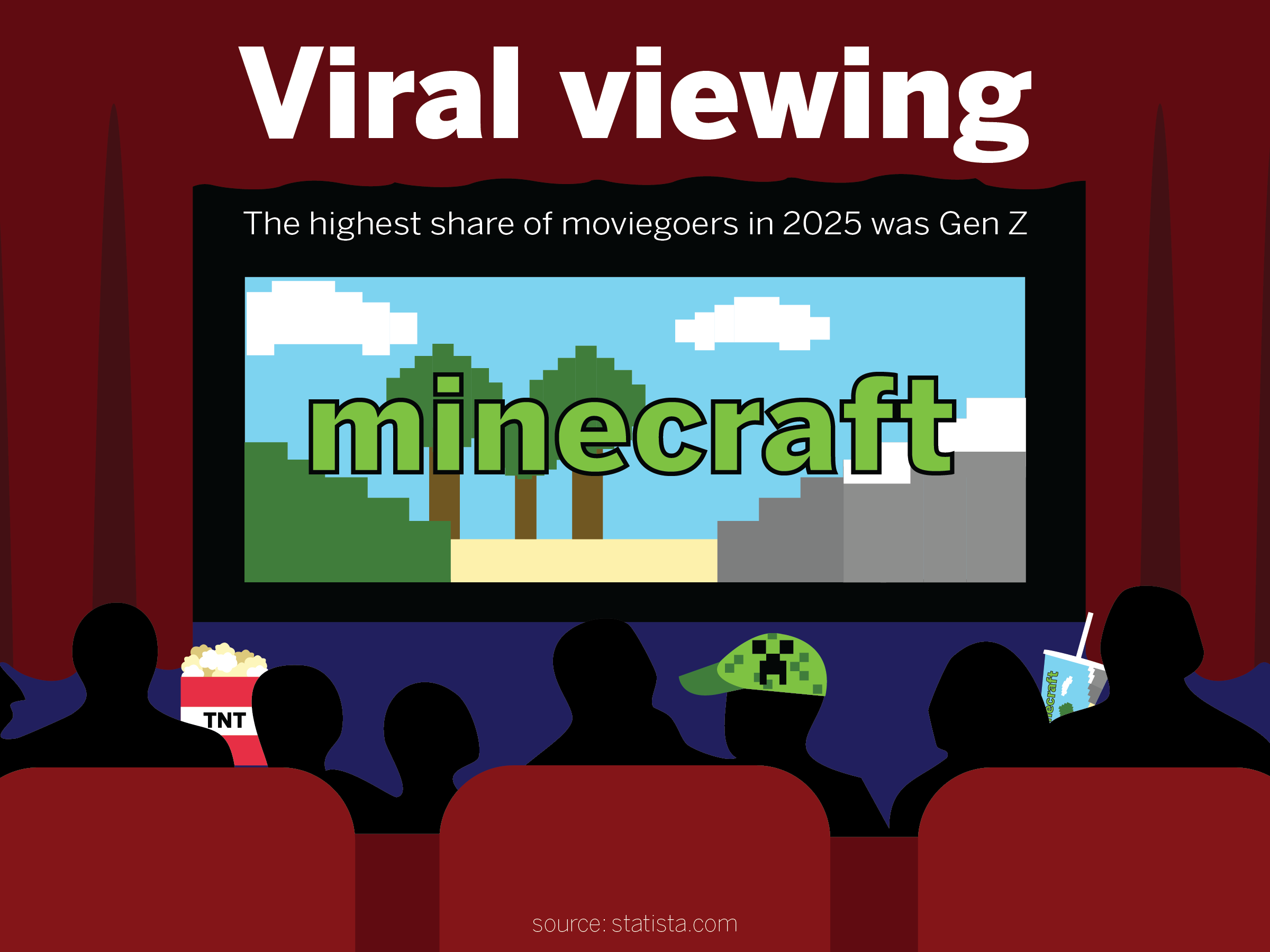
Ever since Greta Gerwig’s “Barbie” grossed nearly $1.5 billion at the box office, movies like “The Super Mario Bros. Movie,” “Five Nights at Freddy’s” and “A Minecraft Movie” were soon to follow. Similar films targeting Gen Alpha are in the works as well, such as “Cocomelon: The Movie” and a “Skibidi Toilet” film.
The reason studios keep producing these films is simple – what they lack in quality, they make up for at the box office. “Barbie” is the sixth-highest grossing film so far in the 2020s with “The Super Mario Bros. Movie” right behind it. In addition, these were the only two films out of the top 10 highest grossing films since 2020 to not be connected to an existing film.
There have been many creative, star-studded, original films that have been released recently, yet most of them seem to have disproportionate results at the box office.
The fact that movie-goers are giving these films with familiar characters and pop culture references attention reflects an American recession and a desperate need for comfort. Historically, people flocked to theaters for lighthearted entertainment in times of economic trouble. The Golden Age of Hollywood was during the 1930s, when America was in the Great Depression. The movies released during this time were generally more uplifting and comical, like “The Wizard of Oz,” created to distract Americans from their economic concerns.
 Zoey Grimes | Design Editor
The same is true for periods of high unemployment. The unemployment rate has been climbing since 2023, leaving audiences desirous of entertainment that is friendlier on their wallets and comforting in times of uncertainty. It’s no wonder that silly movies with familiar characters and sequels are outperforming more serious films, even if those serious films are of better quality.
Movies on pop culture references, toys and games are being made because there is a demand for them. Watching these movies is an escape in our tumultuous and uncertain political climate.
The reason these pop culture-centered movies drive audiences to theaters in a way that today’s dramas and comedies can’t is that they turn movie viewing into a nationwide event.
When “Barbie” premiered in theaters, audiences flocked to the big screens clad in every shade of pink imaginable. When “A Minecraft Movie” came out, the “Chicken Jockey” chaos flooded nearly everyone’s feeds. Their ability to appeal to a wide audience and incorporate a social aspect into the movie-viewing experience makes seeing these films in theaters a can’t-miss event.
This is further proven by how well sequels and franchise films are doing right now – they already have an established fan base, so seeing the film is a social event for that fandom. Society is interested more in the social and cultural aspect of movie viewing than the film itself, clinging to a sense of community and lightheartedness.
To self-proclaimed cinephiles, this phenomenon may be a scary thought. But it isn’t something to fret. People are divided now more than ever, and despite their varying levels of quality, these movies not only make sure movie theaters can stay afloat, but they also provide a new way for people to connect.
Hannah Hewitson is a freshman majoring in journalism. She can be reached at hrhewits@syr.edu.