Opinion: Rejecting model minority myth is essential for Indian American solidarity
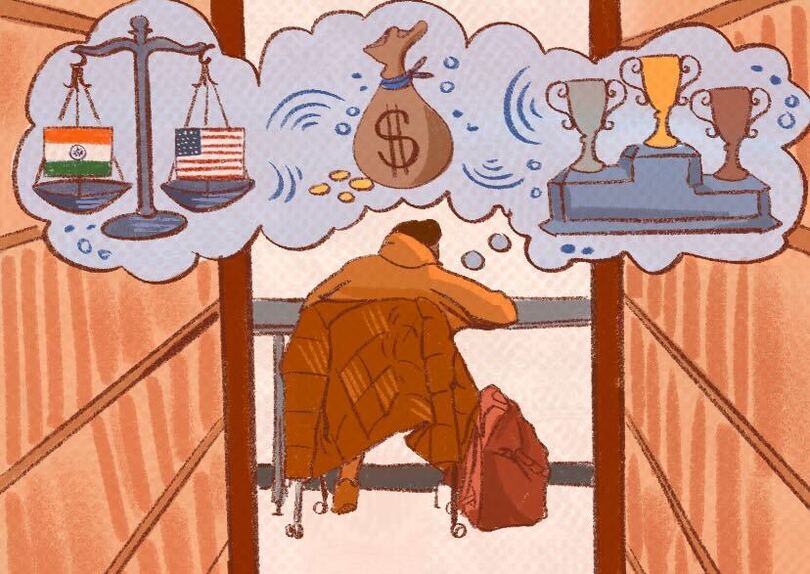
Our columnist asserts Indian Americans hold a sense of superiority by virtue of their hard-earned place in America. We must acknowledge challenges faced while not invalidating systemic difficulties present today, she emphasizes. Hannah Mesa | Illustration Editor
Support The Daily Orange this holiday season! The money raised between now and the end of the year will go directly toward aiding our students. Donate today.
As a first-generation immigrant from India, I deeply cherish my background and values as both Indian and American. While this dual identity has its share of challenges, I’ve never felt the need to fully sacrifice one to be considered the other.
But with the rise of Indian right-wing ideology in recent years and the first year of President Donald Trump’s tumultuous second term nearly behind us, I find myself increasingly uncomfortable with my position between both communities.
As one of the highest-earning groups in the United States, Indian Americans are often touted as standards of success, examples of the American dream fulfilled and models for other immigrant communities. Many Indians themselves are extremely proud of this pedestal, recklessly using it to uplift themselves over communities they perceive as less prosperous.
Within my Indian communities, I’ve repeatedly witnessed this shared sense of superiority – not solely derived from cultural pride, but by merit of our hard-earned “place” in America.
This is exemplified through the model minority myth, which propagandizes mainly Asian Americans as especially diligent and successful workers. It isolates us from other groups, like Black and Latino communities.
I often hear things like, “If they just worked harder,” “We shouldn’t be blamed for our success” or “We came the right way, why can’t everyone else?” – comments that absolve us of any moral responsibility to improve collective circumstances in this country.
Many Indian Americans point to our community as an example of meritocracy, claiming that we have merited our positions of power and status through focused, hard work. This supposedly elevates us from other groups in America.
Rather, it’s to acknowledge that our community’s difficult road to success doesn’t invalidate the systemic challenges that precede our presence in the country.Christy Joshy, Columnist
But it also ignores the fact that many Indians who came to America were already educated – boasting the highest percentage of college graduates among any other immigrant group in 2022 – and funneled through an immigration system that desires more skilled professionals.
As of 2023, Indians also formed the third-largest undocumented immigrant population in the U.S., further revealing the cracks in the model minority myth’s attempt to paint us as a monolith. It creates sweeping generalizations that harm and blind us to the plight of those considered “invisible” in the false community success story we’re so intent on clinging to.
The irony of the model minority myth is that Asian Americans, one of the highest-earning groups in the country, also have the widest wealth gap of any ethnic community.
This isn’t to say Indian Americans shouldn’t take pride in how far we’ve come or deny the challenges we’ve faced to get here. Rather, it’s to acknowledge that our community’s difficult road to success doesn’t invalidate the systemic challenges that precede our presence in the country. We should resist the “dangerous assumption that economic or educational privilege” exempts us from racial discrimination.
If being a model minority is defined only by maintaining the largest number of billionaires rather than challenging the structures that keep others from attaining the same level of success, it’s not a standard worth upholding. Really, it should be rejected.
This lack of solidarity is not a new phenomenon for Indians. The country has long suffered from low self-esteem and hostility toward members of its own due to religious, caste or skin color differences – it was fated to carry these divisions into a new country.
Zohran Mamdani, a Muslim of Indian origin, gained a historic victory as mayor-elect of New York City. But his campaign exposed a problematic trend: right-wing Indians who were quick to use Islamophobia to fearmonger against him.
Dinesh D’Souza, a Catholic Indian-American right-wing political commentator, tweeted about Mamdani in the days leading up to his victory: “We didn’t see 9/11 coming and when we did it was too late. We’ve seen this guy coming for a while. The result will be no less catastrophic.”
The forced association of an unassuming Muslim with extremist terrorism isn’t a habit exclusive to the West, but a daily occurrence in India as well.
Throughout the West, fear and anger toward immigrants who establish a presence and achieve even menial levels of prosperity have been on the rise. The “white replacement theory” is a racist and ethno-nationalist conspiracy theory inspired by several anti-immigration movements throughout history. It posits that non-Christian, non-white immigrants are masterminding a covert operation to marginalize and eliminate white people throughout the West.
Surprisingly, our insistence on the model minority myth hasn’t made the West any kinder to us. Instead, it’s made us active participants in the fictional movement to disenfranchise the very group we embarrassingly idolize.
The rise of anti-Indian sentiment worldwide necessitates the need for greater class consciousness and solidarity within our community and with other minorities. We may not be responsible for the attacks against us, but we are responsible for the narratives we reproduce to exalt ourselves over others.
Pride in our community’s journey shouldn’t take the form of self-importance over others, especially when members of our own community continue to suffer from outdated caste ideology used to justify internal hierarchical structures in the U.S.
I’m proud of my Indian American community. Still, I want to see us abandon our cultural disposition towards hyper-competitiveness that limits us from seeing one another as people rather than adversaries.
As the second-largest immigrant group in the U.S., we have the responsibility to use our influence and presence to build bridges and empower the disenfranchised. Our longing for approval from the West must not make us servants to the oppressive system we gained independence from in 1947.
Christy Joshy is a junior international relations and supply chain major. She can be reached at cjoshy@syr.edu.