As Owens prepares for City Hall, local leaders assess issues she’ll inherit
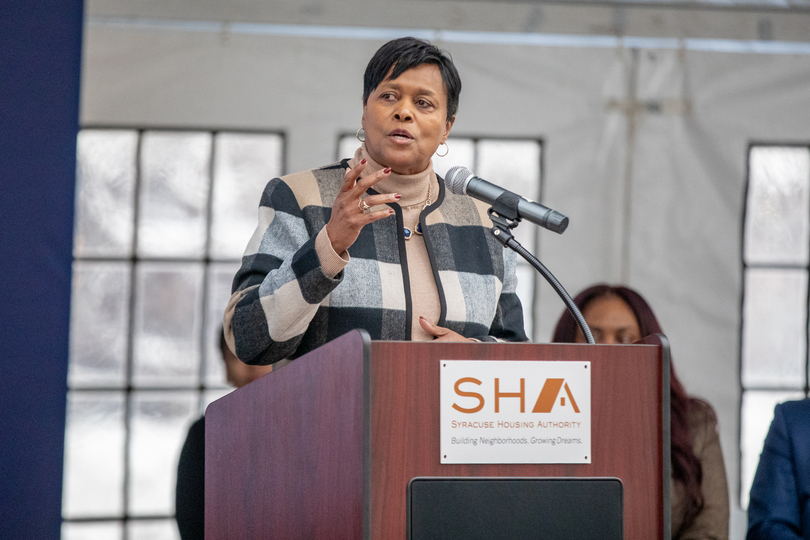
Syracuse Mayor-Elect Sharon Owens will enter office this January, facing the opportunity to shape the city. Her campaign emphasized her commitment to the housing crisis and public safety. Leonardo Eriman | Photo Editor
Support The Daily Orange this holiday season! The money raised between now and the end of the year will go directly toward aiding our students. Donate today.
As Syracuse Mayor-elect Sharon Owens readies for her first term, local political figures say she faces a turbulent opening stretch as she steers the city through competing forces of growth and potential struggle.
As Micron Technology, a semiconductor and microchip manufacturer, plans to make a multibillion investment in Clay, the city is expected to see extraordinary economic growth. Owens is preparing to lead the city through its subsequent challenges to ensure all residents profit, along with addressing affordable housing and public safety.
The introduction of Micron to the city remained a frequently discussed topic throughout the city’s mayoral race. Bringing nearly 50,000 new jobs, the company could drastically reshape the area, Grant Reeher, a Syracuse University political science professor and host of NPR’s “The Campbell Conversations,” said.
“Syracuse is on the precipice of a potentially new era,” Reeher said. “In 15 years, (Syracuse) might look completely different and feel completely different than it does now. And so I think there’s a lot of opportunity there.”
Throughout her campaign, Owens emphasized her commitment to remedying the Syracuse housing crisis through the Thriving Neighborhoods project, an initiative aiming to address the gap between household budgets and the cost to build and repair homes.
Another major component of her campaign focused on public safety for all residents. Although overall crime dropped 27.3% in the first months of 2025, Owens said she wants to make people’s perception match reality, according to her website.
She says her administration will focus on making Syracuse safer by working with law enforcement to reduce the amount of violent crime and illegal guns in the city.
While Micron brings a promise of economic growth, the incoming mayor will play a pivotal role in determining who will profit from it, Reeher said. Outgoing Syracuse Mayor Ben Walsh told The Daily Orange that an integral part of Owens’ term will be to ensure Syracuse maximizes the benefit of those investments.
“Specifically, that the people of the city of Syracuse, especially the communities that have historically been marginalized by these types of investments, communities of color, women and other marginalized communities, stand to benefit from these investments,” Walsh said.
The city has also received $180 million from New York state and the federal government to reconstruct the Interstate-81 viaducts. The project presents significant housing redevelopment for the area around the highway, Reeher said.
Largely through sales tax, the Micron project could bring much-needed revenue to Syracuse as it grapples with a housing crisis and homelessness, which saw a 30% increase in central New York between 2022 and 2023. But uneven investment between the city and its suburbs could widen the wealth gap Micron may create, Reeher said.
Reeher said this puts current low-income residents at risk. He worries the project might displace people in public housing and questions how affordable new construction will be — and it’ll take years to fully see how these issues will play out under Owens’ leadership.
“The challenge is the question of how inclusive will all those things be?” Reeher said. “Will they lead to some gentrification?”
Creating a team of people who have a strong background in housing and business will be a “critical” first step to tackling these challenges, Walsh said.
On Thursday, Owens announced her appointments for her transition team who will assist her with tackling her primary priorities during her first phase as mayor.
Owens also appointed Mark Rusin as the Syracuse Police Department’s new Chief of Police on Friday. In his position, Rusin will have the final authority on any matters concerning department policy, operations and discipline.
Rusin has been in the Syracuse Police Department for 19 years, working with Owens to create community-informed police reform. In the coming weeks before Owens takes office, she is expected to announce the rest of her appointees, including who will fill her current role of deputy mayor.
Syracuse Common Councilor Pat Hogan, who ran against Owens for the mayoral seat in the Democratic primary, said he trusts her to approach the challenges ahead.
However, he is paying attention to Owens’ appointees who will play an important role in determining her administration’s success, especially as he expects many ongoing issues, like housing, to require flexibility.
“A good municipal government should be ready to go in a different direction,” he said. “(They should) be flexible and nimble, and try to expect the unexpected.”
Both Hogan and Reeher said they expect Owens will likely take a more aggressive approach to her role that could help her resolve issues more efficiently than Walsh’s administration — like the I-81 viaduct project.
Owens has served in her position as deputy mayor for the past eight years, which Walsh said will help prepare her for a smooth transition.
“What differentiates her is her heart for the community, for the people that we serve,” Walsh said. “That’s why she is so uniquely positioned to maximize this moment, because she will not rest until she ensures that everyone in the city has the same opportunities.”
Owens will take office on Jan 1.