

Syracuse food pantries work to recover from shutdown SNAP pause
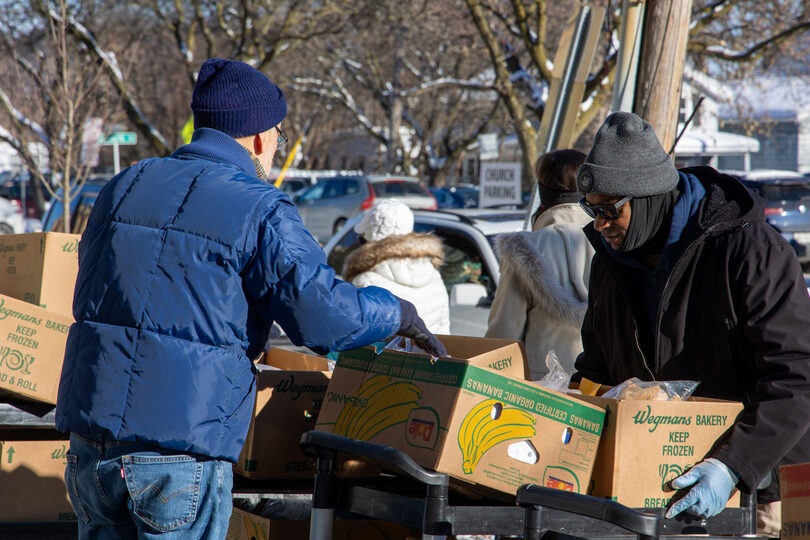
Syracuse food pantries, soup kitchens and other distributors are working to fill gaps left by November lapses in SNAP benefits. The Interfaith Community Collective packs 325 boxes of food to distribute weekly to over 1,000 people. Eli Schwartz | Staff Photographer
Support The Daily Orange this holiday season! The money raised between now and the end of the year will go directly toward aiding our students. Donate today.
Around 30 volunteers shuffled in the lower level of University United Methodist Church, steering carts piled with fresh produce. One volunteer quickly placed four oranges into cardboard boxes stacked across every inch of available table space.
The Interfaith Community Collective packs 325 boxes of fresh fruit, vegetables, bread, meats, cheeses, dairy and juice for its emergency food distribution. The boxes, handed out to residents every Friday, feed over 1,000 people, ICC’s Executive Director Galyn Murphy-Stanley said.
After being filled to the brim, each box is carried upstairs and outside, where a long line of cars circles the block. The site’s inventory seemed sufficient until last month, Murphy-Stanley said.
After Supplemental Nutrition Assistance Program benefits were cut on Nov. 1 during the United States’ longest government shutdown, Syracuse food pantries, soup kitchens and other distributors worked to fill the gaps. Still, many said they didn’t have enough food to meet the growing need — especially as the possibility of another shutdown in February looms.
Meredith Perreault, secretary on ICC’s Interim Board of Directors, usually runs the carpool line and checks people in. When residents lost their SNAP benefits, she said that people were “frightened,” with cars wrapping around the site’s block three times.
“We saw a lot of new people who were like, ‘My SNAP, I don’t have my SNAP. I don’t know what I’m going to do.’ And we would just reassure them, ‘we’re here,’” Perreault said. “But that first day we ran out of food, it was just awful.”
Roughly 42 million Americans rely on monthly food stamps, and SNAP is the largest federally funded nutrition assistance program — providing around $96 billion in assistance.
According to 2023 census data, Rochester, Buffalo and Syracuse ranked among the top 20 U.S. cities for the percentage of households receiving food stamps. In Syracuse, nearly 30% of households — over 17,800 — receive food stamps, including more than 44% of households with children.
The ICC, founded during the COVID-19 pandemic, became a nonprofit organization last year, separate from the Methodist Church. The distribution site is now open weekly from 10 a.m. to noon.
In November, Murphy-Stanley said the site frequently ran out of food in under an hour and 15 minutes, leaving those who arrived later with limited options. She said people were “scared” they wouldn’t have enough food for the week.
On top of neighborhood donations, Murphy-Stanley said the site receives around 2,000 pounds of food from the Food Bank of Central New York each week, which is then sorted, rebagged and distributed.
Michael Songer, an ICC board member, said he saw regular visitors give up a share of their food to people who lost their SNAP benefits last month. With greater need, the site also expanded its normal 300 boxes to 345 to try and meet demand, he added.
“It was definitely a whole community thing. It wasn’t just us here,” Songer said. “It was the people who are here kind of sacrificing and putting each other first.”
Community vulnerability
The ICC is one of 550 food pantries, banks and soup kitchens in Syracuse that receive food and additional funding from the CNY Food Bank, Becky Lare, the food bank’s vice president of government relations, said.
She added that the food bank’s food distribution increased by 57% during the SNAP cuts.
Anytime there’s a disruption with SNAP, it directly affects the whole emergency food network, Lare said. For every meal the food bank provides, she said, SNAP can provide nine.
Lare said SNAP funding was cut at the start of the federal fiscal year, draining much of the United States Department of Agriculture’s contingency fund that usually helps to prevent disruptions. She called it a “perfect storm.”
While Syracuse is still recovering from the pause, Lare said SNAP benefits wouldn’t be cut in a potential government shutdown this February since the USDA’s full-year funding has been finalized.
Millions are still expected to lose SNAP benefits in the coming years as states roll out new work requirements and eligibility rules passed by Republicans in Congress over the summer. In New York, those changes take effect on March 1.
As the food bank advocates for households to meet the new requirements, Lare said she still expects some to lose benefits and for food assistance demands to rise by early summer.
Who’s to blame?
Even with SNAP benefits restored, ICC volunteers and residents disagreed on what federal policies could best address food insecurity, as well as who was responsible for the government shutdown.
John, a regular visitor who asked to be identified by first name only, blamed Democrats in Congress for refusing to pass the Republican bill that would end the shutdown.
Because John only receives $23 a month in SNAP benefits, he said the recent cuts didn’t affect him — but rising food prices have. He said he remembers seeing the price of eggs at grocery stores double, forcing him to “stretch food dollars” to get by.
John said President Donald Trump’s administration is doing a good job of addressing national food insecurity and “is not a king like everyone says.”
One Syracuse University student studying television, radio and film, who asked to remain anonymous for privacy, said they found out about the cuts while writing a story about the government shutdown for a local television station. Their job at the station qualifies as a federal work study, allowing them to apply for SNAP benefits.
“I literally look over to my producer, I go, ‘Oh, my God, I don’t have SNAP anymore. I don’t have food money,’” the student said. “I was just shell-shocked that as a working person, a student, I wasn’t going to be able to feed myself.”
The student, who receives just under $300 a month, said while they were able to work off their benefits from October and receive help from her roommate, she was still forced to cut down on groceries.
Having grown up below the poverty line, the student said, it’s something she’s had to “learn how to deal with.”
‘Misconceptions’ about people on SNAP
The SU student said the current political climate and “preconceived notions” about SNAP make them reluctant to tell friends they rely on benefits. They said the Trump administration’s recent changes to work eligibility have added to the stigma.
“It’s becoming a lot harsher of an environment for people to thrive on benefits and not be ashamed of it,” they said. “I think the Trump administration is doing a really good job of hurting the people who voted for him.”
Anne Bellows, a food studies professor at SU who also volunteers at ICC, said some of her past students have struggled to get food on the table every day. However, when she asks her emergency food class to define what food insecurity means, she said few raise their hands.
Lare said there are a lot of “misconceptions” about people who rely on SNAP benefits. Most of the time, she said, they’re seniors, veterans or working families who don’t make enough money to provide for themselves or their families.
“Housing costs, childcare costs, transportation costs, food costs, all of those different pieces affect the bottom line of what resources you have available to put food on the table,” Lare said.
Murphy-Stanley said the largest demographic she sees at the ICC site is retired hourly workers who have little to no pension.
A larger issue, looking forward
On Dec. 2, the Trump administration said it would withhold SNAP benefits from most Democratic-led states next week unless they turn over additional information about recipients, including names and immigration status.
Last month, USDA Secretary Brooke Rollins said her agency uncovered “massive fraud” in SNAP, calling it “corrupt” and justifying recent changes to the program.
Both Murphy-Stanley and Lare said having New York state leadership committed to providing emergency food has made New York less vulnerable than other states, pointing to a new hunger relief fund by Gov. Kathy Hochul.
As a lifelong Syracuse resident, Murphy-Stanley said addressing food insecurity requires more than government aid and charity, emphasizing the need for stronger local food networks.
Perreault said relying on faith communities to fill gaps in the food system is “unsustainable,” calling for a national “overhaul” of the food system.
“It’s an incredibly broken system, and it’s gonna fall apart,” Murphy-Stanley said. “I’m just working in that system and trying to craft a very grassroots local effort to take care of Syracuseans.”