Syracuse is one of D1’s worst free-throw shooting teams. A sports psychologist weighs in.
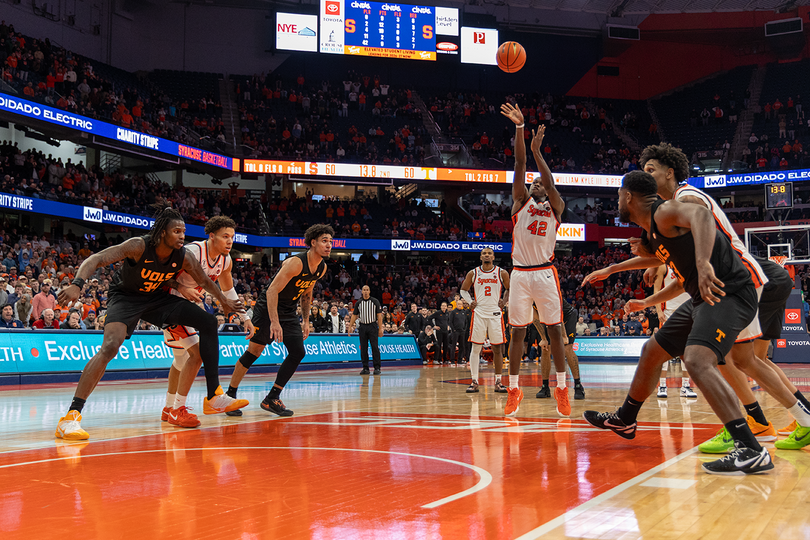
One of Syracuse's biggest weaknesses this season has been its 57.3% free throw percentage. Dr. Mark P. Otten, a sports psychologist, discussed how SU can reverse that trend. Eli Schwartz | Staff Photographer
Support The Daily Orange this holiday season! The money raised between now and the end of the year will go directly toward aiding our students. Donate today.
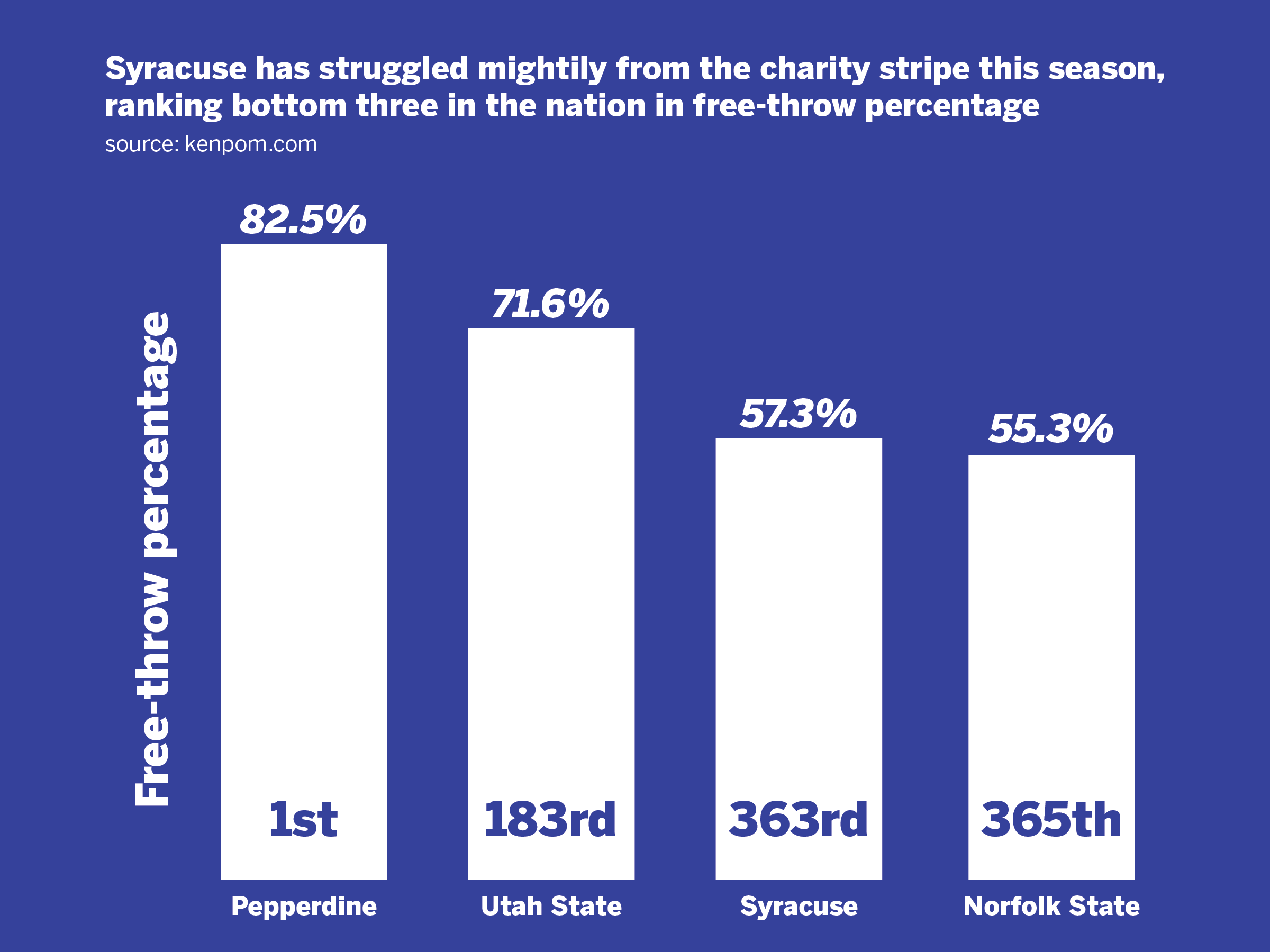
Among college basketball’s 365 Division I programs, only two have a worse free-throw percentage than Syracuse: Little Rock and Norfolk State. Respectively, those programs are rated Nos. 316 and 225 in KenPom’s rankings.
Syracuse, meanwhile, is rated No. 63. If not for drastic free-throw struggles, especially during the Players Era Festival, that figure could likely be more than a dozen spots higher.
The Orange’s 57.3% free-throw percentage is the worst among Power 5 teams in the country. For an in-conference comparison, Georgia Tech’s 64.1% clip is the second-worst in the Atlantic Coast Conference.
Sophia Burke | Digital Design Director
To try to understand why SU is struggling so much from the charity stripe, The Daily Orange spoke with Dr. Mark P. Otten. Otten is a Professor of Psychology at California State University, Northridge, where he runs the sports psychology research lab. He earned his PhD from UCLA in 2007; his dissertation was a statistical model to predict successful free-throw shooting.
Here are Otten’s thoughts on the Orange’s free-throw struggles:
Inside the mind of a sport psychologist
Otten said the first thing he’d do if he were working with the Orange is talk to people to understand why they might be struggling. On the team level, Otten acknowledged this could differ depending on the player.
So, he split his approach into two buckets. The first is for players who need “mental planning” to help simulate shooting a free throw in advance.
Among the things Otten says psychologists would do to help a player prepare is either sit them down in a chair or stand in their living room, envisioning a successful free throw. Additionally, he said he’d try simulating the experience in advance, which could entail playing crowd noise through headphones.
However, if a player is already doing this and still struggling from the charity stripe, Otten explained he’d have to go in a different direction. This second bucket would focus on relaxing and creating a trigger to relax before shooting.
‘COVID for free-throw shooting’
Otten anticipates that Syracuse might have a contagion, comparing it to “COVID for free-throw shooting.” This stems from the idea that if a player sees his teammates struggling from the charity stripe, it can lead that player to start doubting themself, which could spread across the team.
A contagion could continue to spiral, Otten said, but he was optimistic it could be reversed. For example, if one player starts to figure it out, his success could spread and rub off on the team.
“Suddenly, William Kyle makes 15 shots in a row, everybody’s like, ‘Oh, if he can do it, then I can do it,’” Otten said. “So the contagion can turn, I think, with a positive mindset.
“But it’s hard, easier said than done.”
Is this a one-off?
One of the aspects Otten was most interested in was whether SU’s players were better free-throw shooters before joining the program.
“Were these guys better free-throw shooters in high school and before they got to Syracuse than they are this year? And if so, then it’s a Syracuse problem, and it’s not a recruiting problem,” Otten said. “If these guys all suck at the free-throw shooting before they got there, well then the coach needs to recruit better free-throw shooters.”
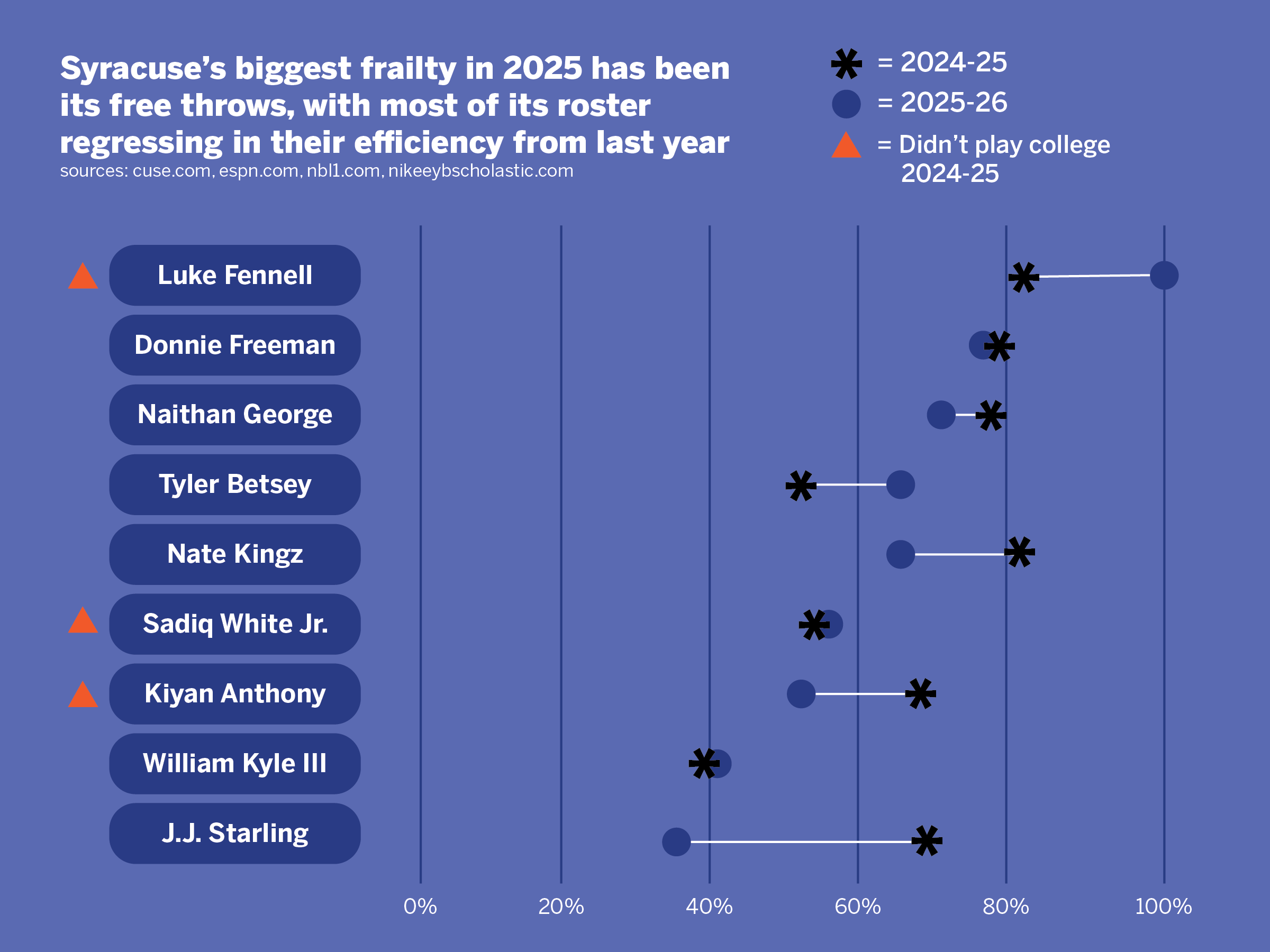
Here’s a look at how each player with a made free throw compares in free-throw percentage this season versus last:
Sophia Burke | Digital Design Director
Of the Orange’s nine players with a made free throw this year, four have seen their foul shot percentage decrease by at least 7% from last year. On the flipside, only two have seen their percentage increase by more than 7%.
The player with the biggest discrepancy is SU returnee J.J. Starling, whose free-throw percentage has dropped by 31%.
This year, Starling has a noticeable hitch before he releases his free throws …
Starling’s hitch
Otten contributes Starling’s hitch to possibly being a form of the “yips.” The “yips” are a term coaches and sport psychologists use to label mental blocks athletes experience in the absence of physical injuries. In reality, the yips are a stress response athletes encounter during high-pressure moments in sports.
In Starling’s case, Otten said he could be getting tight and nervous, contributing to his shooting stroke breaking down. Otten explained research shows there are ways to fix that by relaxing, not focusing on technical adjustments and instead focusing on things like pre-shot routine.
Of note: Starling’s hitch isn’t present when he shoots from the field. His 43.8% field goal mark is the second-best of his career, while his 35.3% 3-point percentage is on track to be a career-best.
Peace of mind
Once players are at the free-throw line, Otten said that the best shooters have “very little” go through their minds. A focus on something specific — like the back rim, bouncing the ball three times before shooting or spinning the ball before shooting — can help a player accomplish this, he added.
Otten realizes that in big games or moments, it’s hard to block out the crowd noise. If a shooter can’t block out the noise, it can hinder their attempt. But if they can successfully tune it out, the crowd hardly matters.
If a player is nervous, Otten said, it can contribute to their anxieties from the charity stripe. But if a player feels excited or inspired to be clutch, the pendulum flips.
Intuition
If Otten could boil successful free-throw shooting to one psychological feeling, it’d be intuition. He calls it “intuitive control” or “perceived control.”
For a player like Carmelo Anthony, Otten said, there’s a mindset they have that helps form a positive interpretation before shooting.
“‘Oh, it’s clutch time. It’s my time. I’m good, I’m ready, I’m excited.’ Things like that help when you’re under pressure as well,” Otten said.
Right now, Otten interprets Syracuse might have the opposite feeling, as in “I’m going to miss this.”