‘Freak athlete’: William Kyle III isn’t your typical center
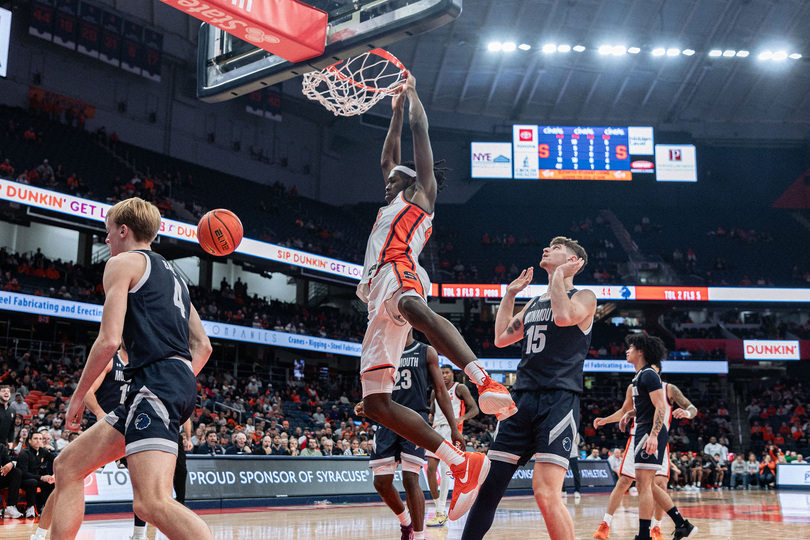
William Kyle III’s blend of athleticism, knack for doing the little things and undersized stature make him unlike a typical center. Joe Zhao | Senior Staff Photographer
Support The Daily Orange this holiday season! The money raised between now and the end of the year will go directly toward aiding our students. Donate today.
William Kyle III sat in his family’s Kia as they drove nearly 900 miles so he could compete against the world’s best 10-year-old high jumpers. It’s something Kyle III’s father, William Kyle Jr., didn’t initially know his son was qualified to do.
That was until an opposing coach approached him at the USA Track & Field Regionals and asked if they were going to Houston for Nationals. Kyle Jr. hesitated. “You do realize he’s top 20 in the country, right?” the coach responded.
Kyle Jr. had no clue. When he went home, he approached his wife about the idea. Despite the financial investment, Kyle Jr. said the family decided to drive to Houston. Kyle III then placed sixth in the high jump.
“In my head, he was going to just be like a tall ass Olympian,” Kyle Jr. said.
While he switched gears to focus on basketball, Kyle III’s Olympian-like athleticism has made the center a match made in heaven for Syracuse. Standing 6-foot-8 “on a good day,” per his father, Kyle III is several inches shorter than most centers, isn’t the typical low-post threat and isn’t a 3-point threat like some modern centers.
But with a 44-inch vertical jump and 7-foot-3 wingspan, SU general manager Alex Kline says Kyle III plays like he’s 7-foot. And with a knack for doing the little things, Kyle III’s unique skillset makes him one of the most valuable players on a new-look Orange squad looking to snap their four-year March Madness drought.
“My separator is my motor, my shot blocking ability and the ability to be that freak athlete that finishes lob plays, screen bodies and just makes winning plays,” Kyle III said.
Zoey Grimes | Design Editor
Kyle III’s most pivotal winning play yet came down the stretch in SU’s win over Tennessee. He stepped into the lane to disrupt Ja’Kobi Gillespie’s drive, forcing the guard to feed Kyle III’s original assignment, Jaylen Carey, near the restricted area.
Recovering quickly, Kyle III got in front of Carey before the bruising Volunteer forward dropped his shoulder and tried to bully his way through. Kyle III held his ground and went straight up, using his verticality to disrupt Carey’s shot, forcing a game-sealing miss.
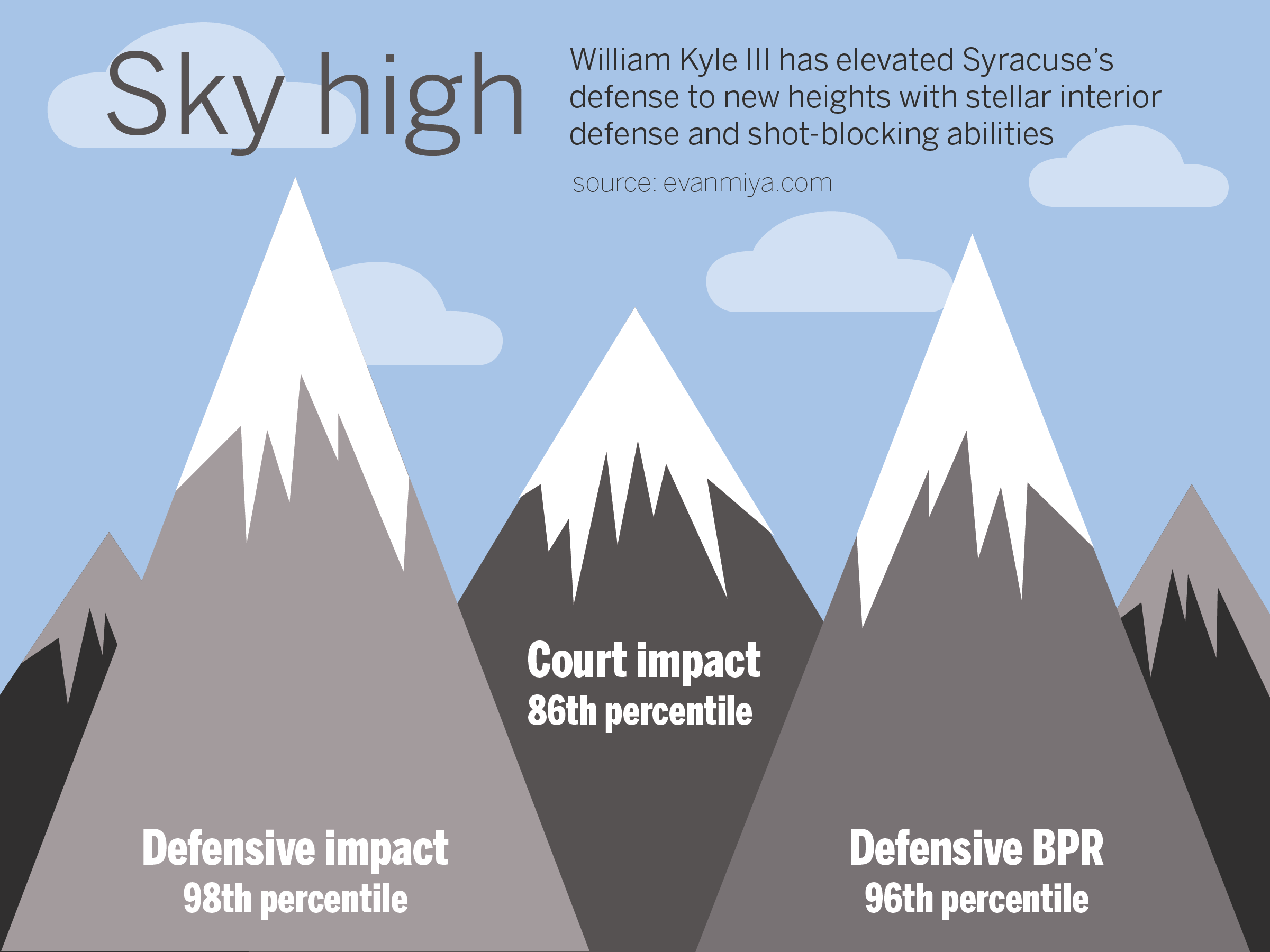
It’s one of countless examples why EvanMiya’s Defensive Impact grade — which quantifies how much a player impacts his team’s defensive performance beyond what’s measured in the box score — rates Kyle III in the 98th percentile.
Additionally, Kyle III’s 2.8 blocks per game are tied for the most in the ACC, while his 22 total blocks already surpassed the 16 that last year’s starting center, Eddie Lampkin Jr., a more prototypical big, recorded.
Paired with how he runs like a gazelle and looks like he’s jumping off a springboard in transition for alley-oops, it’s easy to see why the Orange coveted Kyle III when he entered the portal. But externally, Kline said there was plenty of skepticism from fans.
After all, Kyle III averaged 2.9 points and 1.8 rebounds in his lone season at UCLA. And he doesn’t look the part of a center, either. So, Kline made a list of around 20 6-foot-8 and 6-foot-9 centers in his phone who were top college players to prove Kyle III would fit.
Syracuse’s William Kyle III has been on a defensive tear to begin his senior season
Kyle is averaging 9.9 PPG, 7.9 RPG, 1.5 APG and 2.8 BPG
Kyle’s combination of vertical athleticism and instincts on defense makes for what has been an awesome defensive prospect
Taken a leap,… pic.twitter.com/wzfzl9DOBA
— Arman Jovic (@PDTScouting) December 5, 2025
Within the last decade, smaller bigs have carved out roles in the NBA, too. Kline, an NBA scout for eight years before becoming the Orange’s GM, said he first remembers seeing the infiltration around the time the Golden State Warriors and Houston Rockets were battling in the playoffs.
The teams met in back-to-back playoff series in 2015 and 2016. Both teams started traditional 7-footers Andrew Bogut and Dwight Howard at center. But when they met again in 2018 and 2019, 6-foot-9 Kevon Looney and 6-foot-6 Draymond Green played most of the Warriors’ center minutes, while 6-foot-10 Clint Capela and 6-foot-5 P.J. Tucker did so for Houston.
Today, 6-foot-9 center Bam Adebayo is one of the NBA’s best players. Meanwhile, similarly-sized centers Robert Williams III, Isaiah Stewart and Larry Nance Jr. have become prominent role players.
“(Kyle III) very much is the typical modern big that plays in the NBA, or has a chance to play in the NBA, and would be someone that teams could really benefit from short-term and long-term,” Kline said.
After his year at UCLA, Kyle Jr. said his son’s confidence was at an “all-time low.” SU needed to rebuild it to reach the NBA level Kline saw in Kyle III.
It was a dramatic difference from where Kyle III was a year prior. After leading South Dakota State to the 2024 NCAA Tournament and earning All-Summit League First Team and Defensive Player of the Year honors as a sophomore, he entered the transfer portal.
Before Kyle III did so, Kyle Jr. asked his son if his life was about to change. Instantly, Kyle III’s phone lit up. Because they have the same names, his father’s and grandfather’s naturally did too, Kyle Jr. said.
The next day, then-Texas A&M head coach Buzz Williams was in his living room, Kyle Jr. said. He added that over 60 high-major programs showed interest in his son before he committed to the Bruins.
It was a dream come true for Kyle III. He grew up idolizing UCLA legend Russell Westbrook, and with hopes of playing in the NBA, transferring to a Big Ten program was a crucial step.
It was an impressive feat, considering Kyle III started taking basketball seriously just a few years earlier. As a freshman at Bellevue West High School (Nebraska), Kyle III began the season on the freshman B team. By the end of his sophomore year, when Bellevue West won the State Championship, Kyle III dressed with the varsity team but hardly played.
At the time, he was focusing on track and field. Beyond excelling in the high jump, he ran the 400 and 800-meter dashes as a freshman on varsity.
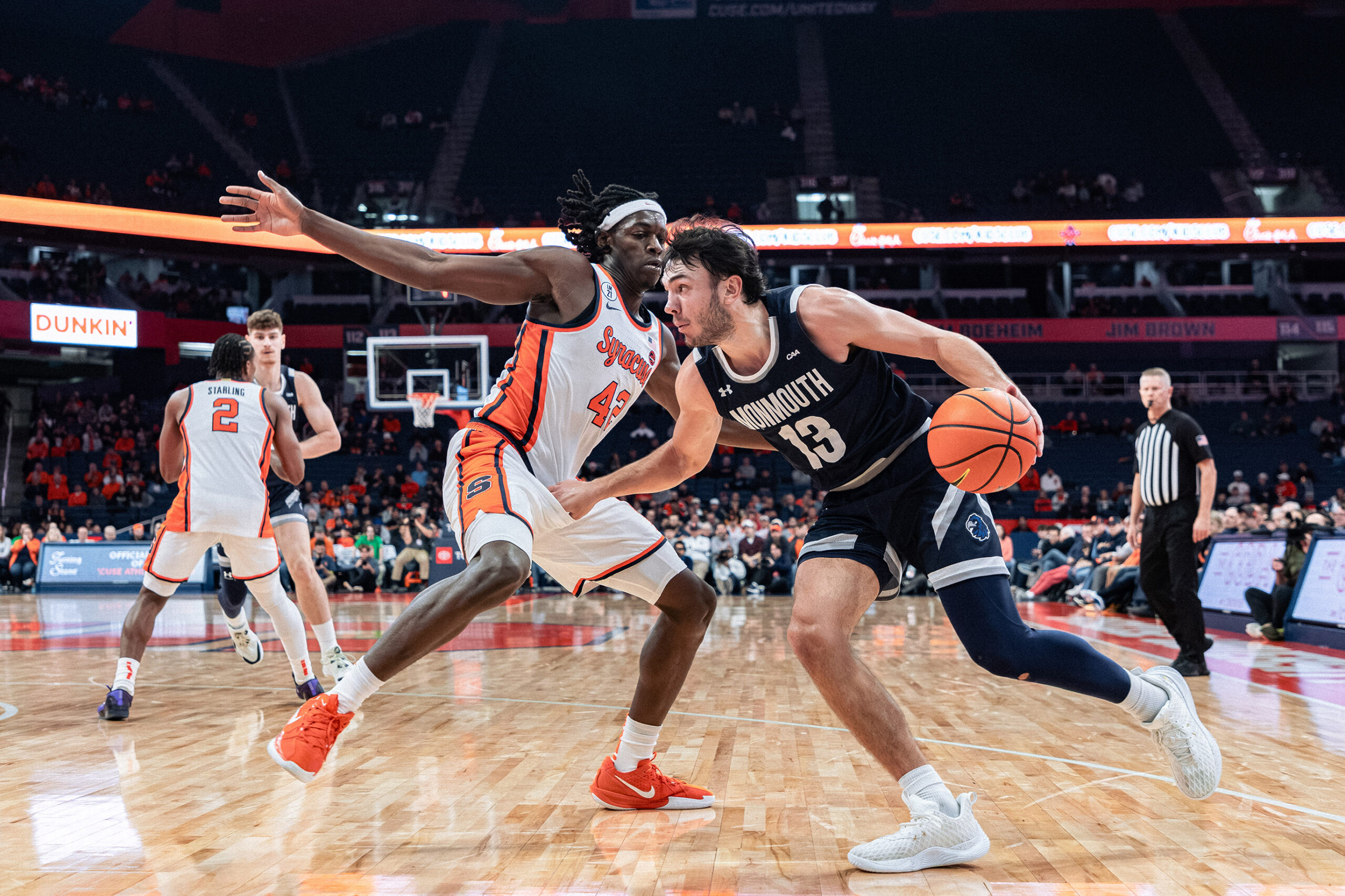
William Kyle III has made an instant impact for Syracuse this season, averaging 9.9 points per game, plus a team-high 7.9 rebounds per game and 2.8 blocks per game. Joe Zhao | Senior Staff Photographer
But once the COVID-19 pandemic canceled the track and field season, Kyle III decided he wanted to go all in on basketball. He worked out three times a day, doing agility, lifting weights for the first time and working out on the court.
Kyle III was teammates with former Louisville guard Chucky Hepburn, whose father owned a gym. There, Kyle III trained with the Hepburns.
Simultaneously, Kyle III began playing AAU basketball and grew to 6-foot-7. He began garnering attention from NAIA and D-III schools, but it took until the summer before his senior year for smaller D-I programs to notice, leading him to South Dakota State.
“My son didn’t have a half a star coming out of high school,” Kyle Jr. said.
At South Dakota State, Kyle Jr. said the initial expectation was that his son would redshirt. An early-season injury to Jackrabbits starting center Luke Appel instead thrust him into a starting role. As a sophomore, he became one of the best players in the conference.
Following his breakout, Kyle III felt his best option was to enter the portal. Kyle Jr. said he was “extremely way off” on his son’s market value. He didn’t disclose how much UCLA or SU paid Kyle III, but he said, “it’s not chump change,” and it’s “life-changing money.”
Nonetheless, Kyle III played just 9.6 minutes per game with the Bruins before entering the portal again. While it was a “humbling” experience, Kyle III said he felt he improved throughout the year.
As the Bruins became a March Madness team, Kyle III faced third-team All-Big Ten selection Tyler Bilodeau, Aday Mara and redshirt Devin Williams in practice. Bilodeau is now a senior at UCLA, while Mara (Michigan) and Williams (Florida Atlantic) both rank top 10 among D-I players in blocks per game alongside Kyle III after they all transfered.
Despite his limited playing time, Kyle III became the first transfer Syracuse brought on campus for a visit, Kline said, before he became its first commit.
“They wanted athletes; it was intriguing for me,” Kyle III said. “They weren’t telling me to do anything different than what I’ve done my whole career.”
Kyle Jr. said the Orange did a “phenomenal job” rebuilding Kyle III’s confidence. Kline added he gives a lot of credit to the coaching staff, specifically Dan Engelstad, for restoring Kyle III’s belief.
It’s got to the point where Hall of Fame coaches now laud him. Houston’s Kelvin Sampson said Kyle III has “a lot of winner” in him at the Players Era Festival. Meanwhile, Tennessee’s Rick Barnes called him an “unsung hero” who “just makes basketball plays.”
(Kyle III) very much is the typical modern big that plays in the NBA, or has a chance to play in the NBA, and would be someone that teams could really benefit from short-term and long-term.Alex Kline, Syracuse Men's Basketball general manager
Former SU star and current broadcaster Eric Devendorf praised the Orange for how their athleticism, quickness and versatility have improved compared to last year. It all revolves around Kyle III.
“Every game that he plays, he’s going to be more athletic than the guy across from him,” Devendorf said.
Kyle III allows every other defender to play tighter because their center can clean up their mistakes, Devendorf said. It’s helped the Orange become the 34th-best defense in the country, per KenPom and EvanMiya.
Outside of the dynamic blocks and alley-oops, Kyle III’s role isn’t glamorous work. Setting screens. Making the right passing reads from the short roll on a pick-and-roll. Guarding players 1 through 5 on all three defensive levels. Deflecting passes.
Even if it’s in relative silence, it’s paramount to the Orange’s success.
But if anyone dares to meet him at the rim, he’ll make a highlight-reel play by jumping with them.