ESF student org hosts panel on community, local climate solutions
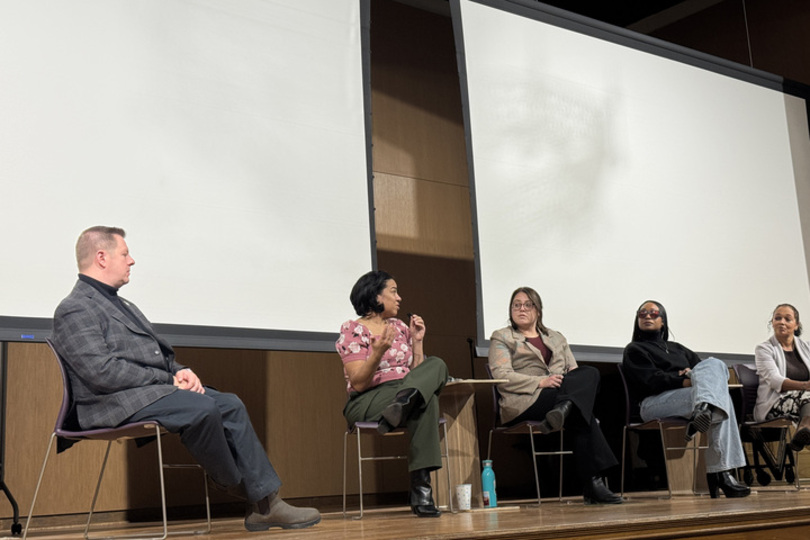
SUNY ESF’s Environmental Studies Student Organization hosted a climate change town hall Tuesday night. Panelists discussed the modern challenges and how communities should organize and react to environmental changes. Courtesy of Spencer Berg
Get the latest Syracuse news delivered right to your inbox.
Subscribe to our newsletter here.
As the city of Syracuse faces persistent environmental inequities, local advocates praised community-driven action at a climate change town hall hosted by SUNY ESF’s Environmental Studies Student Organization on Tuesday.
Last September, ESSO hosted its first climate change town hall with Syracuse City Auditor Alex Marion. Motivated by the September event’s success, ESSO President Molly McGarity and Vice President Faraz Lotfi, organized another one.
“After our first town hall in September, many of us felt inspired knowing that there are people working toward solutions for the problems that are facing our planet,” McGarity said. “We wanted to facilitate a similar atmosphere here tonight.”
Marion also moderated the Tuesday event, asking the panelists questions about the power of community and local climate solutions. Attendees like Mo Brown were in the audience.
The panel was composed of four local environmental advocates – Lanessa Owens-Chaplin, Kiara Van Brackle, Oceanna Fair and Chie Togami.
Marion started the discussion by asking the panelists about what they think is the biggest climate challenge facing Syracuse. Both Fair — a co-chair for Families for Lead Freedom Now — and Van Brackle — a Syracuse University alumna and clinical neurophysiologist — agreed the climate crisis must be viewed holistically, emphasizing that the city’s recent extreme weather is a direct effect of global climate change.
“When we talk about climate change, we are always talking about how the earth is heating up, and we don’t think about that now as we’re all sitting here freezing,” Fair said. “But sitting here freezing is a direct effect of the fact that we have the polar ice melting. ”
Togami, an ESF environmental science professor with a focus on environmental and climate justice, encouraged moving the world away from fossil-fuel-based economic practices. She also pressed for Syracuse to update its water infrastructure to eliminate lead water service lines.
Syracuse gets its clean water from Skaneateles Lake, but lead pipes are found often in older homes. In 2024, lead levels in Syracuse were more than double those found in Flint, Michigan.
“As we’re rebuilding these systems, we have to think about who has historically been the most impacted, and what we owe to those communities who have borne the brunt, suffered the most and how we can rebuild in a way that results in more equity,” Togami said.
Marion asked panelists how communities should organize and react to environmental changes such as the proposed battery energy storage site in Outer Comstock. Owens-Chaplin said while she believes the site could be better for the environment, its environmental impacts must also be considered.
Owens-Chaplin said it is impossible to have a world in which there is no pollution, using landfills as an example. She also said the technology to handle battery fires does not yet exist.
“If you live in a neighborhood that’s experiencing this, you should be thinking and talking to your fire chiefs and saying, how are you prepared? Are you equipped to put a fire out if this thing actually burns? What are the consequences?” Owens-Chaplin said.
As an attorney, she advised communities to request an extension of the public comment period when a new tech project is proposed in their neighborhoods. She also said requesting extensions gives communities time to read the projects and develop stronger arguments for their comments.
During a question-and-answer portion of the town hall, SUNY ESF Chief Sustainability Officer Mark Lichtenstein asked panelists about their feelings on the potential sustainability recession the United States may be experiencing.
Owens-Chaplin said through her work, she has seen firsthand large corporations that once supported her later remove environmental justice from their programs.
“By managing our expectations and realizing organizations like the ACLU, which were 100% privately funded, we can be that voice,” Owens-Chaplin said. “We can be the voice. We can be the folks that are out there calling on this administration to sue them.”
Lotfi and McGarity ended the town hall by urging members of the audience to attend their next meeting on Feb. 10 which will focus on sustainable fashion.