Hochul unveils record-high state budget spurred by impact of federal cuts
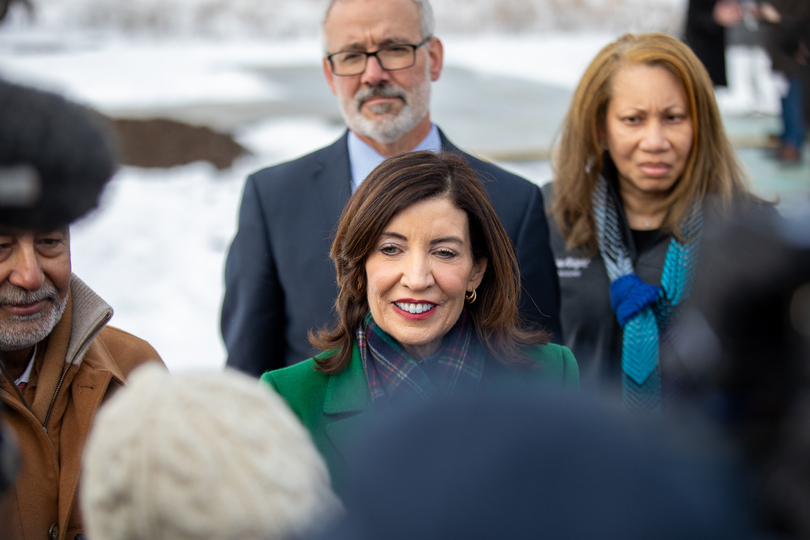
“Every dollar in this year’s budget is being put to work to fight for families.” New York Gov. Kathy Hochul presented a record-high executive budget focused on affordability, education, health care and housing hit by federal cuts. Leonardo Eriman I Senior Staff Photographer
Get the latest Syracuse news delivered right to your inbox.
Subscribe to our newsletter here.
New York Gov. Kathy Hochul presented a record-high executive budget Tuesday, focusing on education, health care and affordable housing in light of federal cuts.
At $260 billion, the fiscal year 2027 budget exceeds last year’s by 0.7%. Hochul said this increase aims to offset an 11.4% decrease in federal funding from last year.
“Every dollar in this year’s budget is being put to work to fight for families,” Hochul said. “While Washington tries to break our budget, we are making smart investments, protecting taxpayers and committing to delivering the services New Yorkers need most.”
Hochul said some of those cuts were expected as pandemic relief came to an end. However, the state relied on some of the funding to support large programs like Medicaid.
While Hochul said the budget is focused on affordability for working families, Republican Assembly Minority Leader Will Barclay criticized the budget’s $17 billion in additional revenue identified by the Division of the Budget.
“Where is the direct relief for all New Yorkers?” Barclay wrote in a Tuesday press release. “That money should be given back to taxpayers already burdened by high taxes, soaring energy costs and making ends meet in one of the least-affordable states in the nation.”
Co-directors of the New York Working Families Party, Jasmine Gripper and Ana María Archila, echoed Barclay’s frustration in a joint Tuesday press release.
“New York is in the midst of an affordability crisis, but Governor Hochul missed the opportunity to tackle this crisis,” Gripper and Archila wrote. “The Governor’s refusal to raise revenue from the wealthiest New Yorkers will limit the state’s ability to invest in working families.”
However, they praised the budget’s investment in child care and Pre-K services. Notably, $60 million will be used to pilot child care programs around the state, including Broome and Monroe Counties.
The budget proposes an additional $90 million to maintain a tuition freeze for resident undergraduate students at SUNY and CUNY schools.
The budget also proposes $38.2 billion for the state’s Medicaid Program to support the 6.8 million New York residents enrolled in the program, which lost $3 billion in recurring federal funding in 2025. It also supports New York safety net hospitals, protecting access to reproductive health care and promoting access to services provided by hospitals and nursing homes.
Kevin Kerwin, the president and CEO of Iroquois Healthcare Alliance, said he is encouraged by many of the provisions in the budget. The IHA, a nonprofit healthcare trade organization, represents Upstate NY hospitals and health care systems.
“It is clear the Governor shares our concerns about the need to ensure the stability of hospitals in Upstate and rural New York,” Kerwin said. “In the face of the uncertainty flowing from Washington, these ongoing investments in our hospitals become that much more important.”
However, the Fiscal Policy Institute criticized the budget’s Medicaid plan in a Tuesday statement, writing it won’t sufficiently address the federal cuts from the One Big Beautiful Bill Act.
The FPI raised further concerns about how the budget will address the OBBBA’s restrictions on the Supplemental Nutrition Assistance Program. The proposal will allot $10 million to combat food insecurity through NY PLATES — a new program to fund pantries, food banks and other hunger prevention programs.
These efforts follow significant federal cuts to SNAP in 2025, which left 100,000 residents in central New Yorker who rely on the program in jeopardy.
Hochul also announced a five-year, $3.75 billion plan to improve water infrastructure and create affordable housing across the state. The plan could have an impact in Syracuse, where over 9% of children had above normal levels of lead in their systems.
“Your family–and your future–is my fight,” Hochul said. “Together, with my partners in the Legislature, we will protect New York’s future and ensure it remains the best place in the nation to raise a family.”