‘Made in Poland’ photo exhibition honors roots from outside the box
Karolina Wojtas' first solo exhibit in the United States, “Made in Poland,” opened Jan. 22. Wojtas intends for viewers to feel like a parcel has exploded around them when they see her photos. Josie Kibel | Contributing Writer
Get the latest Syracuse news delivered right to your inbox.
Subscribe to our newsletter here.
Bread, angels, bricks, mail, onions and pretzels may seem unrelated. But artist Karolina Wojtas weaves these items together to tell a story and share a piece of her Polish culture.
“In this exhibition, maybe Poland can look very weird, but this is also the way of photography,” Wojtas said. “I really enjoy it if someone likes it, or simply hates it.”
Wojtas’ “Made in Poland” exhibit at Light Work’s Kathleen O. Ellis Gallery marks the artist’s first solo exhibit in the United States. Since opening Jan. 22, the Light Work exhibit aims to put a twist on the image of a care package sent from Poland to the U.S., Wojtas said.
The exhibit is meant to flip the trope of a rich uncle in the U.S. who sends American goods back to his Polish relatives. With her artwork, Wojtas crafts a story of a fictional aunt who writes to her American nephew and sends him goods from Poland. The viewer should feel like the package has exploded around them, Wojtas said.
“It’s kind of a photo and sculpture installation of the artist’s experiences in Poland; being from there,” said Cali Banks, Light Work’s communications coordinator. “This exhibition is so interesting and there’s so many details. I feel like you could stay in here for hours and still find something new.”
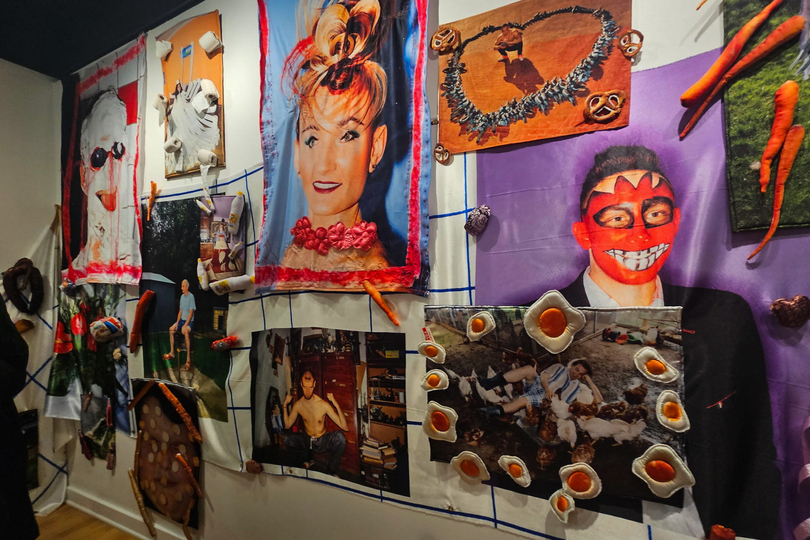
The pieces, specifically designed for Light Work’s gallery space, revolve around a piece of grid-patterned fabric that winds across the room’s walls, utilizing sculptural elements and mixed media. The fabric originates from a 3D sewn envelope, the care package’s container. On one wall, giant stuffed hands reach down from above.
Wojtas’ photographs are strewn across the walls at various levels, sizes and textures. Some are printed onto inkjet paper and overlap their surroundings, while others are isolated or framed. Photo subjects range from someone posing with a flower-stuffed toilet to a child in a head-to-toe outfit made of vegetables.
Ellen Purl, a Syracuse University freshman, said the sewn pieces, like stuffed eggs, carrots, bread, pickles, pretzels and a Polish brand of butter, surrounding Wojtas’ photos make the exhibit special.
“It’s definitely not like anything I’ve seen before,” Purl said. “I learned a lot about the culture in Poland, foods that are important to them, and their traditions.”
From a young age, Wojtas has been interested in unconventional imagery, which she now uses in her own photos, she said. At her grandmother’s house, she enjoyed looking at old, sometimes “nonsense” photographs, she said.
“I’m still trying to play and just have fun; not thinking much, but just seeing what’s working, what doesn’t work. If something doesn’t work, I’m just changing the idea and making new things,” Wojtas said.
The exhibit features a video screen, which displays looped photos and video clips of various slices of life from Poland. Also throughout the exhibit are written excerpts from the fictional aunt’s letter, which Wojtas said were written by her screenwriter friend, adding to the mixed media elements.
For the curatorial team, Banks said they had a different experience putting together this exhibit than others, all collaborating to sew pieces together and hang them.
“Things are very high up or low on the walls, a lot of stuffed sculptures, unconventional imagery or portraiture, so this was more of an experimental approach to the installation process, which was fun, ” Banks said.
Banks hopes the exhibit challenges the way people think about photography.
“I feel like this is so different from a traditional portrait or a landscape or maybe what people outside of the art field may think of when they think of a photography exhibition, so hopefully we can kind of open their eyes to different ways you can expand the boundaries of photography,” Banks said.