Murals, statues sprinkled around SU represent remnants of rich art history
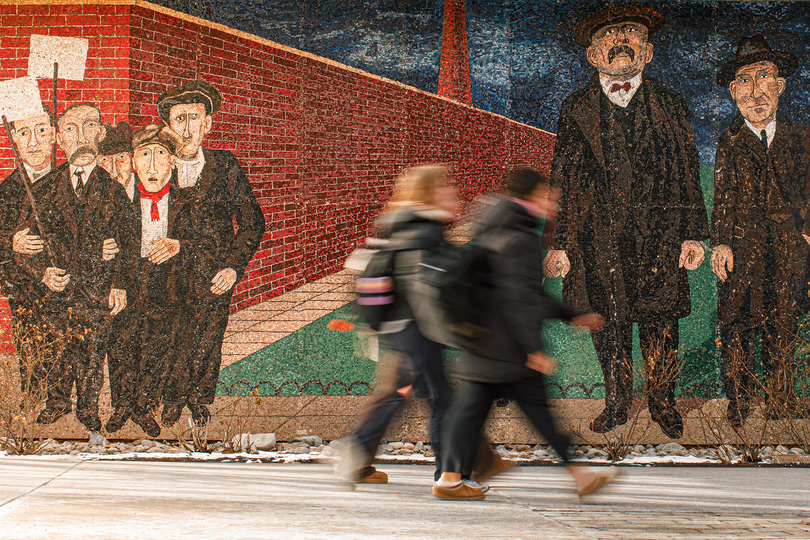
Created by Ben Shahn in 1967, “The Passion of Sacco and Vanzetti” mosaic mural lives on the right side of Huntington-Beard-Crouse Hall. The mural reflects Shahn's interpretation of the unjust execution of Nicola Sacco and Bartolomeo Vanzetti. Avery Magee | Photo Editor
Get the latest Syracuse news delivered right to your inbox.
Subscribe to our newsletter here.
UPDATE: This story was updated at 11:20 a.m. EST on Thursday, Jan. 22, 2026.
When Syracuse University senior Gabriela Peniston spent her summer on campus last year, she and her friend Brennan Finder took advantage of the empty campus to record a TikTok tour of SU. They showcased their favorite spots, including a segment on the amount of statues they noticed.
The video amassed 35,000 views, reaching Taylor Westerlund, Communications & Outreach Specialist at the Syracuse University Art Museum. The TikTok reminded him of the resonance SU’s public art scene holds on students to this day.
“In that way, I think this generation of students is taking ownership of the public art on campus,” Westerlund said. “Making (public art) their own, giving it their own inside jokes, letting it be part of their lives, whether they realize it or not.”
Westerlund was tasked to compile a self-guided and audio tour of different public art pieces on campus last May. Launched a few months later, the Public Art @ SU Self-Guided Tour on Bloomberg Philanthropies’ website spotlights 27 of the 40+ works of art on SU’s campus, including Jean-Antoine Houdon’s George Washington sculpture and Malvina Hoffman’s Elemental Man sculpture. Now, students have another avenue to engage with the statues and murals on their campus.
When creating the tour, Westerlund said his main challenge was finding information on certain pieces that have been copied throughout the years, like the “Winged Victory of Samothrace,” which has lived on the second floor atrium of Crouse College since 1905. The original sculpture, now located in the Louvre Museum, has appeared in Audrey Hepburn’s 1957 “Funny Face.”
The statue has become well known among students, something that doesn’t surprise art and architectural history professor Romita Ray.
“It’s also very boozing,” Ray said. “It commands your attention. She’s a huge and beautiful sculpture.”
Plastic cast sculptures like the “Winged Victory of Samothrace,” which was cast in 1894 based on a marble original that dates back to 190 B.C.E., were not based on an actual human figure. Therefore, artists required a thorough understanding of human anatomy and foundational drawing skills, Ray said.
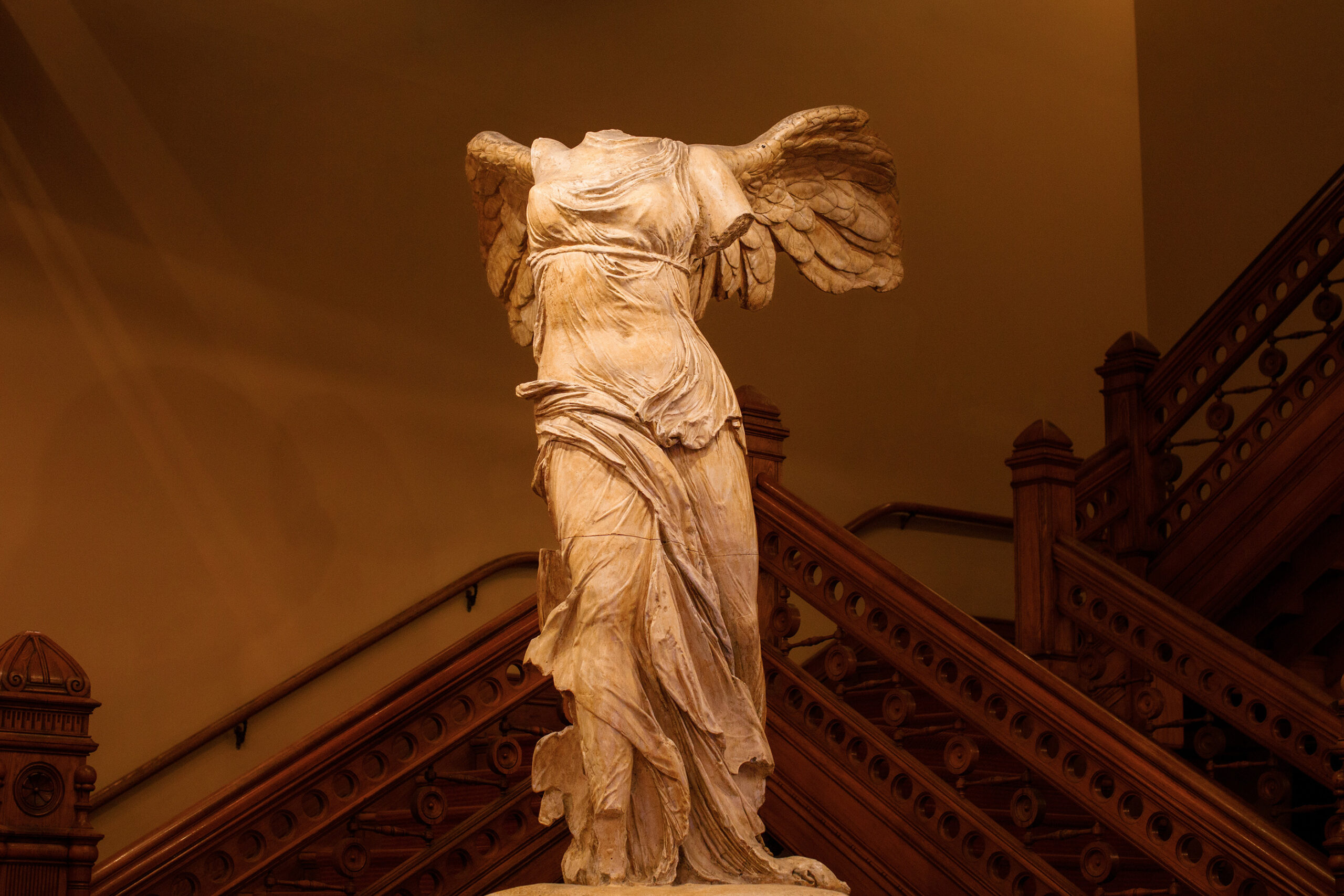
In 1905, a copy of the “Winged Victory of Samothrace” was unveiled at SU, where it now lives on the second floor atrium of Crouse College. The original sculpture currently resides at the Louvre Museum in Paris. Avery Magee | Photo Editor
The need to nail these essential skills reflects SU’s long history in preparing aspiring artists for the real world, SU Art Museum curator Melissa Yuen said. In 1873, SU was the first institution in the United States to offer a baccalaureate degree in Fine Arts. This initiative continued through the 1970s, when university leaders sought to establish SU as one of the leading centers for the study of American art, Yuen said.
When Ray first arrived at SU in 2006, she said she was impressed by the diverse range of sculptures the school featured. Uncommon on other college campuses, SU featured sculptures from the late 19th century to the modern era.
One of the sculptures that caught Ray’s attention was Anna Hyatt Huntington’s “Diana,” which was previously housed in Bird Library and now lives in Carnegie Library. Upon encountering the statue, Huntington said she was immediately made aware of the long art legacy at SU.
Though SU’s version is a copy, the statue was a gift from Huntington and her husband, Archer. “Diana” stands as a more intriguing sculpture compared to other statues, Ray said. When Huntington was sculpting this piece, her own background as an elite member of society materialized. An ancient Roman goddess, Diana is depicted in a modern way instead. Diana is seen shooting an arrow — a leisurely sport among elite women during Huntington’s time — and is sporting a flapper girl haircut as she stands next to her greyhound, Ray said.
“Diana” has sparked a long tradition with SU students. During finals season, students would rub the greyhound’s paw for good luck. The marked spot on the paw has become a more polished spot than the rest of the sculpture from wear, Westerlund said. The tradition connects students to the art on their campus, he said.
History assistant professor Britt Tevis said she was stunned when she first saw a mural of Ben Shahn’s 1967 “The Passion of Sacco and Vanzetti,” on campus.
Tevis was first drawn to Shahn’s work when she was in graduate school, relating to his roots as a Jewish immigrant who was deeply involved in social justice and creating art during the New Deal. Before starting at SU in August 2024, Tevis was looking for her new office in the Maxwell School of Citizenship and Public Affairs with her family, when she stumbled upon the mural on the right side of Huntington Beard Crouse Hall.
“When I encountered this mural on campus, it was just a sign that I had landed a job at the exact right place, because here was this mural by this artist who I love. I was just completely tickled,” Tevis said.
“The Passion of Sacco and Vanzetti” was originally a painting by Shahn from 1931 to 1932. The painting revolves around the sentencing and execution of Nicola Sacco and Bartolomeo Vanzetti in Massachusetts in 1927. During a time of xenophobia in the country, the two men were sentenced to the death penalty for murder and armed robbery despite a lack of evidence.
The outcome sparked national and international outrage, which prompted Shahn to paint his perspective of the case. This resulted in creating a 23-piece series, which is now scattered across the country in the Whitney Museum, Museum of Modern Art and the Harvard Art Museums. The mural is adapted from the original series.
For Tevis, it feels like a privilege to be surrounded by historical pieces like “The Passion of Sacco and Vanzetti,” which speak to the larger, current events in the country.
“It’s also interesting to think about how these symbols change and how these pieces don’t necessarily have a fixed meaning,” Tevis said. “They may mean something to the artist and the people who live through these events, and they mean something different, possibly for us now.”
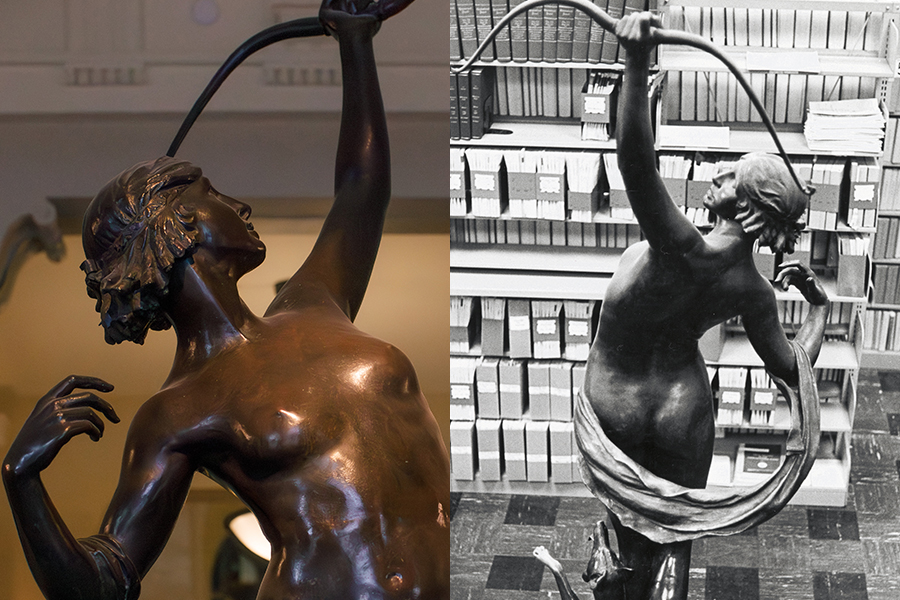
Donated to SU in 1932, “Diana” resides in Carnegie Library after relocating from Bird Library. It has become a tradition for students to touch the dog’s paw on the sculpture for good luck during exams. Avery Magee | Photo Editor. Courtesy of SCRC
As a University 100 tour guide, junior Hannah Fuchsberg, shares historical public art pieces like “The Passion of Sacco and Vanzetti” with prospective students.
“It’s a nice way to make the tour more personable and makes Syracuse different from other tours. There’s a lot of similarities between all these colleges and programs,” Fuchsberg said. “But it’s something that can make the tour a little different by showcasing a little more into our history and culture on campus.”
Though presenting these public art pieces on SU’s campus exhibits the school’s prior commitment to art, it not only gives the campus an aesthetic charm, but to also be part of something larger in SU, Fuchsberg said.
Since making the TikTok, Peniston has learned more about the nearby statues and murals through her social media pages. Now, she pays attention to the rich public art scene around her when walking around campus to get between classes or meetings.
For Yuen, who has been a curator for the SU Art Museum since 2021, having physical art pieces enriches the student experience, since engagement with art now often happens through screens. With initiatives like Public Art @ SU, art is combined with technology, making public art on campus more accessible.
“I’s really valuable for everyone on campus to have these artworks that we can look at in person, because, like, some things, some details are lost,” Yuen said. “And so with these sculptures, we can also walk around the work. We also get to see the difference and we get to experience the work from different perspectives.”
Correction: A previous version of this article notes that “Winged Victory of Samothrace” was made of plastic. It is made of plaster and was cast in 1894. Additionally, a previous version of this article stated that “The Passion of Sacco and Vanzetti” is painted. The mural is a mosaic. And a previous version of this article stated that there are 27 works of art on SU’s Campus. The guided tour included 27 of the total 40+ works. The Daily Orange regrets these errors.