RSOs at SU grapple with budget cuts, lack of ‘equal’ funding distribution

Several Syracuse University RGOs are grappling with funding challenges amid budget cuts and overspending within the Student Government Association. Many RSOs expressed concern about unequal fundraising between organizations. Hannah Mesa | Illustration Editor
Get the latest Syracuse news delivered right to your inbox.
Subscribe to our newsletter here.
After learning that Syracuse University’s Student Government Association would only fund half of its yearly print issues beginning in the spring 2025 semester, the staff of Jerk Magazine knew they needed to be creative to keep the publication alive.
For the magazine, which current Editor-in-Chief Sophie Davis said prides itself on publishing four print issues annually, the funding change immediately put its May 2025 edition at risk. Karla Perez, her predecessor, turned to crowdfunding — launching and sharing a GoFundMe via social media that ultimately raised more than double what the magazine needed to go to print.
This year, Davis said maintaining Jerk’s publishing standard, one she described as rooted in campus social issues and alternative content, amid budget cuts has required an “all hands” approach.
“I told them that we were going to have to get scrappy and figure out stuff with fundraising,” Davis said. “And Jerk has always had a little bit of a fight-the-power vibe, at least in the content we produce — we don’t really pull punches … I feel like this has just emboldened us a little bit more to speak for the people.”
Jerk is one of several registered student organizations grappling with funding challenges amid SGA budget cuts and overspending. As the issue stretches into a second academic year, several RSO leaders said they’re increasingly frustrated and worry these tighter budgets aren’t temporary. To navigate these concerns, many are working to adjust in creative ways, crowdfunding, seeking sponsorships and recycling old materials whenever they can.
Budget struggles began in spring 2025 after SGA allocated $250,000 in rollover funds accumulated during the COVID-19 pandemic to make up for budget cuts to the association.
By the spring, SGA found it overallocated $100,000 in funding and received requests that were three times greater than the spring budget could accommodate.
Alexis Leach, SGA’s comptroller, said because the association is no longer operating with an inflated budget, the Finance Board has naturally needed to deny more requests. Because a vast majority of SU undergraduates weren’t on campus before the COVID-19 pandemic, she said she understands why organization leaders may not be used to post-surplus decreases.
“Nobody here remembers a time before we lived in a surplus,” Leach said. “So I wouldn’t say that this is as much as a restraint as it is going back to the way things were.”
However, she added the SU Undergraduate Student Activity Fee — the source of funding for all of SU’s over 300 RSOs — has stayed relatively “stagnant” over the last five years when compared to other fees like tuition.
Last year, SGA raised the fee by just $8, which was then approved by SU’s Board of Trustees. This was the first time SU raised the fee in several years, Leach said.
The fee is currently $219 a semester, about an 3.8% increase from 2019-20, before the pandemic.
In contrast, annual undergraduate tuition has increased by 27.5% since 2019-20. The $211 activity fee in 2019 has the same buying power as around $266 today, according to the U.S. Bureau of Labor Statistics’ Inflation Calculator.
“The problem is that inflation is growing, and as the state of the world is going how it is, this money isn’t keeping up with that,” Leach said.
During this transitional period, leaders of several RSOs said they needed to scale back their events.
University Union — SU’s student programming board — posted a statement to Instagram at the start of the fall semester explaining its programming “may look a little different” due to “current economic changes and changes in funding across the university.”
Kate McKenna, UU’s president, said the organization saw lower attendance at the Juice Jam music festival, one of its hallmark events, after it was forced to book smaller, less expensive artists.
UU also hosted the usually ticketed event for free on Shaw Quadrangle, deviating from much larger previous locations at Skytop on South Campus and the JMA Wireless Dome.

Christian Calabrese| Staff Photographer
Jordan Ward performs at the Shaw Quadrangle for University Union’s Juice Jam on Sept. 20.
“We’ve had a semester to learn and grow how to deal with this budget, so I anticipate that it won’t be as challenging on the end of trying to figure out the logistics, but we’ll still see those changes reflected in the programming,” McKenna said. “We’ll still have all of our events … it just might look a little different than it has in previous years.”
UU, a Tier 4 RSO, is eligible to make funding requests for more than $40,000. SGA determines these tiers based on “programming capital,” referring to its history of holding successful special events or initiatives.
Tier 3 organizations can request up to $40,000, Tier 2s $25,000 and Tier 1s $12,500.
Jesús Tiburcio Zane — the president of Latine Undergaduates Creating History in America, a Tier 3 RSO — believes this system inequitably funds student organizations. While transitioning to a smaller budget, he said he wishes that SGA would’ve been more transparent about how much is in the student activity fund and made efforts to distribute it fairly.
“RSOs don’t know what the big pool we’re able to grab from is. I feel like that’s an issue,” Tiburcio Zane said. “(SU) wants to see a lot of organizations throw events and upscale them, but at the same time, not all organizations are represented equally.”
Leach said while the Student Activity Fee pool fluctuates depending on undergraduate enrollment, it has previously sat at around $3.1 million.
RSO leaders have also raised concerns with how the Finance Board makes its allocations and subsequently communicates its decisions.
Tiburico Zane said, for La L.U.C.H.A., this issue became apparent during its Latine Heritage Month programming. He said that, with balancing fiscal agent training and the start of the semester, getting his budget approved for the month proved difficult, as the process starts in mid-September.
RSOs don’t know what the big pool we’re able to grab from is. I feel like that’s an issue.Jesús Tiburcio Zane, La L.U.C.H.A. president
For OttoTHON — a philanthropic organization that hosts an annual dance marathon fundraiser — restricting the amount a Tier 1 can request for catering made it so internal events director, Abby Haffner, felt the group may not be able to feed the hundreds of attendees it expected from previous years.
Haffner described the cut to their catering budget, which decreased from $3,000 to $1,500 for Tier 1s as a result of SGA’s new catering cap, as a “surprise.” Haffner said, after being unable to raise OttoTHON’s funding tier, she needed to contact catering directly and try to find other means for providing food during her midterm exam season.
“This was during one of the busiest times of year, and you’re trying to get in contact with catering,” Haffner said. “You’re trying to get in contact with people … to see what they can do to provide food for a 10-hour-long event they have known about since the beginning of the year.
Haffner said because SU has previously promoted OttoTHON — which donates money to Upstate Golisano Children’s Hospital — she thought they “wouldn’t have to be concerned” with funding issues.
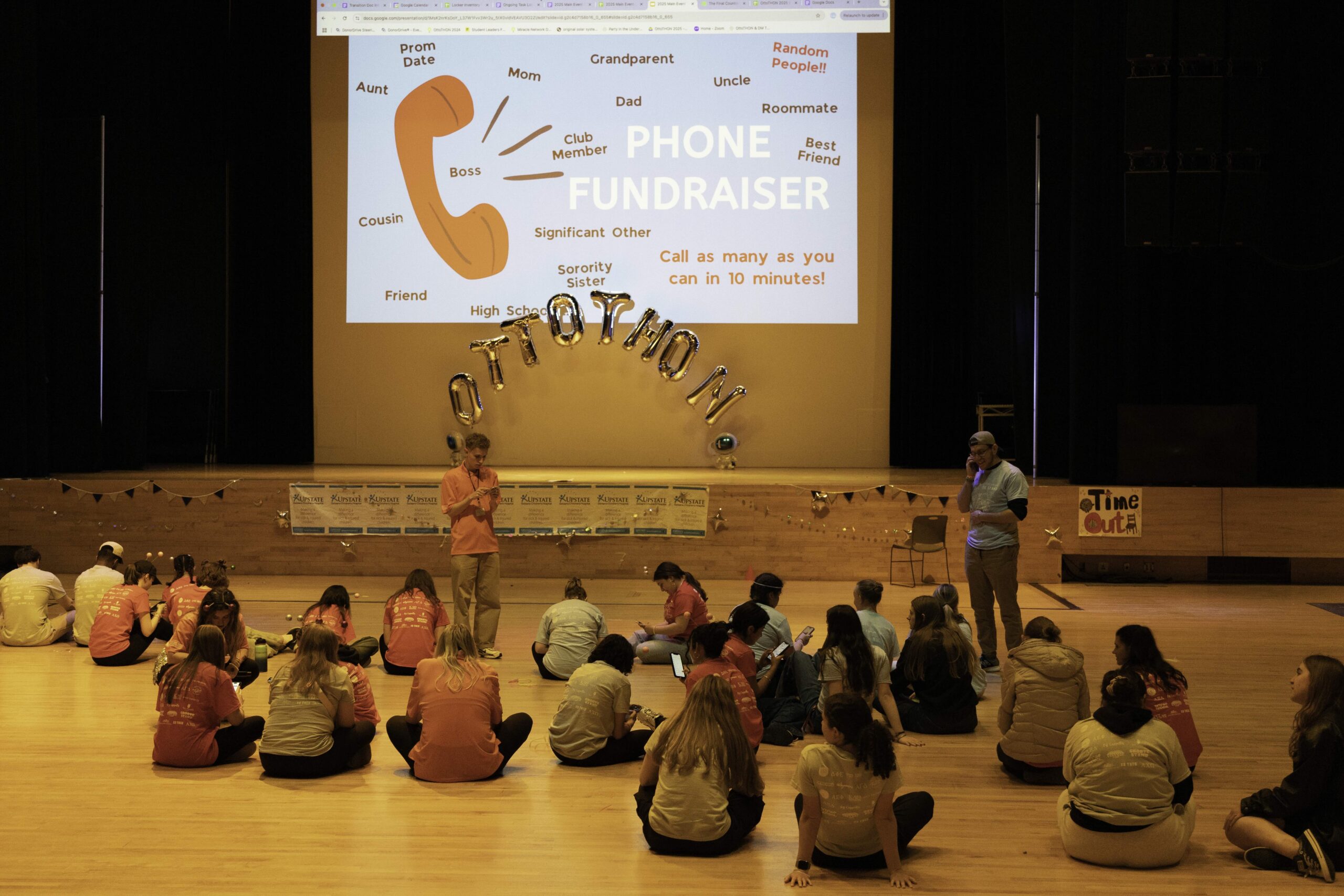
Solange Jain | Senior Staff Photographer
Students attend OttoTHON’s annual phone fundraiser on March 30, 2025.
Davis, of Jerk, and UU’s McKenna also expressed facing communication challenges. Several leaders said they have previously not understood, and occasionally disagreed with, the Finance Board’s rulings.
Leach said she holds office hours for RSOs with funding questions and also communicates with leaders through email, though she acknowledges it can be difficult to keep up with various messages from RSO leaders. As for its decision-making criteria, Leach said, the Finance Board determines funding based fully on the rules outlined in its fiscal codes.
RSOs can apply for semester budgets through advanced allocations submitted the semester prior, or special programming requests for events planned at least two weeks in advance.
The Finance Board then makes its decisions based on adherence to its fiscal codes before voting on it in the assembly. If the Finance Board denies a request, an RSO may appeal its decision.
When Davis submitted her funding request for two Jerk issues in the spring, she said the Finance Board explained that they had found several undistributed copies from previous years, indicating that they hadn’t adequately estimated the amount they needed to circulate. Davis said that, in the case of the magazine, the issues were from back in 2017.
Leach said that, when SGA went to clean out the Student Engagement office, they found “hundreds of copies” of unused student publications — causing them to establish the two-per-year rule. Davis said she wished the Finance Board would’ve communicated these specific concerns before she filed her requests.
“If I had known October of (2024), when I was filing all those budget requests, that they were just going to keep denying them, no matter how many hours I spent on Canva making my presentation look good, or how many people I had look over it, it would have saved a lot of time and stress,” Davis said.
McKenna said she didn’t understand why the Finance Board chose to cut UU’s performing arts shows, which she said often sell out in years where they’re fully funded. McKenna said SGA also declined its requests for movie screenings, causing the organization to pay for these events with its supplemental funds.
However, McKenna said she understands many limitations are “not completely in (SGA’s) control.” She, and other RSO leaders that spoke to The Daily Orange, said they believe these changes begin at university-leadership level and are spurred on by outstanding economic factors.
“I can confidently say that I don’t think we’re going backwards. I do think we’re moving forward in being able to allot as much as we can to as many organizations as we can, but I can’t say there isn’t going to be nos,” Leach said. “We can’t say yes to everything. That isn’t possible, because there’s never going to be enough money for that.”
SU also hosts a semesterly Student Organization Challenge, a month-long initiative encouraging community donations to RSOs. The organizations with the most unique donors also received an additional monetary award from SU. Though some organizations have instead looked to outside sources to generate funding.
Haffner said OttoTHON is looking into outside brand sponsorships that will work with them to incentivize student donations, as well as using products from old events to save whenever they can. UU has worked on improving its marketing departments, McKenna said, and currently plans to hold its spring music festival, Block Party, back in the Dome.
Tiburcio Zane even took to spending his own money to provide Latin American coffee brands for its Café con Leche event instead of the Dunkin’ products approved by the Finance Board. He said he’s already begun to plan and budget for next year’s events.
Still, the leaders said they wish SU would invest more resources into student-led organizations and publications, something they said the university touts as a draw for admissions.
“If you are taking away money, you’re taking away creativity, you’re taking away passion from your students,” Haffner said. “It’s not going to really look good for the university, and it’s only going to hurt them more than it will help them.”
Asst. Digital Editor Owen Smith contributed reporting to this article.