Arts and Sciences strategic plan will focus on ‘nationally renowned’ areas
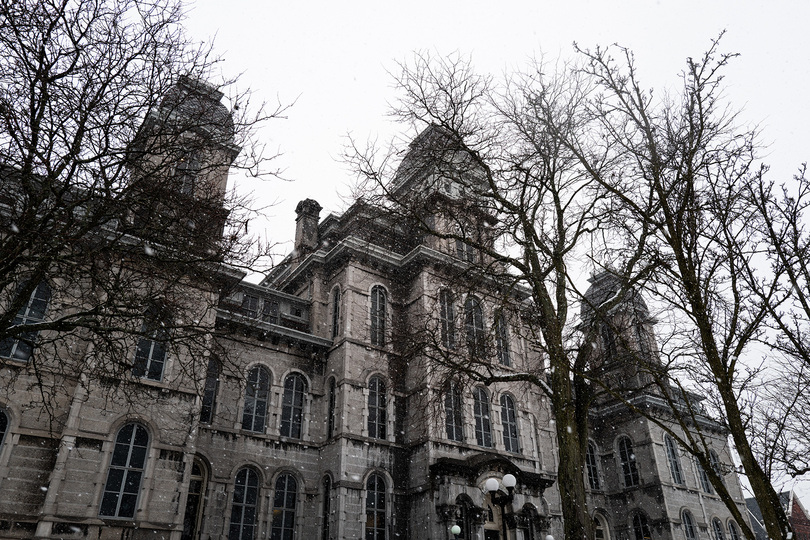
A&S Dean Mortazavi discussed the college's new academic strategic plan, which he said prioritizes operational changes. Tara Deluca | Asst. Photo Editor
Get the latest Syracuse news delivered right to your inbox.
Subscribe to our newsletter here.
Syracuse University’s College of Arts and Sciences’ new academic strategic plan has changed to prioritize operational changes and focus on areas where the college is “nationally renowned,” A&S Dean Behzad Mortazavi told attendees during a moderated webinar Tuesday.
Mortazavi spoke to current SU students and alumni about the 2025-30 strategic plan, which was finalized and released in January. His remarks centered on how the college is working to enhance areas that give students “competitive advantages” in the workforce during a time when Americans increasingly view college as less important.
“We’re not trying to do everything moderately well. We’re trying to do a few things at a high level, creating a national distinction for the College of Arts and Sciences,” Mortazavi said.
In the hourlong session with over 140 attendees, Mortazavi answered curated questions from Lisa Courtice, chair of the Dean’s Advisory Board, about the plan’s four pillars: climate change and the environment; health and well-being; culture, community and change; and innovative technologies. During the meeting’s last 15 minutes, Mortazavi took four audience questions.
In these questions, the dean wasn’t asked whether any of A&S’s recent public changes — including SU’s decision to pause admissions to 18 programs and its associated “academic portfolio review”— were made in alignment with the plan’s goals.
Mortazavi also announced several goals not directly mentioned in the strategic plan document that coincide with each pillar.
One idea included establishing an endowment for professors who need to “overhaul” their curriculum to accommodate emerging technologies, such as artificial intelligence. He mentioned another plan to create a “positive psychology course,” modeled after a similar course at Harvard University.
The Harvard course aims to “help bring renewed vigor, more positive relationships, and a higher level of contentment” to its students, according to its website. Mortazavi said the goal is to fit 250 students into the first class but anticipates up to 1,000 students being interested.
“I saw a college uniquely positioned to tackle these challenges in meaningful ways. The world is working very fast, and disruption is a way of life,” Courtice said. “We need the arts and sciences more than ever.”
This past October, the Dean’s Advisory Board — comprised of 36 SU alumni across different industries — reviewed a drafted version of the five-year strategic plan. A&S published the final version, titled “Shaping the Future: Innovation, Engagement and Impact,” on Jan. 13.
The advisory board, who helped develop the strategic plan, included representatives from both humanities and STEM disciplines.
On Feb. 12, SU hosted an “Academic Strategic Plan launch event,” during which faculty engaged in interactive activities outlining the plan’s goals.
Although the plan doesn’t directly mention the current federal administration, it makes several references to “times of division” and the “flames of polarizations” — themes which also emerged during Tuesday’s webinar.
U.S. President Donald Trump previously threatened to cut funding in his 2026 budget for the National Endowment for the Humanities. In late January, Forbes reported that a majority of grants the NEH awarded went toward conservative-leaning projects.
“There are many threats to higher education right now, and many colleges are focused on protecting what they’ve always done and hunkering down,” Courtice said. “And our College of Arts and Sciences is asking a very different question: ‘What can we do that no one else can do, given our interdisciplinary approach?’”
Mortazavi said one of his main goals in creating the new plan was to define what distinguishes an SU A&S education from that of other universities. He said he hoped to develop a plan that was tangible instead of “just aspirational.”
The college recorded its highest year-to-year retention rate and received a record 15,000 applicants last year, Mortazavi said. Because A&S establishes the university’s core curriculum, he said, every student interacts with the college — making it even more important to set “thoughtful” academic goals.
“Their focus was not looking outside initially, but looking inside and seeing where our strengths are, and then building a plan around our strengths,” Mortazavi said. “These four (pillars) came to be as a result of faculty feeling (that) this is where we have excellence, and this is where we can contribute to the society.”
The dean also promoted interdisciplinary opportunities among faculty. He highlighted the multiple clinics A&S operates, including audiology, speech pathology, psychology and marriage and family therapy. He said the college hopes to create funding opportunities that allow these clinics to collaborate.
Mortazavi also celebrated faculty research, including Dr. Robert Doyle’s development of an anti-obesity drug. He said he hopes to continue encouraging research that addresses pressing issues such as climate change.
However, he added that addressing these issues also requires a humanities education to better understand the human decisions behind them.
“What we’re trying to achieve here is making an investment in an integrated approach where scientists and humanists are at the same table from the beginning,” Mortazavi said.
Tuesday’s discussion also focused heavily on the integration of new technologies and AI. While Mortazavi said students’ opinions on AI are mixed, he sees A&S courses finding ways to make AI a tool — which he acknowledges will take time and money.
Mortazavi said he hopes to improve students’ wellbeing with the new plan, due to rising national rates of mental health challenges and internal surveys of A&S that reveal students’ struggles with loneliness, anxiety and depression.
Mortazavi didn’t provide a timeline for the implementation of the proposals to the academic strategic plan.
The full document is available online on Arts and Sciences’ website.