Aurantium philosophy journal advocates accessibility, intellectual inquiry
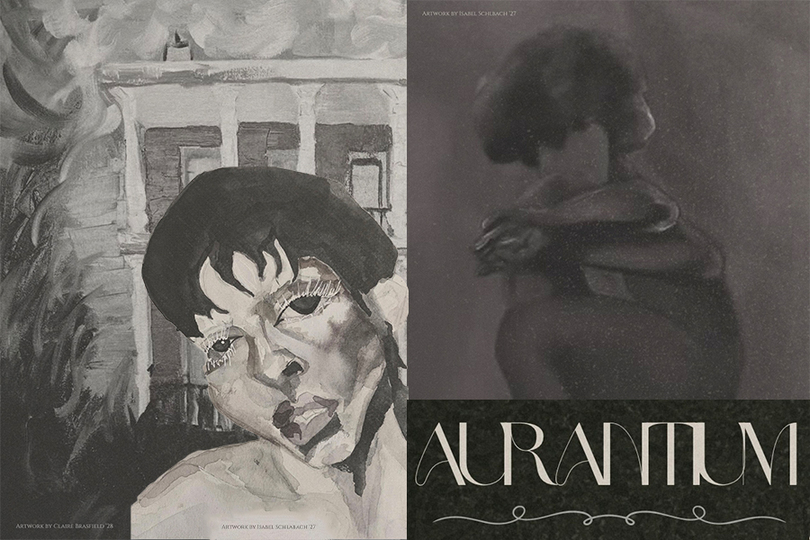
The student-led philosophical journal Aurantium intends to make philosophy accessible, accepting submissions from all majors. The journal publishes two issues a year. Collage by Avery Magee | Photo Editor
Get the latest Syracuse news delivered right to your inbox.
Subscribe to our newsletter here.
Syracuse University’s student-led philosophical journal, Aurantium, can be an outlet for philosophical dialogue for all majors — whether it’s an educational piece or a short story.
“Our biggest goal is to create a space where this kind of intellectual inquiry can meet, and where thought isn’t limited to your vocabulary, or educational background, or where you come from,” Aurantium co editor-in-chief, Bri Brzytwa said. “Philosophy should be something that everyone can enjoy, just like art.”
Then-junior Lucio Maffei, along with other members of SU’s Philosophy Club, founded the journal in late 2023. Featuring reflective pieces, creative pieces, short stories and poetry, the journal is open to all undergraduates.
“We were kicking around the idea of a journal as a way to grow the Philosophy Honor Society and the department,” Maffei said. “I’m very happy to see that it’s continuing to grow.”
The journal publishes two editions each school year. One is exclusive to SU and SUNY ESF students in the fall semester, aimed at strengthening the school’s philosophical community. The other is open to contributors worldwide in the spring semester, to “grow philosophy in the world,” Maffei said.
In their editor-in-chief roles, Brzytwa oversees the journal’s creative direction and social media outlets and senior Ben Popkin manages the editorial side.
Brzytwa said she wasn’t interested in philosophy until she found her love for it in college. She’s been a writer since she was young, and rediscovered her passion for it recently, she said.
During her freshman year, Brzytwa first submitted a research paper on the theoretical frameworks and nuances surrounding cosmetic surgery to Aurantium.
The Department of Philosophy at Syracuse is very small and tight-knit, and as an active member of the Philosophy Club, she was offered the editor-in-chief position, Brzytwa said.
Brzytwa said she is creative by making the journal “visually pleasing, but also intellectually digestible.” She said she designed the cover of the latest edition, bringing a creative flair to the club.
Originally named by Maffei, Aurantium means orange in Latin. They wanted to create a “vibrant” and “aesthetic” rebrand to fit the name, Brzytwa said. Brzytwa helped initiate a rebrand of the journal when she became editor-in-chief last school year.
Most philosophy publications are basic, with white and black fonts. Aurantium wanted to push for art students to submit their art and write about their work, expanding the journal’s aesthetic lens, Brzytwa said.
The journal’s creative rebrand attracted contributors like Noah Darrin, a sophomore majoring in creative writing and law, society and policy. A member of the Philosophy Club since his freshman year, Darrin submitted work he originally wrote for an introductory writing course. While not strictly philosophical, the piece aligned with the journal’s broader ideas.
“I had never really gotten my work off the ground in any kind of way publicly,” Darrin said.
Getting published has been one of Darrin’s creative goals since he was 9 years old, he said. He said it was really exciting seeing others read and respond to his work.
Cooper Childres, a sophomore on the editorial board, just published his own paper on Thomas Hobbes for the journal. On the editorial team, Childres’ job includes reviewing submitted papers, choosing what to publish, suggesting edits for authors and cutting pieces out completely.
Being published in a journal is something that can skyrocket someone’s writing or academic career, Brzytwa said. Philosophical writing is an experience that can develop one’s writing skills; Maffei was able to use his editing experience with Aurantium as an advantage in law school.
“Giving people those opportunities early in their academic career is very important, more than they might know,” Brzytwa said.
For Childres, the journal’s future goals include increasing student outreach and potentially inviting submissions from students who study internationally, including those studying in Germany, where he is currently abroad.
The Aurantium JNL is more than a student publication, Brzytwa said, it is a creative space where everyone should be able to share their opinion.
“For the most part, we love to hear the weird and unconventional thoughts,” Brzytwa said.