VPA professor Boryana Rossa pushes intersection of art, AI through teaching
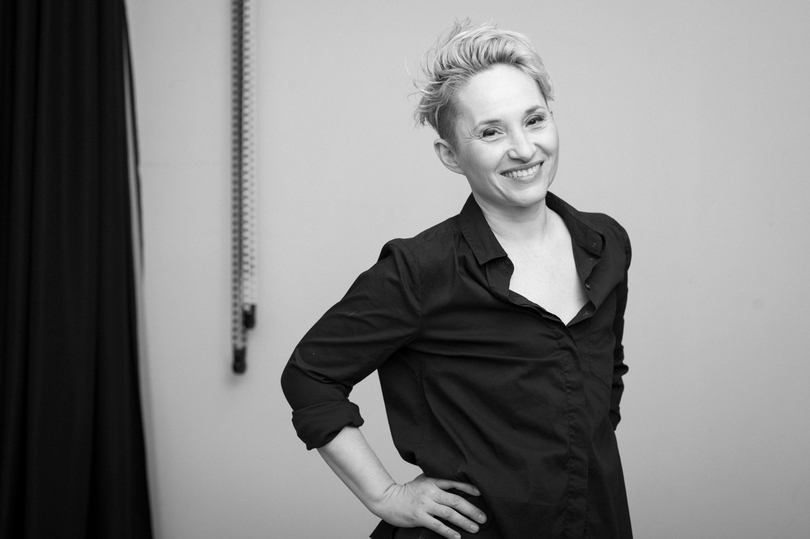
Boryana Rossa, a professor in film and media arts, is not only learning how AI technologies can be used in art, but also how science and art coincide together. In 2018, Rossa, along with biology professor Heidi Hehnly, started the Bio Art Research Coalition of Syracuse. Courtesy of Boryana Rossa
Get the latest Syracuse news delivered right to your inbox.
Subscribe to our newsletter here.
As Syracuse University professor Boryana Rossa watches over her class, students gather around lab tables; some hunch over microscopes, while others stir liquids in test tubes. Though the students may appear to be conducting a scientific experiment, they are actually creating pieces of art.
“I always wanted to have my art to be somehow shown to big places, to engage an audience that is accidentally passing by, I never thought about my art as belonging only to a gallery space,” Rossa said. “I always thought about art as an active tool for engagement of people.”
Rossa is a professor in the College of Visual and Performing Arts at SU. She focuses on innovative techniques in her teaching and using technologies in her independent art practice. Among others, she teaches classes at SU that combine biology and art. Next fall she is introducing a class on AI in art.
Growing up in Bulgaria, Rossa always knew art was her purpose. She first started drawing very young and said she was advanced for her age.
As Rossa got older, she studied art in both Bulgaria and the United States. Rossa experimented with painting, drawing, film, photography and other mediums. She applied technological elements to her work during her time as a student in Bulgaria, using projectors to implement those artworks into her DJ sets.
Rossa became a professor in the film and media arts department at VPA in 2012. She continued experimenting with unconventional art techniques and began using artificial intelligence as an artistic outlet.
As AI becomes more technologically advanced and integrated into society, Rossa has become interested in studying its implications in art, she said.
In the upcoming fall semester, Rossa will teach a new VPA class, FMA 311: AI for Art and Creative Industries. Students will learn about various artists who have used AI and technology throughout history, the positive and negative repercussions of AI in art and how to implement AI into their own work.
“Artists are quite often, they are futurists,” Rossa said. “The question for art is, ‘What if this fantasy becomes real? Let’s try what will happen.’ So it is an investigation in the future.”
Graduate student Suihang Huang is taking an early version of Rossa’s class through an independent study this semester. With Rossa’s guidance, Huang is investigating the stereotypes and biases of AI and social media by creating an artistic artificial character. She said Rossa’s interest in the subject has motivated her to explore new technology in her own work.
Rossa gave Huang the technical background and guidance she needed to execute her ideas, Huang said. She said she’s inspired by Rossa’s knowledge, passion and her use of the technology in her own work, which led to a collaborative environment.
In addition to her focus on AI in art, Rossa also studies and teaches bioart, a medium that uses scientific material like cells and DNA to present an artistic idea. Rossa has worked with Heidi Hehnly, a professor of biology at SU, who helped with the technical parts of her projects.
In 2018, Rossa and Hehnly founded the Bio Art Research Coalition of Syracuse, which aims to provide a space for bioart to be discussed and researched through events and mixers. The pair brought the coalition to SU in 2022, offering bioart classes that focus on fundamental lab techniques through the lens of artistic expression.
Rossa’s natural curiosity led her to exploring biology in her artwork, she said. Throughout her career, she has valued presenting art in unexpected ways with nontraditional mediums. Bioart fulfills that, Rossa said.
“Let’s say you have a skin cell and this skin cell turns into a tissue and this tissue can turn into some kind of image or some sort of a conceptual art piece that engages both the art and science ideas,” Rossa said.
For Hehnly, the bioart coalition allows her to express her artistic side. Though Hehnly’s work is in the biology field, she’s always been interested in art; collaborating with Rossa gives her a creative outlet.
“How she looks at art is that it’s this storyline where she uses scientific tools and techniques to create the story,” Hehnly said. “She’s sort of like the mastermind of the project and what the tale will be, and then she brings in scientists and technical experts to help her do the deed.”
The bioart classes are different from other classes offered at SU because they bring in both science and art students. It exposes them to topics that their studies don’t usually include, Hehnly said.
Rossa’s new AI art class will have a similar structure. When former master’s SU student Anshul Roy took one of Rossa’s bioart classes, it opened his eyes to how he can use his STEM background in a different way, he said.
As a former master of fine arts student with an undergraduate bioengineering degree, Roy said Rossa’s guidance in the class combined his two passions in both science and art. In the class, Roy created microscopic self-portraits that represented his heritage and identity.
“Science and arts are seen as very distinct things. They are seen as things which never intersect,” Roy said. “(Rossa) can look at scientific inventions and technologies in a very poetic way.”
As AI and technology continue to advance, Rossa said she hopes to continue learning about and applying new technologies to her artwork while pushing her students to do the same.
“Everybody can do things that look alike and this is not enough for an artist. The artist should go beyond that and should move horizons, should be an avant-garde,” Rossa said.
Disclaimer: Anshul Roy previously worked as a staff photographer for The Daily Orange. His work did not influence the editorial content of this article.