Opinion: ICE was always violent. The media just started paying attention.
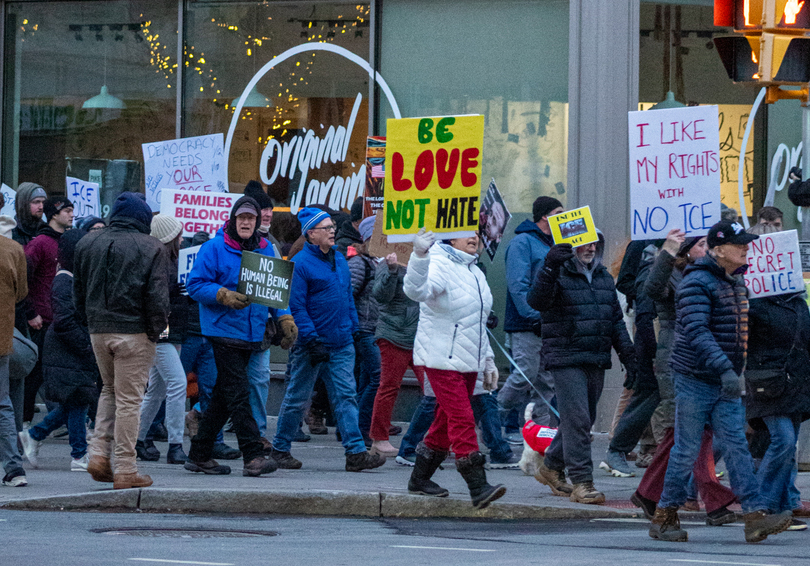
Syracuse University claims to welcome students from all backgrounds. As fears of ICE detention loom, our columnist argues it is on SU students to build a welcoming community to accomplish this. Cassie Roshu | Senior Staff Photographer
Get the latest Syracuse news delivered right to your inbox.
Subscribe to our newsletter here.
Early January marked the first time in years that the United States Immigration and Customs Enforcement’s abuse of power shifted from a mostly ignored background issue to daily headlines. But it wasn’t because ICE suddenly became violent.
On Jan. 7, 2026, Renee Nicole Good, a 37-year-old United States citizen and Minneapolis resident, was shot and killed in her car by an ICE agent. Less than two weeks after her murder, on Jan. 24, Alex Pretti, an intensive care unit nurse and U.S. citizen, was tackled, shot and killed by ICE agents during an anti-ICE protest in Minneapolis while trying to help a woman being attacked.
Both deaths are deeply tragic and have made a permanent impression on Americans. Our own citizens are being killed, reported as mere statistics in national headlines. American residents continue to endure, witness and, in many cases, directly experience conditions that resemble a dictator-run regime, a totalitarian community and a military-controlled society rather than a democracy.
This flood of coverage is more than understandable. American citizens are being killed by their own government’s federal agents on U.S. soil – it would be absurd for the nation not to pay attention. The intensity of this attention reveals something uncomfortable for Americans: The story only matters when white people are at the center of it.
Good and Pretti are only two of eight people who have died at the hands of ICE in 2026 alone. The other victims have received little to no national attention.
Beyond the widely reported killings of Good and Pretti, at least six other people have died in ICE custody in 2026 without comparable media coverage and national outrage.
Six other victims have families mourning their tragic losses. They haven’t been highlighted or given a legacy. There haven’t been nationwide protests or headlines to honor their lives. They weren’t just cases; they were human beings who breathed, laughed, worried, just like all of us, but their lives were cut short under government control. They deserve more than quiet recognition; they deserve to have their stories told, they deserve to be here with us today and they deserve to be part of a national conversation that doesn’t pick and choose whose suffering qualifies as breaking news.
Among them was Geraldo Lunas Campos, a 55-year-old Cuban immigrant in El Paso, Texas, who passed from asphyxia after being restrained by a guard. Luis Gustavo Nunez Cacares, 42, was originally from Honduras and died at HCA Houston Healthcare. Another Honduran man, Luis Beltran Yanez-Cruz, 68, from Honduras, passed from cardiac issues while being detained. In Philadelphia, Parody La, 46, a Cambodian immigrant, passed from medical neglect. Heber Sanchez Dominguez, 34, a Mexican man, was found dead inside a detention center in Georgia. In Texas, Victor Manuel Diaz, 36, a Nicaraguan man, was ruled to have died by suicide in a Texas detention camp, though his family disputes the reports.
None of these people have become household names or viral posts sparking mass national outrage. None have sparked the same coverage. For the loved ones of these victims’ families who mourn them every day, the silence is an erasure.
We must build a community where every person is safe, seen and heard, not because tragedy picks sides, but because justice means every life matters.Saimun Uddin, Columnist
News organizations and policymakers tend to elevate suffering only when it happens to those who resemble the default national citizen, white Americans.
Here in Syracuse, we have students who are international students and immigrants who have been extremely cautious in recent news. They shouldn’t have to live in fear or worry in their everyday life because of the hatred of sick people with federal power. For students from all corners of the world, these aren’t distant policy battles but are daily reminders that the same federal power being excused in Minneapolis could show up here.
Immigration enforcement doesn’t only harm white people. It’s gone by several names throughout history, always exemplifying the disgusting nationalist imbalance between citizens and government through violence. These glorified murderers have long targeted Black, Latino, Indigenous and Asian communities. Communities of asylum seekers, refugees, U.S. citizens. Federal enforcement faces little accountability, public scrutiny and almost no urgent sense of national debate.
This raises questions about the state of the U.S and who is deemed worthy of care and protection. It forces us to ask whether helping fellow civilians has been reframed as an act of defiance rather than a moral obligation, especially as many Americans feel increasingly helpless in the face of policies they didn’t choose and cannot control.
The deaths this year are not anomalies — they are the continuation of an upheld system that operates against common people.
Syracuse claims to welcome students from all backgrounds. Our students should be able to go to class, meet friends and live their lives freely without the weight of potential detention looming over them.
The media didn’t suddenly discover that immigration enforcement is deadly at the beginning of this year. People of color have seen this truth for years. The only new thing is whose deaths are being noticed.
For years, the deaths of noncitizens in immigration detention, whether from medical neglect, violence or under contested circumstances, unfolded with little notice. Only now, with high profile cases like Good and Pretti drawing national outrage, are broader audiences beginning to grapple with the human cost of immigration enforcement, even as many immigrant lives lost under similar conditions remain largely unseen.
If coverage of Good and Pretti opens a national conversation, we should use that conversation to illuminate the names of those ignored, challenge a system that treats some deaths as news and others as footnotes. We must build a community where every person is safe, seen and heard, not because tragedy picks sides, but because justice means every life matters.
Saimun Uddin is a graduate student majoring in engineering management. She can be reached at sauddin@syr.edu.