Record-shattering comes naturally to senior SU sprinter Elijah Mallard

Elijah Mallard has set school records in the 300 and 400-meter sprints for Syracuse, despite primarily specializing as a hurdler. Courtesy of SU Athletics
Get the latest Syracuse news delivered right to your inbox. Subscribe to our sports newsletter here.
Elijah Mallard sets records. Then he breaks the records he sets. And then he breaks those records again. It all just comes naturally to the senior Syracuse sprinter.
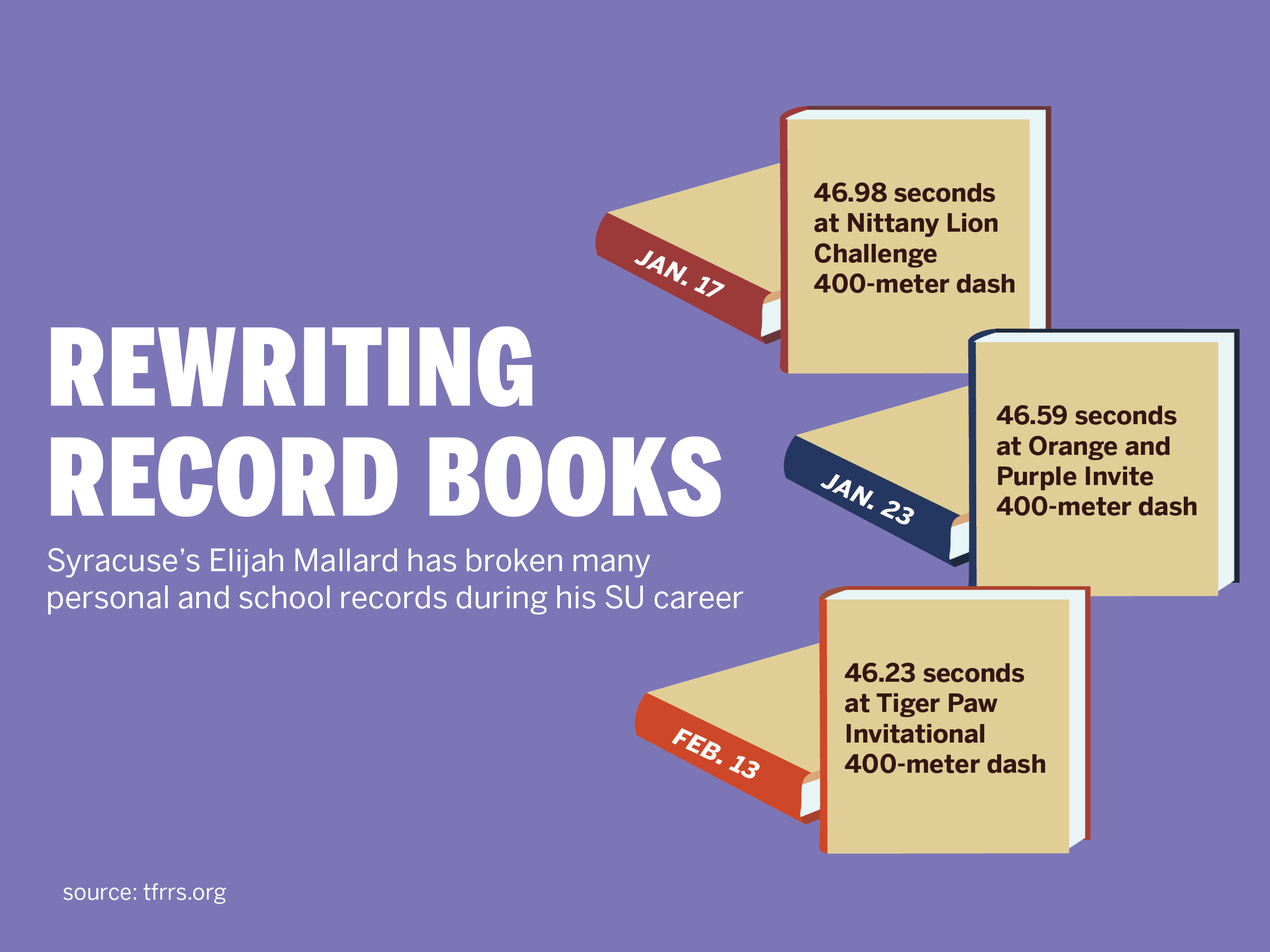
Mallard entered the year having already owned the record in the 300 and 400-meter. He shattered the 300-meter school record he set as a sophomore in his first meet of the year. In the next meet, when he took on the 400-meter, he rewrote history again.
Not just once. Not even twice. But three times in three meets.
It’s just too easy. That’s why, if you ask Elijah Mallard to characterize the success he’s achieved with the Orange, his answer is simple. It’s just a “sidequest” to him.
Mallard — whose main event is hurdles — has already firmly cemented his status as SU’s best-ever indoor runner in the 300-meter and 400-meter events. Heading into this weekend’s Atlantic Coast Conference Indoor Championships, Mallard is reaching rarified air. He’s undoubtedly in the best form of his career, rewriting record books each time he steps on the blocks. He’s spent his entire career working toward this kind of success.
But that work ethic — the one that pushed Mallard to earn everything he’s achieved — is the same trait that almost took it away.
He’s always pushed himself to the limit in training, and in his junior season, he tried pushing past it. Mallard developed a stress fracture in his right foot. It was the cost of overworking his body, and eventually, his legs gave out.
Sophia Burke | Co-Digital Design Director
He initially tried to push through the injury, fueled by his competitive fire. But before the 2024 ACC Indoor Championships, he finally hit his limit. He had to pull out.
“I still ran the indoor season, but I couldn’t actually run,” Mallard said. “I was running with two taped feet. It (felt like) pins and needles in my feet every single time I took a step.”
The fracture cost him his junior outdoor season, and it brought a mental anguish even more difficult to overcome than the physical pain.
“It really did get really hard to remember that I’m still here,” Mallard said. “I’m still at a D-I university. I’m still thankful. I’m still appreciative to be here.”
Stress fractures don’t heal overnight. The recovery process was grueling and, compared to his usual training regime, mundane.
But through the long months away from the track, his mother, Evelyn Mallard, knew her son needed to change more than his training to return to form. Eventually, Mallard reluctantly agreed to go to an acupuncturist and a massage therapist to relieve stress in his foot.
“You’re doing all the training, but the difference now in making you faster and getting back to the elite level is going to be all the other things,” Evelyn recalls telling Elijah. “Recovery, nutrition and sleep are just as important. It’s not just the training; you have to package it all together.”
Now, Mallard has fully leaned into a healthier lifestyle. He refocused on his faith and began paying attention to the minutiae that he would have called “the little things” just a year ago.
He’s dialed in on his nutrition with supplements, eaten more protein and improved his sleep quality, attacking it all with the same seriousness he’d always given his training. It was less about working harder and more about working smarter.
“I was getting ahead of myself before I go,” Mallard said. “I was really trying to push too hard. By setting me back and allowing me to take time to look at myself and look at my performance, I was able to grow into the person I am today.”
Few can return from an injury of that magnitude and immediately find their form again. But Mallard did. Mallard’s dad, Isaac Mallard, worked with him to get back in shape over the summer. Isaac knew getting back to breaking records was only part of Mallard’s motivation — what really drove him was returning to his team.
I was running with two taped feet. It felt like pins and needles in my feet every single time I took a step.Elijah Mallard, Syracuse men’s track and field runner
“Even though he was the number one-ranked 400-meter hurdler in high school, he cared more about his 4×4 relay team than he did about the fact that he was the number one hurdler,” Isaac said. “He wanted them to succeed as much as he was succeeding.”
Throughout the indoor season, Mallard has shown that he isn’t the same racer he was when he first arrived on campus as a freshman. His approach to competing has changed just as much as his training.
Initially, Elijah said he used to run tight and aggressively, comparing his style to slamming a sledgehammer against a rock. He’s since moved away from that approach and has reaped the rewards.
“Now, I think of it much more calmly,” Elijah said. “I just run my race.”
Don’t be mistaken. The calm doesn’t mean he’s lost his competitive flair. In fact, far from it. Before each race, he repeats the same three things to himself: quick, fast, aggressive. He still gets nervous. After all, he is still human, but he’s learned to rise to the level of his competition, not shy away.
Even after setting and shattering all the records in the book, Mallard isn’t satisfied. Because, in his mind, he hasn’t had “the one” yet — his best possible race.
So, how will anyone know when it finally happens?
“I’ll be on the floor,” Elijah said. “I’ll be rolling around. I won’t be able to speak. I’ll probably be by the garbage can for about 30 minutes.”
The records are nice. But the sidequest isn’t over yet.