Emerald Fennell butchers ‘Wuthering Heights’ with soulless script, execution
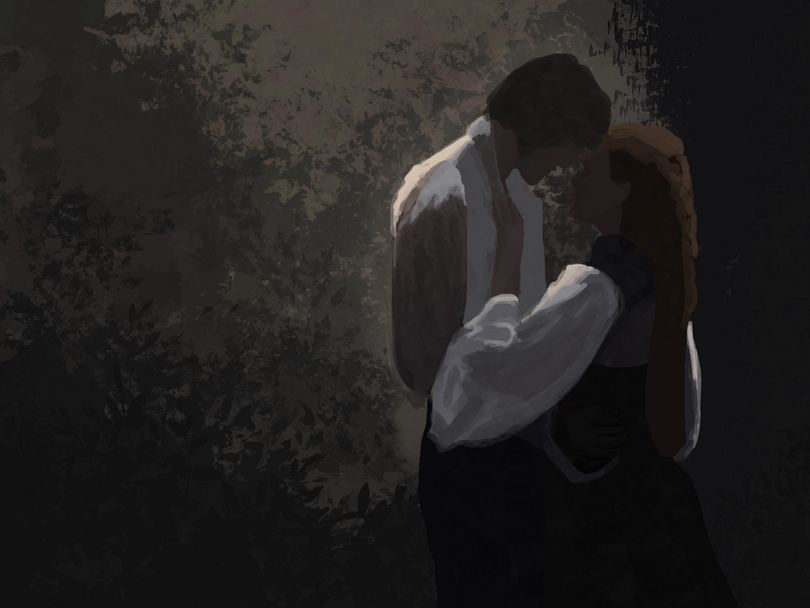
Before its theatrical release, Emerald Fennell’s “Wuthering Heights” faced many controversies, mostly surrounding Jacob Elordi’s casting. Elordi’s casting represents an erasure of the original novel’s central theme, our columnist says. Abigail Aggarwala | Design Editor
Get the latest Syracuse news delivered right to your inbox.
Subscribe to our newsletter here.
Emily Brontë’s novel, “Wuthering Heights” has been reused and recycled in more than 35 media adaptations over the past 100 years. This Valentine’s Day, it was brought to life again.
As a fan of the classic gothic romance, I was counting down the days until the release of Emerald Fennell’s highly advertised “Wuthering Heights” film. Whether it was dread or anticipation, I wasn’t sure what to expect — until I walked out of the theater feeling just, confusion.
“Wuthering Heights” is an adaptation of Emily Brontë’s English dark romance novel of the same name, set in the Yorkshire Moors during the 18th century. The story opens with the Earnshaw family, Mr. Earnshaw and his daughter Catherine, as well as their maid Nelly Dean, at their estate Wuthering Heights. Mr. Earnshaw adopts a young boy, who Catherine names Heathcliff and the two form a deep attachment.
Despite her love for Heathcliff, Catherine grows up to marry their affluent neighbor, Edgar Linton, instead. In response, Heathcliff marries Linton’s sister Isabella. Catherine and Heathcliff continue a sordid affair, until Catherine’s death after a miscarriage.
Before the movie’s release on Friday, one of the first public criticisms of “Wuthering Heights” was the casting of Catherine (Margot Robbie) and Heathcliff (Jacob Elordi). Catherine is supposed to be young and have mousy brunette hair, very different from Robbie’s conventional “Barbie aesthetic.”
More controversially, Heathcliff is described in the book as a “dark-skinned” man, which explains the abuse and neglect he faced from an elitist society, shaping him into an abusive and neglectful man. Casting white heartthrob Elordi strips the nuance from Heathcliff’s character and erases a central theme of the plot. When asked about this casting, Fennell explained that was simply how she “visualized” Heathcliff (yeah, lots of women are also parasocially in love with Elordi, too).
Marketing for “Wuthering Heights” focused on surprise, shock and novelty. Robbie and Elordi showed off their newfound chemistry on the press circuit; “brat” superstar Charli xcx created the soundtrack and creators teased potential viral “BookTok” worthy sex scenes. The marketing advertised the film as cutting edge and romantic, but the movie itself fell short of this.
Fennell partnered with costume designer Jacqueline Durran to challenge historical fashion norms, dressing Robbie in latex corsets and sequined nightgowns instead of Georgian dresses and petticoats.
The radical costume design does not read as extravagant, but rather a reckless abandonment of aesthetics. When we see adult Catherine for the first time, she is clad in a Swiss corset and checkered skirts — the outfit looks like her Shein order came just in time for Oktoberfest.
Something Fennell gets right is collaborating with Swedish cinematographer Linus Sandgren, who she previously worked with on her 2023 film “Saltburn.” The visuals in “Wuthering Heights” are striking and stunning. The rich coloring of the lavish costumes and sets, against the natural gloomy colors of the English moors. They illustrate further themes of wealth versus liberty, and man-made pleasures versus natural beauty.
The set design is also woven beautifully into the story. The Earnshaw Estate that Catherine and Heathcliff grew up in is dark and beaten down, with only one room of beauty and cleanliness, showing their position as a once prominent family.
When Catherine marries Linton, she moves up in society and enjoys an extravagant, gaudy home, with whatever indulgences she desires. One notable design choice is the room that is painted to look like Catherine’s skin, even including her veins and moles. The styling of the set, paired with the cinematography, calls back to Fennell’s disturbing yet beautiful style, a look into the psyche of her characters and their desires.
Yet, sparkly bandaids can’t fix the bullet holes Fennell shot in the heart of the story. She completely assassinates the main characters and abandons the second half of the novel. Fennell turns the abused, single mother Isabella into a “girlboss” in a consensual, submissive sexual relationship with Heathcliff. Nelly, the maid, is villainized in the film as the driving force between Catherine and Heathcliff, while in the book she is a lower class hero who seeks to protect Catherine from abuse.
The film itself attempts to shock the viewer — whether that be through the town’s erotic response to an execution, or Heathcliff’s sexual fascination with eggs — but consistently falls short.
While the cast portrayed their respective characters well, their performances cannot throw water on the fire that is the script. Adapting a beloved classic is no easy feat, especially one that has been adapted dozens of times before, but ignoring the soul of the book in its entirety is a challenge itself.
Fennell excludes the children that Catherine and Heathcliff have in the film, who in the novel go on to marry each other and break the generational cycle of abuse, instead choosing to kill Catherine after a miscarriage. While the tragedy itself was emotional, the film’s conclusion was unsatisfying. It’s as if Fennell gave a really interesting setup and walked away from the mic as soon as it was time to deliver the punchline. As “Wuthering Heights” ends, the audience is left wanting to know what the movie was about.
What was the message of that movie? Or, was there a message at all?
Critics did not seem to find a message either. It’s been slammed as “too hot, too greedy” and describe Brontë as “rolling in her grave.” Positive reviews rebuke those messages, suggesting that an almost 200-year-old book requires an adaptation that changes with the times. And by nature, this is completely rational. However, when comparing the changes with the soul of the story, it’s clear these new adaptations take away from the “point” of the plot.
I saw a review that said “Emily Brontë died of tuberculosis 177 years ago yet this adaptation is still the worst thing that has ever happened to her.” While I wouldn’t go that far, I agree that this version is disingenuous and pales in comparison to the novel.