ESF graduate assistants lose financial support after stability plan cuts
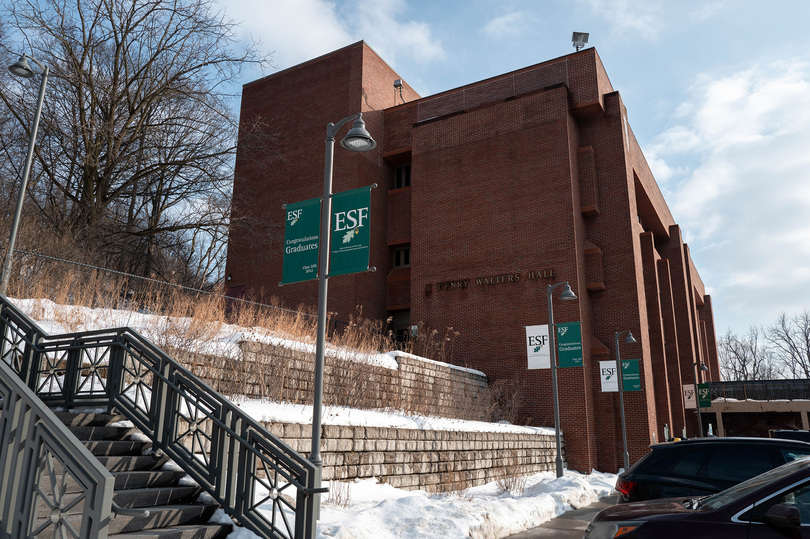
“The amount of research that people are able to do is going to decline.” After funding for SUNY ESF graduate assistant positions was cut by almost 20%, some students have taken on full-time jobs or shifted to part-time status. Tara Deluca | Asst. Photo Editor
Get the latest Syracuse news delivered right to your inbox.
Subscribe to our newsletter here.
As year one of SUNY ESF’s fiscal stability plan continues, graduate students are navigating their education with less financial support after the university cut funding for graduate assistant positions.
Last summer, SUNY released the plan to close ESF’s structural budget deficit. The plan aims to increase undergraduate enrollment and reduce spending in several areas, including graduate assistant funding.
ESF cut GA funding by 17% compared to last year, and the funding is expected to be cut by another 13% next year, ESF administration confirmed in a Wednesday statement to The Daily Orange.
GAs work as teachers and are compensated with tuition stipends and benefits. These roles typically support graduate students in their early years at ESF before they transition to federally funded research assistantships later in their programs, Emily Friden, a fourth-year graduate student and president of ESF’s graduate student association, said.
Only about 12% of graduate students nationally receive any form of assistantship, according to ESF’s statement. Even with the cuts, ESF is still at the average number of GA positions per 100 students for SUNY’s University Centers, the statement said.
ESF Professor Colin Beier said funding cuts to GA positions will make pursuing a graduate education at ESF less accessible and appealing.
“That is going to have a lot of impacts on the delivery of courses and obviously the ability for grad students to even attend ESF,” said Beier, who also serves as ESF’s vice president of academics for United University Professionals. “The idea is that you’re not going to come unless we make it financially feasible for you to come.”
Though GA positions are important for recruitment, the university said, they are not the main reason why students attend ESF.
ESF established a stability planning committee in December to advise the university on the execution of the stability plan. Although the committee can make recommendations to ESF leadership, Friden said it cannot require them to take any action.
“We have been, and will continue to be, completely transparent about the importance of maintaining ESF’s fiscal health and the strong future of our campus,” ESF administration wrote. “The need to reduce operational costs has been discussed at many public forums in the past year.”
If students cannot secure external research assistant funding for their final years of school, many return to their GA positions that act as a “security blanket,” Friden said.
Students appointed as GAs receive a stipend, benefits including health insurance and a tuition scholarship, according to ESF’s statement. Students with a 20 hour per week position receive a scholarship equivalent to up to 10 credits.
Instead, graduate students like Liz McDaniel, a chemistry Ph.D. candidate, have taken full-time jobs to financially support themselves. McDaniel now works at a local lab and comes to campus twice a week to work on her research.
Working full-time has reduced the time she can dedicate to her research and led her to take a “big step back” from her campus involvements, McDaniel said.
Slower research means students take longer to complete their programs, which Friden said could jeopardize ESF’s R2 research classification because fewer students will graduate with Ph.D.s. R2 status is a major draw for potential graduate students seeking research opportunities, she added.
ESF said the R2 status is not at risk because the status is based on Ph.D. completion.
Chris Koudelka, a third-year Ph.D. candidate at ESF, said he’s cut his research “in half.” Ph.D. students won’t be encouraged to pursue innovative research because they’re focused on the “fastest way to get out,” he said.
Some Ph.D. students have shifted to a part-time status since the cuts or are unsure if they will be able to finish their degrees, Koudelka said. The time needed to write a dissertation doesn’t work around the schedule of an off-campus job, he said.
“The amount of research that people are able to do is going to decline,” McDaniel said. “I know that I’m worried about the Carnegie ranking for the school and I know I’m not the only one.”
While Friden said ESF values its R2 status to attract prospective and current students, cuts to graduate student funding don’t match that goal. Because SUNY hopes to increase undergraduate enrollment, the workload for professors and graduate assistants will also increase, straining resources and ultimately “diluting the quality” of ESF, Beier said.
Graduate students could become overworked and “spread too thin,” he added.
“It’s ‘tightening the belt,’ but it’s like cutting new holes in the belt,” Beier said. “It’s going to a level where we estimate that, based on the numbers that we have in front of us, that we’re going back to the staffing level, including grad assistants, of the 1970s.”
When a professor brings on a graduate student to do research, they are often supported with a GA position if they don’t have a research grant, Beier said. He said the exchange keeps students focused on their research at ESF, rather than needing to support themselves with another job.
Without the ability to obtain his degree while teaching, Beier said he wouldn’t be where he is today — an opportunity fewer graduate students will now have access to.
Koudelka said reducing funding for GA positions harms the “backbone” of ESF and keeping student success metrics the same with the cuts is “not feasible.”
He claimed the announcement of the stability plan violated ESF’s shared governance policy. He believes students and faculty affected by cuts should be involved in making administrative decisions, not informed after.
“It feels this way that we’re being managed,” Koudelka said. “Because it’s assumed that we won’t understand, and so it already creates issues of trust and accountability.”
McDaniel found out about the change during a department meeting last year. The chemistry department chair explained that students further in their degrees and not taking a full courseload wouldn’t be able to return to GA positions.
As the graduate student representative in ESF’s stability planning committee, Friden said the committee has been trying to find “footing” in the financial information ESF has shared with them about each department.
She said ESF administration has been receptive to sharing information with the stability planning committee, which has been moving in a “positive direction.”
Koudelka said he doesn’t see ESF’s mission statement, “Improve Our World,” reflected in the stability plan’s cuts. Beier said he views the stability plan not as a “plan,” but as a “set of targets.”
“Right now, it’s clear that education is secondary to cost control, because the leadership is managing optics rather than addressing the consequences of the stability plan,” Koudelka said.
President Donald Trump’s administration cuts to funding for federal agencies like the Environmental Protection Agency and National Science Foundation feel like “two punches at once” for graduate students, Friden said. Because external research funding from those federal agencies isn’t there, she said financial options for graduate students are reduced further.
“These next three years are going to be really frustrating as we work through the five-year stability plan on our turf and then the three years on the federal turf,” Friden said.
For Friden, graduate students bring a trove of research and teaching experience to college campuses, and are a “driving force” behind science programs that require lab classes.
“As much as advisors and professors can do research, it’s on the backs of graduate students,” Friden said. “So the fact that SUNY sees the amazing work we’re doing and says, ‘Let’s decrease their funding,’ is awful. It devalues the work we do.”