Former Syracuse lacrosse player expelled after Title IX investigation

Former Syracuse men’s lacrosse player Chrishawn Hunter was expelled from the university after an SU Title IX investigation found evidence that he engaged in dating and domestic violence. Leonardo Eriman | Senior Staff Photographer
Get the latest Syracuse news delivered right to your inbox.
Subscribe to our newsletter here.
UPDATE: This story was updated at 3:35 p.m. on Thursday, Feb. 12.
Editor’s note: This story includes descriptions of dating and domestic violence.
Former Syracuse men’s lacrosse player Chrishawn Hunter has been expelled from the university after a Title IX investigation found evidence that he engaged in dating and domestic violence.
Syracuse University received a formal Title IX complaint against Hunter on May 5, 2025. The complainant, a female undergraduate student, alleged three incidents that caused her to fear for her safety, according to hearing outcome documents obtained by The Daily Orange. The two are no longer involved with each other.
A Title IX hearing officer designated by SU found Hunter responsible for two of the three alleged incidents, violating SU’s Sexual Harassment, Abuse and Assault Prevention Policy related to both dating and domestic violence, as well as sections 1, 2 and 3 of the university’s Student Conduct Code. The sections address physical assault and intentional conduct causing harm. The hearing officer found insufficient information to conclude that Hunter engaged in sexual harassment, according to the decision.
The hearing officer found that Hunter subjected the undergraduate student to “continued and unwelcome actions” from spring 2024 through spring 2025, the documents state. The complainant’s relationship with Hunter ended after the third allegedly violent incident.
Hunter is no longer a student at SU and has not been a student since spring 2025, Sarah Scalese, the university’s vice president for communications, confirmed in a statement to The D.O.
Though two “physical acts” were separated by several months, the hearing officer found a “pattern of behavior” as Hunter “chose to engage in physical violence as a response when frustrated by someone with whom he was in a dating relationship.”
Hunter’s expulsion means he is ineligible to “receive any diploma, degree, or certificate from Syracuse University and is permanently ineligible for re-admission,” according to the documents. He is also banned from SU property.
Hunter did not respond to The D.O.’s request for comment. His university-appointed advisor is “not permitted to comment on students, matters, or outcomes,” they wrote to The D.O., and does not provide statements to the media.
Federal privacy laws prevent SU from commenting on specific cases, Scalese wrote, but all reports submitted through the Title IX process are “thoroughly reviewed.”
“Syracuse University’s policies and procedures for investigating and adjudicating Title IX cases fully comply with federal and state law and are applied fairly and expeditiously to all parties in the investigative and disciplinary hearing process,” Scalese wrote.
The complainant asked that The D.O. not use her name because she is still enrolled at SU and has concerns about her privacy and safety.
Dating and domestic violence cover any violent act against someone who’s in a relationship with the respondent — or used to be, according to the documents. This includes romantic relationships, domestic partnerships or other close personal connections. It also applies if the respondent tried to start these kinds of relationships with someone.
Hunter submitted his full written appeal of the hearing officer’s decision and the sanction between Oct. 31 and Nov. 6, according to the documents. The Appeal Panel in the Title IX investigation confirmed the initial findings in a Dec. 17 letter, cementing his expulsion.
He reappealed the sanction on Jan. 20, arguing the hearing officer’s findings did not justify his expulsion. The Appeal Panel affirmed the hearing officer’s decision on Feb. 3.
Hunter participated in SU’s men’s lacrosse program from 2024-25. He grew up in Rochester and played field and box lacrosse around central and western New York. After attending the Westtown School in Pennsylvania to further his athletic career, Hunter became a three-star midfield recruit and committed to Syracuse on Nov. 8, 2022.
In 2024, Hunter did not see the field as a true freshman. He appeared in three games during the 2025 season as a sophomore: Feb. 1 versus Jacksonville, Feb. 7 against Vermont and March 18 versus Manhattan.
Hunter’s “physical violence” continued during SU men’s lacrosse’s spring 2025 season, according to the documents. Hunter remained on Syracuse’s active roster throughout a season where the Orange won the Atlantic Coast Conference title and made the NCAA Final Four.
SU Athletics did not respond to The D.O.’s request for comment.
Hunter is currently enrolled at Onondaga Community College, about four miles from SU, where he is rostered as a midfielder on the school’s men’s lacrosse team. On Nov. 7, 2025, Hunter posted a highlight reel of him participating in OCC’s fall practices.
Roger Mirabito, OCC’s executive director of communications, confirmed Hunter is a student at the community college and a member of its men’s lacrosse team, but said additional information is protected under the Family Educational Rights and Privacy Act.
“Onondaga Community College is an open access institution, committed to equal opportunity in its enrollment and participation procedures and educational programs,” Mirabito wrote.
Hunter acknowledged the impact of his actions in his appeals, was willing to seek therapy and had a desire to learn from this experience, according to the documents. But the director of community standards wrote in the documents that probation was “simply not an appropriate outcome in this case.”

Leonardo Eriman | Senior Staff Photographer
Hunter played in three men’s lacrosse games as a sophomore. His physical violence toward the female undergraduate student continued in the 2025 season.
While the two were in a relationship, the complainant alleged Hunter pushed her into a wall and choked her twice at his South Campus apartment in April 2024, according to the hearing outcome. Hunter claimed this incident did not happen, according to the documents.
Text messages between Hunter and the complainant, referenced in the hearing, corroborated the complainant’s account, according to the documents. The complainant provided a screenshot from May 2024, of a text exchange reportedly with Hunter “in which they discussed her talking to another male,” according to the documents.
The complainant wrote in a text message, “At least he wouldn’t have thrown me against a wall and choke slammed me!” Hunter responded, “ik (I know) I’m terrible.”
Hunter claimed the complainant’s text conversation was not with him. The complainant provided the hearing officer with screenshots showing Hunter’s face as the contact’s profile picture, according to the documents. The hearing officer deemed Hunter’s testimony of the incident not credible.
At the start of the fall 2024 semester, Hunter and the complainant had a verbal argument that “escalated to mutual pushing,” per the documents. But Hunter’s expulsion from SU was determined by the two allegedly violent incidents reviewed by the Title IX panel, according to the documents.
SU’s Department of Public Safety responded to Hunter’s apartment after receiving an anonymous call about the argument. Hunter told DPS, the investigator and the hearing officer that he spoke with the complainant with his “hands behind (his) back so that (he) can make the deliberate point that (he) was not touching her at all.”
The D.O. posed questions to DPS and SU Athletics, including if the men’s lacrosse team was notified of DPS’ response to the verbal dispute. Neither responded to The D.O.’s request for comment.
The complainant’s third and final formal complaint alleged that, in March 2025, Hunter physically assaulted her in his apartment on South Campus.
The complainant was visiting Hunter, took his phone and checked if he was communicating with other women, according to her initial complaint described in the hearing outcome. After Hunter noticed the complainant going through his phone, he allegedly tackled her, pinned her down, took back the phone and slept on his couch. It was uncontested that Hunter woke up to find her going through his phone, per the hearing officer.
Then around 8 a.m., the hearing outcome states Hunter and the complainant engaged in an argument that she claims lasted for “several hours.”
The complainant claims Hunter shoved her approximately 15 times, shoved her to the ground twice and pinned her against a window, according to the documents. Hunter denied pushing, grabbing or touching her.
The documents also indicate Hunter grabbed the complainant by the arm and scratched it, drawing blood. The D.O. also obtained a copy of the photo that showed the complainant’s injury. The alleged incident caused her to fear for her safety, the documents claim. The relationship ended after the third allegedly violent incident.
The hearing officer found that Hunter caused the injury in the course of the altercation, according to a sanctioning letter after Hunter’s first appeal. The officer ultimately found “sufficient evidence” that Hunter committed these actions, according to the documents. The officer noted the parties’ accounts differed, and there were no eyewitnesses to the reported conduct.
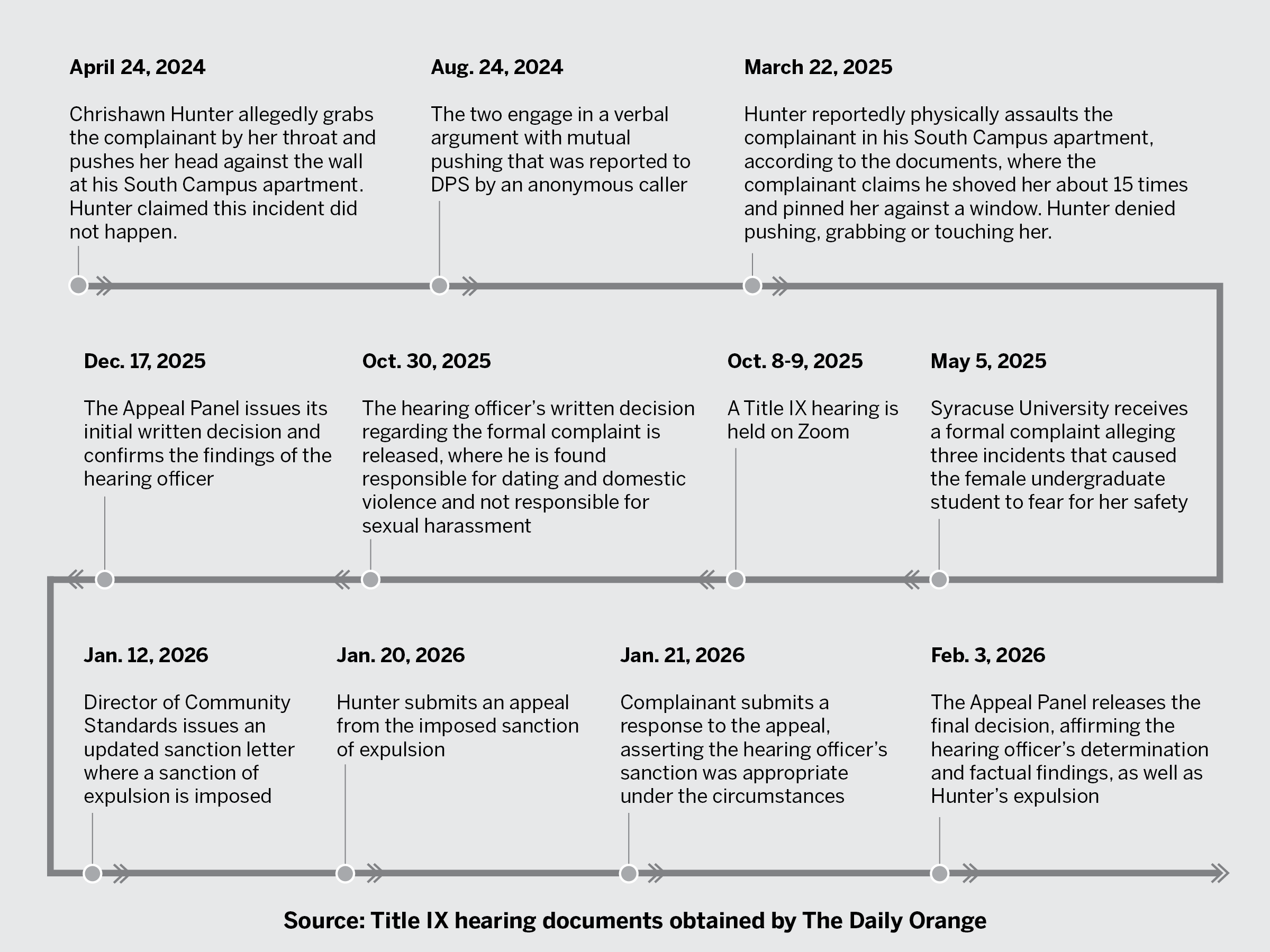
Sophia Burke | Digital Design Director
Hunter’s family backstory includes a history of domestic violence. His father, Christopher Hunter, killed his mother, Melissa Hammond, after a heated argument in November 2006. Investigators said Christopher slashed Hammond 59 times with a fishing knife. Hunter was 2 years old at the time.
Hunter’s father was found guilty of second-degree murder on Nov. 18, 2007. He’s still serving a maximum prison sentence and is eligible for parole in 2032, The Oak Ridger reported in 2007.
In Hunter’s Title IX trial, the hearing officer explained they looked at how credible each person’s story was and weighed several factors: how detailed their accounts were, whether there was any supporting evidence and whether each party had a reason to be biased. They also kept in mind the context of the relationship between Hunter and the complainant.
The officer also confirmed in the documents that they adhered to the Sexual Harassment Policy’s requirement that the respondent is presumed not responsible. The respondent can only be found responsible if the evidence shows it is more likely than not the violation occurred, according to this standard.
Expulsions are a rare outcome for formal Title IX case complaints, said Kathryn Holland, an associate professor at the University of Nebraska-Lincoln.
“It’s very rare for any kind of formal grievance procedure to result in a finding of responsibility,” said Holland, who studies the implementation, use and effectiveness of formal support systems for sexual assault in higher education. “Even the ones that do result in the finding of responsibility, it is very rare for them to receive any kind of sanction that would result in things like termination, suspension, expulsion, et cetera.”
The Syracuse men’s lacrosse team last saw a domestic violence incident in 2021, when Chase Scanlan was arrested and jailed on domestic violence charges. A member of the Syracuse women’s lacrosse team who was in an on-again, off-again relationship with Scanlan then filed a lawsuit against the university, alleging it showed deliberate indifference to her as a domestic violence victim and didn’t fulfill its obligations under the law.
The D.O. obtained a copy of the Title IX Appeal Panel’s third and final decision from Feb. 3. Hunter’s punishment of expulsion was upheld as reasonable.
With this decision, the Title IX process between Hunter and the complainant is over. Hunter, now a student at OCC, is indefinitely expelled from SU and banned from accessing its campus.
“Based on the findings of the Hearing Officer, the sanction of expulsion was one of the options available and fully within the appropriate exercise of discretion by the Director of Community Standards,” the Appeal Panel’s final decision states. “We will not disturb that exercise of discretion.”