Latino SU students find solidarity, pride in Bad Bunny’s Super Bowl performance
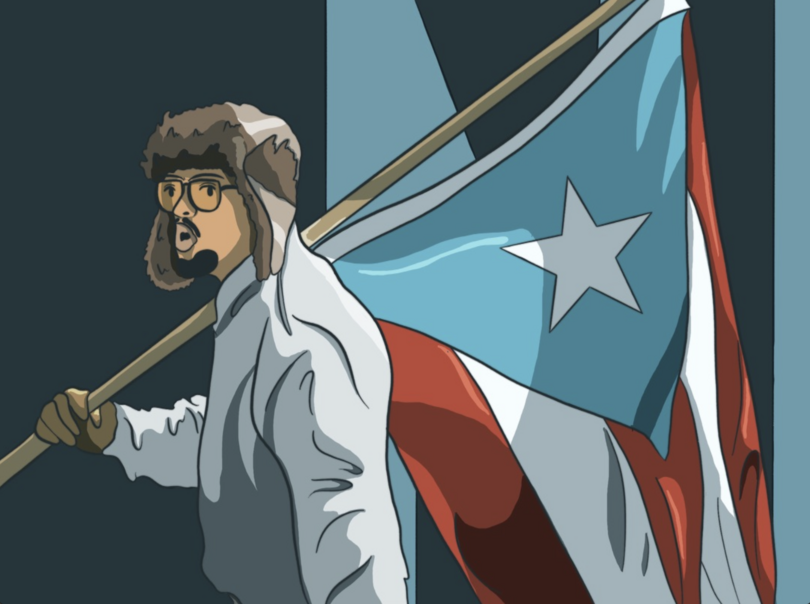
This Sunday, Bad Bunny will perform in the Super Bowl halftime show. Some Syracuse University students believe the performance offers heightened visibility to the Latino community. Maria Masek | Contributing Illustrator
Get the latest Syracuse news delivered right to your inbox.
Subscribe to our newsletter here.
This Sunday, millions of viewers across the globe are expected to watch Super Bowl LX. Watch parties around the country are being planned, not only for the game between the Seattle Seahawks and New England Patriots, but also for Bad Bunny’s halftime performance. At Syracuse University, students are planning their own watch party: Watch Party Benito Bowl.
“We’ve had our moments on this stage before, but I think this one is going to be nothing like before just because he is going to be singing in our language, in our accent, and that’s like the biggest thing to have,” said Sarah Torres, vice president of the Puerto Rican Student Association and SU senior.
In October, Bad Bunny, who won several Grammys Sunday, was announced as this year’s Super Bowl halftime performer, which prompted backlash from the President Donald Trump administration and other right-wing organizations. Many Latino students at SU said Bad Bunny’s halftime show offers heightened visibility to the Latino community.
Some SU students, like Jesús Tiburcio Zane, SU junior and La L.U.C.H.A. president, and Torres have been fans of Bad Bunny since his breakout in 2017, while others became fans during the pandemic.
Cesar Barrera, SU junior and Mexican Student Association treasurer, got involved with MEXSA and La L.U.C.H.A. his freshman year; it made him feel like part of a community after some difficulty adjusting in his first year, he said.
Having shared spaces where community is embraced has been essential for Latinos at SU, Barrera and Valeria Martinez-Gutierrez, co-founder of Latine Honors Society, said. It’s a large part of why Martinez-Gutierrez created the Latine Honors Society during her freshman year.
“These were all places of belonging that I felt like didn’t exist before because they really didn’t,” Martinez-Gutierrez said.
Martinez-Gutierrez and SU junior Sofía Peralta, both said it isn’t just Bad Bunny’s musical talent that they admire, it’s how politically vocal he is.
“Bad Bunny really highlights the issues systemically and politically,” said Tiburcio Zane. “Specifically with gentrification, capitalism, classism, colorism… there’s a lot of intersectionality of what Bad Bunny is referring to.”
Since Trump’s inauguration in 2025, Torres said it has “been consistently worse” to be a Latina in the United States. Going back to his first term in 2016, it has been difficult to see Latino people treated differently because of their immigration status or Spanish language, Torres said.
But Jasmine Padilla, SU junior and co-events coordinator of La L.U.C.H.A., doesn’t feel any sense of diminished pride, she said. Rather, it has only triggered her to be louder about her pride in Latino culture.
Barrera said he not only bought into Bad Bunny’s politics, but he believes that’s part of what fuels his popularity.
“I think Bad Bunny is the most popular Spanish-speaking artist in the world right now because he’s not afraid to voice his opinion,” Barrera said.
Bad Bunny has spoken out about the operations of U.S. Immigration and Customs Enforcement before. One of the reasons he omitted any U.S. stops on his “DeBÍ TiRAR MáS FOToS” World Tour was due to the concern of potential ICE raids at his concerts.
On Sunday, when Bad Bunny received a Grammy Award for Best Música Urbana Album for “DeBÍ TiRAR MáS FOToS,” he began his acceptance speech with “ICE out.”
“We’re not savages, we’re not animals, we’re not aliens. We are humans, and we are Americans,” Bad Bunny said in the speech.
He went on to win the most coveted award of the night — Album of the Year — which he accepted almost entirely in Spanish.
When Bad Bunny was first announced as the halftime performer, the U.S. Department of Homeland Security had announced that ICE would be present at the Super Bowl. Padilla said she believes that ICE’s potential presence at the big game is unnecessary and politically motivated.
“I think it’s a form of intimidation which is really frustrating because any stadium already has high profile security… it’s 100% intimidation,” Padilla said.
Given that the cheapest Super Bowl ticket is over $6,600, Martinez-Gutierrez doesn’t think it makes sense that ICE would be there, given the fact the three most common industries for undocumented migrants consist of lower-wage manual labor.
Though ICE now has no plans to conduct immigration enforcement at the Super Bowl, both Tiburcio Zane and Martinez-Gutierrez specifically believe Bad Bunny’s performance will be political regardless, similar to Kendrick Lamar’s performance last year.
“Everyone in the world is gonna hear from a person from this community at this level kinda call out the system and everything going on right now,” Tiburcio Zane said.
DHS is not the only government entity to touch on the upcoming performance. President Trump has strongly disapproved of the NFL’s choice to headline the performance.
“All it does is sow hatred,” Trump told the New York Post on Jan. 24, calling it a “terrible choice.”
The students unanimously disagreed with the President’s comments, with many noting how “typical” this behavior is from Trump. Turning Point USA, the political organization founded by the late Charlie Kirk, announced an alternative halftime show headlined by Kid Rock. Senior Mateo Lopez Castro called the alternative halftime show “ridiculous.”
“It’s going to get under 100,000 views,” said Martinez-Gutierrez when referring to how many viewers Turning Point’s show will draw.
Last year’s halftime show drew in over 130 million viewers worldwide. The last three halftime performances have drawn in at least 120 million viewers, a potential nine-figure viewership number for Bad Bunny ahead.
While some students are grateful that Bad Bunny’s using his platform to speak out against forms of oppression inflicted on Latino peoples, Lopez-Castro is adamant about being cautious around how this event could be framed.
“I think reducing the struggle of immigration to this moment for the Super Bowl is really counterproductive,” Lopez Castro said.
Lopez Castro is still thankful for Bad Bunny using his platform, but he said he doesn’t think the performance will be a catalyst for change on its own; Bad Bunny is a helper in this movement, not the driver.
Some students will attend the watch party hosted by La L.U.C.H.A., Puerto Rican Student Association and Latine Honor Society, while others who are abroad will watch it in the early morning hours at their local pub. Wherever the students are watching, millions will tune in to an American citizen from Puerto Rico performing in Spanish on one of the nation’s biggest stages.
“There’s nothing more American than being an immigrant,” Peralta said.
Disclaimer: Valeria Martinez-Guitterez and Mateo Lopez Castro are columnists for The Daily Orange. Their affiliations did not impact the editorial content of this story.