Opinion: Critics only reward horror for rejecting its own genre

Only eight horror films have been Oscar-nominated in 97 years. The genre is taken seriously only when retitled, our columnist argues. Sarah Yudichak | Contributing Illustrator
Get the latest Syracuse news delivered right to your inbox.
Subscribe to our newsletter here.
On Jan. 22, Ryan Coogler’s “Sinners” broke Oscar records with 16 nominations, including a Best Picture nomination. While this milestone may signal a long-overdue shift, it also reveals a deeper problem within the entertainment industry.
In its 97-year history, only eight horror films have been nominated for Best Picture, and only “The Silence of the Lambs” has won. Historically, horror is rewarded for how successfully it distances itself from the genre.
When Louis B. Mayer first founded the Academy of Motion Picture Arts and Sciences in 1929, he sought to create an unbiased, all-inclusive awards show celebrating excellence in film. But, almost a century later, one genre still stands on the outskirts of that celebration: horror.
The horror films awarded by the Academy are rarely discussed as horror at all. “The Silence of the Lambs” is framed as a detective story. “Black Swan” is framed as a psychological drama. “Get Out” is praised as a satirical political black comedy that offers sharp social commentary. “The Substance” was praised for its critique of the beauty standards imposed on aging women in the entertainment industry. Horror is an afterthought in these films. They aren’t honored for being horror; they are honored for transcending it.
This demonstrates a clear hierarchy of genres within the Academy. Horror films are routinely shut out of major categories, and recognition is often confined to technical achievements such as makeup, sound or visual effects. So, while horror may be impressive on a craft level, it’s rarely considered worthy of serious artistic recognition.
“For decades, those kind of films have dominated the ceremony: Long dramas about weighty issues, biopics of celebrities, or narratives about moviemaking, with a dearth of genre movies, domestic narratives and stories told by women and people of color,” David Sims, a staff writer at The Atlantic, wrote.
Horror stories, which prioritize thrill and fear, have never fit neatly into that tradition. Because of this, the genre remains invisible in the Academy’s most prestigious categories, regardless of how innovative or influential it is. The Academy’s institutional bias has defined the awards show for nearly a century and has systematically pushed horror to the sidelines for not following its idea of prestige.
Now widely regarded as one of the most influential films ever created, Stanley Kubrick’s 1980 adaptation of “The Shining” was completely shut out of the Oscars. It received no nominations in any category. Instead, the Golden Raspberry Awards, known as “Razzies,” nominated Shelley Duvall for Worst Actress and Stanley Kubrick for Worst Director. The Razzies’ founder Maureen Murphy has since publicly expressed regret over this decision.
The Washington Post dismissed the film as a ponderous, lackluster distillation of Stephen King’s novel, arguing that Kubrick seemed more focused on production design instead of characterization, tension, fear or meaning. The very qualities criticized at the time – the slow pacing, severe tone and visual emphasis – are now considered key to its lasting impact.
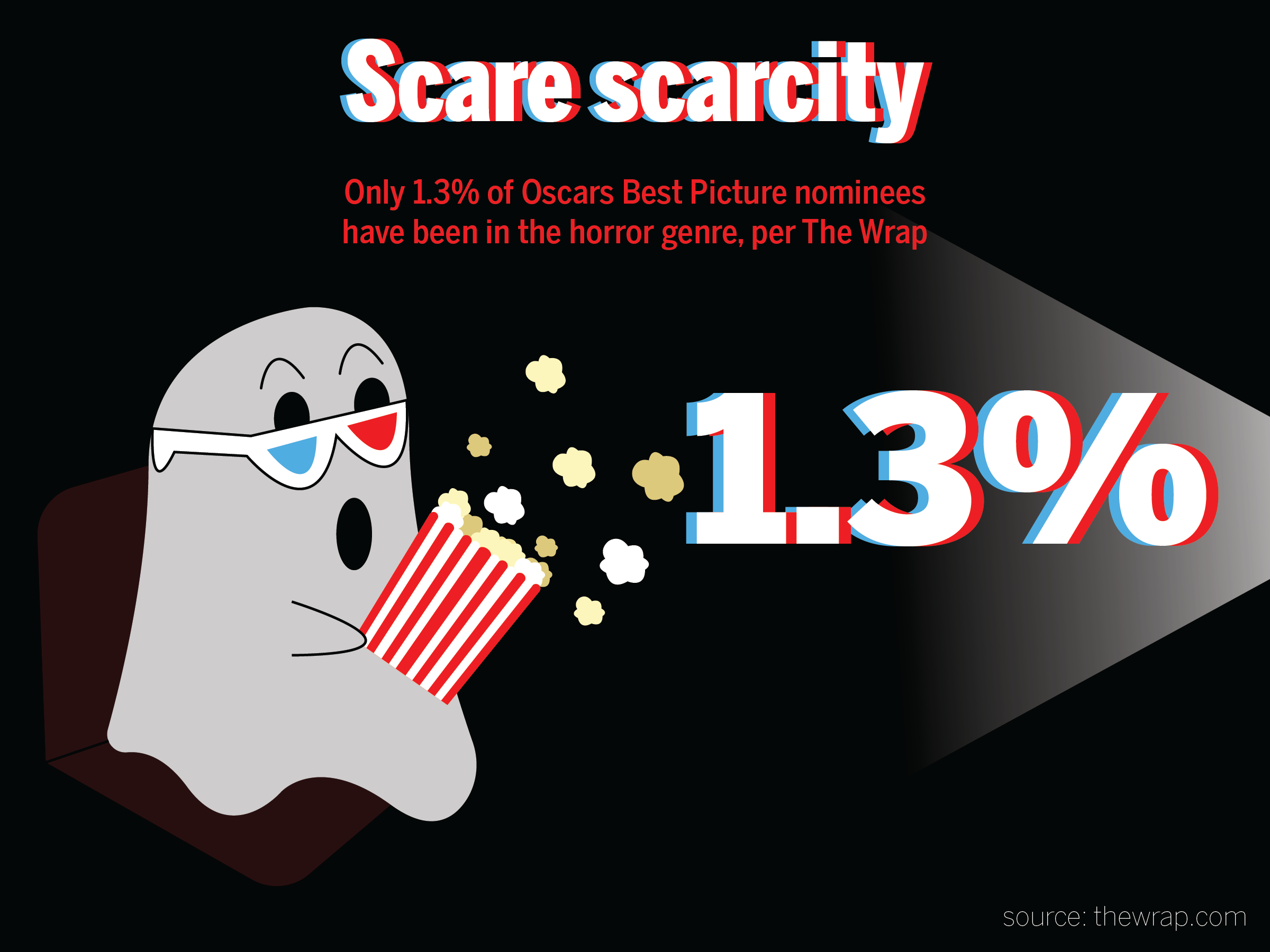
Zoey Grimes| Design Editor
Rather than rejecting horror outright, the Academy has imposed a restricted idea of how the genre is allowed to succeed. When horror does break through, it does so under strict conditions.
Fear must have an intellectual justification, violence must have a symbolic meaning and discomfort must have psychological or social relevance. Horror has to align itself with genres the academy already prizes. When horror exists purely to terrify audiences, it’s typically sidelined to technical categories or ignored altogether.
Critics’ narrow recognition of “Sinners” only discusses narrative and sociopolitical themes. Yet again, the horror elements are framed as secondary, which is precisely the pattern the academy has historically imposed: horror is celebrated when it can be translated into the language of prestige.
The tendency reflects the Academy’s long-time attraction to “Oscar Bait”: Films engineered to align with the narrow-minded idea of what’s considered serious. The Academy rewards the appearance of seriousness – something that horror needs to borrow in order to win – which is why it often recognizes horror stories with allegories or social critique.
The praise for “Sinners” doesn’t prove that the Academy has embraced horror. While the film’s nominations are historic and thrilling, highlighting how horror can carry complex themes and storytelling, the reception reflects a long-standing trend: The genre often gains prestige only when paired with social narratives the Academy traditionally prizes.
If the horror genre is only taken seriously when it’s disguised as allegorical, political or dramatic, then critics and audiences must change the language used when discussing it. The continued lack of inclusion on award stages undermines the genre’s cultural significance.
Collectively, we must label horror as horror, rather than a genre that needs to be translated into another to be taken seriously. And I don’t believe horror should have to disguise itself to be deemed worthy.
Navya Varma is a freshman majoring in political science. She can be reached at navarma@syr.edu.