Opinion: Micron megafab will strain Syracuse communities, electrical grids
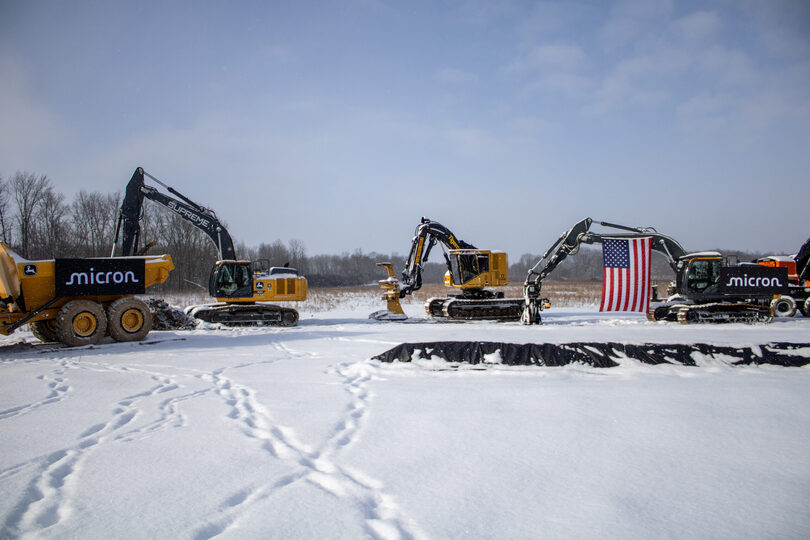
The economic benefit Micron will bring to central New York may not be as plentiful as some think, our columnist writes. She argues the money invested in Micron should have been poured directly into Syracuse communities. Leonardo Eriman | Senior Staff Photographer
Get the latest Syracuse news delivered right to your inbox.
Subscribe to our newsletter here.
On Jan. 16, a local advocacy group in Syracuse filed a state lawsuit against Micron Technology to address concerns of potential environmental and local impacts of the company’s planned “megafab” – an $100 billion investment in a semiconductor fabrication plant meant to supply growing demand for artificial intelligence and memory chips.
Many New York officials have hailed the investment as revolutionary, with Micron promising to deliver over 50,000 jobs to New York through the investment. This fabrication plant will consist of four facilities, with the first set to be finished by 2030 and the remaining three by 2040.
But, this huge development will place a major strain on the surrounding area’s resources, especially through electrical grids. Research found the water wasted by Micron will be monumental, totaling up to 48 million gallons daily. Tech companies seem to have no problem exploiting natural resources despite major concerns raised by local environmental groups.
Micron would be another example of a multibillion-dollar technology company sacrificing our planet and quality of life for the sake of profit. In the past few years, companies like Meta and Google have completely stripped American residents of potable water. Syracuse residents are attempting to hold Micron accountable through lawsuits, but the campaign has not yet seen significant results.
While the project promises economic benefits, many residents and environmental groups remain skeptical of the plan, and rightfully so. The rise of AI is culpable in environmental damage and water waste, with towns located near AI data servers losing access to clean drinking water.
As a country, we have prioritized profit and competition over our daily quality of life. There is no reason U.S. citizens, one of the richest nations in the world, should lack access to clean water. Time and time again, we choose to sacrifice natural resources in the name of ease and innovation.
People are quick to overlook the environmental damage caused by AI. For example, large data centers can consume millions of gallons of water a day, using the same amount as a small town. Most people are well aware of these consequences, they just don’t care. The exploitative process of mining raw minerals has also yet to be a deterrent in the increasing demands for the chips that Micron and other companies produce.
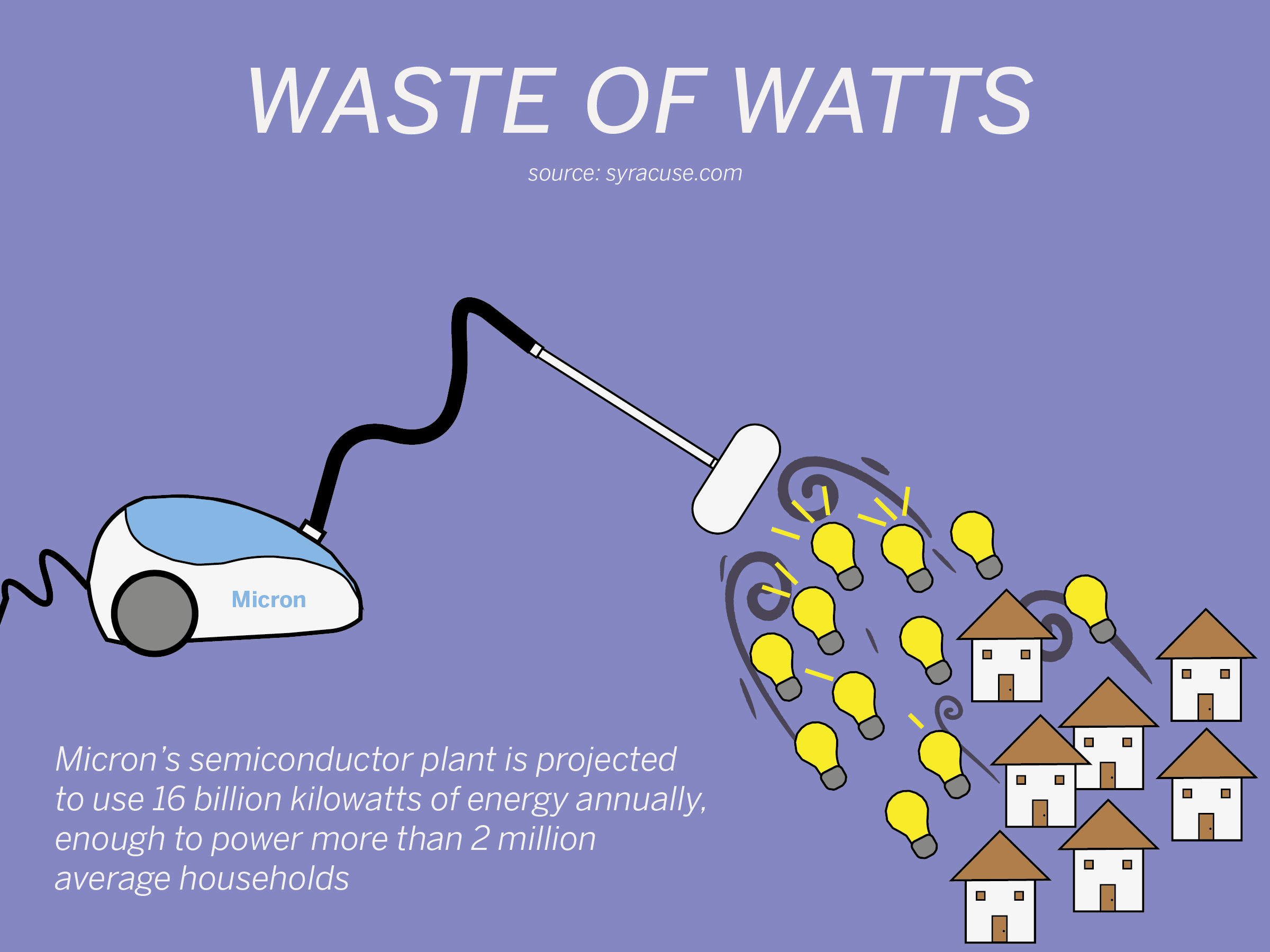
Ilyan Sarech | Design Editor
The construction of such a huge plant will not be a cure-all for central New Yorkers. Micron and Gov. Kathy Hochul have emphasized the project’s potential to spur economic prosperity in central New York, a region that has long struggled with high poverty rates and population decline.
Yet the reality is a new multibillion-dollar complex will not resolve central New York’s economic challenges. Unemployment in the region isn’t driven by a job shortage – research shows there are more open positions than unemployed workers in the area.
Gov. Kathy Hochul and Micron’s assurances that this facility will bring prosperity and population growth seem empty when they have consistently failed to deliver on improvements to CNY’s quality of life.
Population issues could be addressed just as effectively and more sustainably. If more attention was given to improving schooling and social services, both of which are facing budget cuts this year, we might actually see people move back. New York state has $100 million to give to Micron but no money for the residents who have been in Syracuse for decades.
Another major concern is that there seems to be nothing binding Micron to its commitments. Multiple labor unions have expressed a desire for the government to create legal contracts so that Micron delivers on its promises.
Micron has presented sustainability as one of its most important priorities and delivered a detailed report on how it plans to address environmental concerns, but it left many groups unsatisfied with its answers. The company has significantly downplayed the effects the plant will have on surrounding wetlands, as well as how much greenhouse gas will be emitted, according to environmental groups.
Building this megafab will only exacerbate the issues families are already facing, such as environmental racism and economic inequalities. Micron could address these issues and improve the conditions for locals but we need to hold them accountable.
We need to seriously start questioning if this technological revolution is worth it. We don’t need more facilities like the one Micron aims to build. We need to refocus on the residents who have been neglected for so long.
We each have a decision to make as consumers and as citizens. We can continue to exploit our planet and communities for the sake of profit, or we can start to make more mindful choices and consider the real cost of our actions.
Helena Sauriat is a sophomore majoring in journalism and history. She can be reached at hrsauria@syr.edu.