Opinion: Use AI responsibly, put communities before convenience

AI is now widely used by students and staff at Syracuse University, making tasks faster but bringing serious costs. Our columnist argues its environmental and social costs demand responsible use, not blind convenience. Hannah Mesa | Illustration Editor
Get the latest Syracuse news delivered right to your inbox.
Subscribe to our newsletter here.
On Sept. 24, 2025, Syracuse University became one of the first universities in the country to deliver institution-wide access to the generative artificial intelligence tool Claude through a partnership with Anthropic.
A 2026 study revealed that 86% of students use generative AI in their studies, with ChatGPT cited as the most widely used tool. It’s undeniable that generative AI makes routine tasks easier to complete. With a few prompts, students can draft a professional email, summarize a reading or produce AI-generated “art” for social media and entertainment.
Beyond the classroom, AI is also advancing important missions, from beehive pattern recognition strengthening interventions to save the endangered bee population to reading radiology imaging in health care.
But, as a humanities major, it’s bizarre to see how quickly AI has transformed course syllabi, assignments and classroom engagement. Professors I had as a sophomore — and now again as a senior — have been forced to rethink how they conduct tests and assignments to combat AI usage, encouraging material retention and critical thinking. In some cases, this has meant a return to paper tests and technology-free classrooms to prevent students from outsourcing their thinking to AI.
But what we don’t see is the cost.
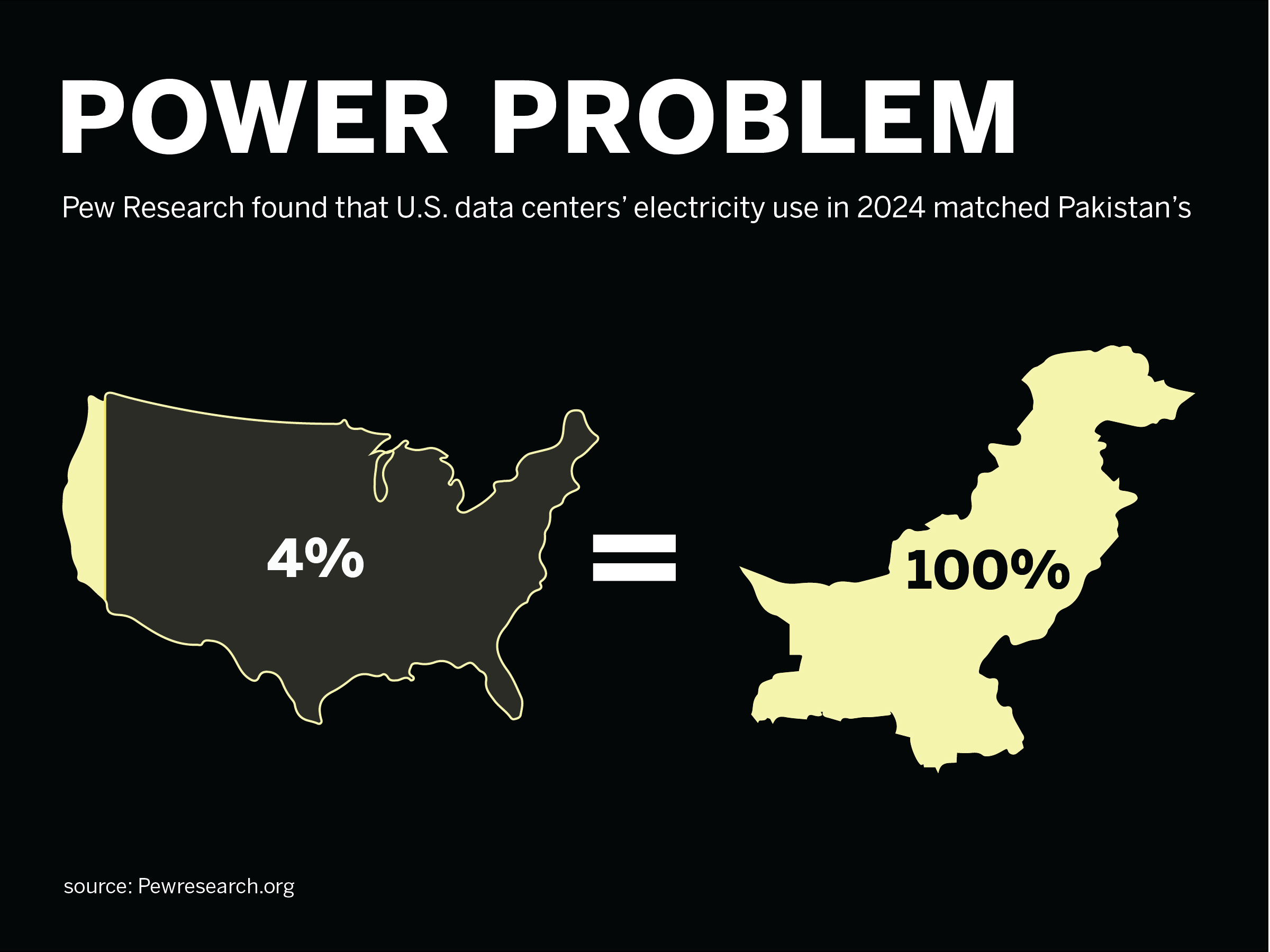
Generating a single 100-word email with ChatGPT-4 requires more than one bottle of water. Generate that email once a week for a year, and water use can total roughly 27 liters. Data centers, which power AI systems, are among the largest water users in the communities where they operate. Facilities that rely on energy-intensive cooling systems also drive up local power bills and strain already oversurged electricity grids. Electricity costs for areas near data centers have increased by as much as 267% over the past five years.
Adding more harm to injury, Cornell researchers found that by 2030, steady annual AI growth rates would annually put 24 to 44 million metric tons of carbon dioxide into the atmosphere. This abhorrent amount of emissions equates to adding 5 to 10 million cars to United States roadways.
From chip manufacturing to operation, data centers substantially degrade air quality and harm public health. These massive facilities strain already stressed power grids while producing fine particulate matter air pollution. By 2028, this pollution is projected to result in up to $20 billion in respiratory-related health costs in the U.S.
Micron Technology’s planned semiconductor plant in Clay, for example, is projected to need 48 million gallons of water a day. Providing that much water to the Micron plant would require the construction of a pipeline from Oswego to Clay which would cost $100 million, and it’s unclear how much taxpayers would be responsible for. Beyond the water consumption, projected electricity consumption is as much power as Vermont and New Hampshire combined, according to the New York Rural Water Association.
The growing demand for AI is projected to contribute to approximately 600,000 asthma symptom cases and 1,300 premature deaths in that same year, exceeding one-third of all asthma deaths in the U.S. annually. If data centers emit air pollutants at the maximum permitted level, the total public health cost will reach $2.2 billion to $3 billion per year, a study by UC Riverside and Caltech scientists found.
These harms aren’t distributed equally.
Environmental racism has historically influenced the racial and socioeconomic disparities in health outcomes in the U.S. through the violent legacy of redlining, and the distribution of data centers follows that same pattern.
Katie Crews | Design Editor
In Memphis, for example, the Colossus facility is slated to become the world’s largest supercomputer, designed to power and train Elon Musk’s AI chatbot, Grok. The facility is located in a low-income, predominantly Black community with historically high rates of pollution-related illness and disproportionate exposure to industrial pollutants.
Colossus is expected to consume enough electricity to power approximately 100,000 homes. Its methane gas turbines are projected to increase Memphis’ smog rates by 30-60%, emitting planet-warming nitrogen oxides and toxic formaldehydes linked to respiratory and cardiovascular disease around the clock.
“It’s no coincidence that if you are African American in this country, you’re 75% more likely to live near a toxic hazardous waste facility,” said Tennessee State Rep. Justin J. Pearson in an interview with Democracy Now.
Time and again, predominantly Black communities are unfairly targeted for the interests of power and wealth.
Much like the development of an addiction, the instantly gratifying results generated by AI can segway into an all-consuming reliance on solving problems or completing tasks. Studies have shown that frequent AI use can erode critical thinking while simultaneously harming the environment and communities through the energy-intensive lifecycle of data centers.
Distance from the immediate repercussions of AI use desensitizes us. We don’t see the water drained, the air polluted or the communities sickened. That distance conditions us to keep using it without second thought.
This issue isn’t mutually exclusive to students. An estimated 57% of the general public is reported to use AI for personal purposes. I’ve witnessed AI turn into a crutch, and while it can be a useful tool, it doesn’t exist in a vacuum. It must be used responsibly.
If we are spending almost $95,000 a year on our education, it’d be an irresponsible investment and a disservice to our careers to overrely on AI.
As economic polarity grows further apart and the climate crisis worsens, the question isn’t whether AI is useful. It’s whether convenience is worth the cost — and who’s forced to pay it.
The next time you’re prompted to renew ChatGPT premium or simply ask it to write an email or summarize a reading, pause and consider whether it’s truly necessary. Ask whether you can spare the time to do it yourself — for your sake and for the communities bearing the weight of our convenience.
Valeria Martinez-Gutierrez is a senior majoring in geography, sociology and environment, sustainability and policy. Her column appears bi-weekly. She can be reached at vmarti10@syr.edu.