Senators move to reevaluate ‘Idea’ language, cite shared governance concerns

SU senators introduced a motion to require the administration’s revisions to the IDEA requirement to be reviewed and approved. Christian Calabrese | Staff Photographer
Get the latest Syracuse news delivered right to your inbox.
Subscribe to our newsletter here.
Syracuse University senators introduced a motion calling for revisions to the “Idea,” formerly “IDEA,” requirement to be formally reviewed and approved by the University Senate at its regular monthly meeting.
The motion, brought forward by humanities professor Harvey Teres and history and political science professor Margaret Susan Thompson, calls for changes to be submitted to the senate for debate and a vote.
Over the summer, the university removed more than 160 words from the IDEA course description and revised its “shared competency” language, eliminating explicit references to diversity, equity, inclusion and accessibility. SU also changed the requirement’s title from “IDEA” to “Idea” in the course catalog.
This change followed the closure of SU’s Office of Diversity and Inclusion, as well as efforts from President Donald Trump’s administration to eliminate DEIA language in higher education.
Administrators previously said the changes did not affect students’ course obligations, learning experiences or outcomes. At Wednesday’s meeting, Teres said the proposal centers on governance rather than the substance of the revisions.
“The merits or the limitations of the changes are not at issue in this motion,” he said. “What is at issue is whether the senate has the right to debate them.”
The proposal argues the revisions are “curricular in nature” and therefore fall under senate jurisdiction and the formal review process required by shared governance.
The motion cites SU’s inclusion of the American Association of University Professors’ 1940 Statement of Principles on Academic Freedom and Tenure in its faculty manual, stating academic freedom “requires the faculty’s collective authority over the curriculum.”
Thompson told The Daily Orange Wednesday night the senate has not yet received the official vote email, emphasizing that members typically have several days to a week to respond.
Provost Lois Agnew told the senate the administration changed the requirement’s catalog description, not the requirement itself. She added that because the Provost’s office drafted the original language, her office took the lead on the revisions.
Teres disagreed with the distinction.
“Anybody who looks at the old version of the Idea requirement and the new version will see substantive changes,” Teres said. “To suggest that the course catalog description is not actually the requirement is bewildering to me.”
Senator Sam Gorovitz said the revision should be understood within the broader context of recent university changes, including adjustments to shared competency language and other academic restructuring decisions.
“This specific change is a change that would convey a very different impression to prospective students and to parents about what the university cares about and is up to,” Gorovitz said, noting families often use the course catalog to understand SU’s curriculum.
During discussion, Teres accused the administration of revising the requirement “in response to the Trump administration’s threats and extortion,” saying the university “acted to protect SU” but that the senate should still have been involved in the process.
“What faculty teach and how they teach it … must be determined by educational goals alone, as determined by both faculty and administration working conjointly,” he said. “Not by outside economic or political interests that may pressure university administration to sometimes overstep their legitimate authority, even with the best of intentions.”
Thompson, who co-chairs the senate’s Academic Affairs Committee, said faculty are capable of making difficult academic decisions but must be allowed to do so through established governance.
“We’re interested largely in process,” Thompson said, adding that elected faculty bodies, not only administrators or council chairs, should engage in curricular decisions.
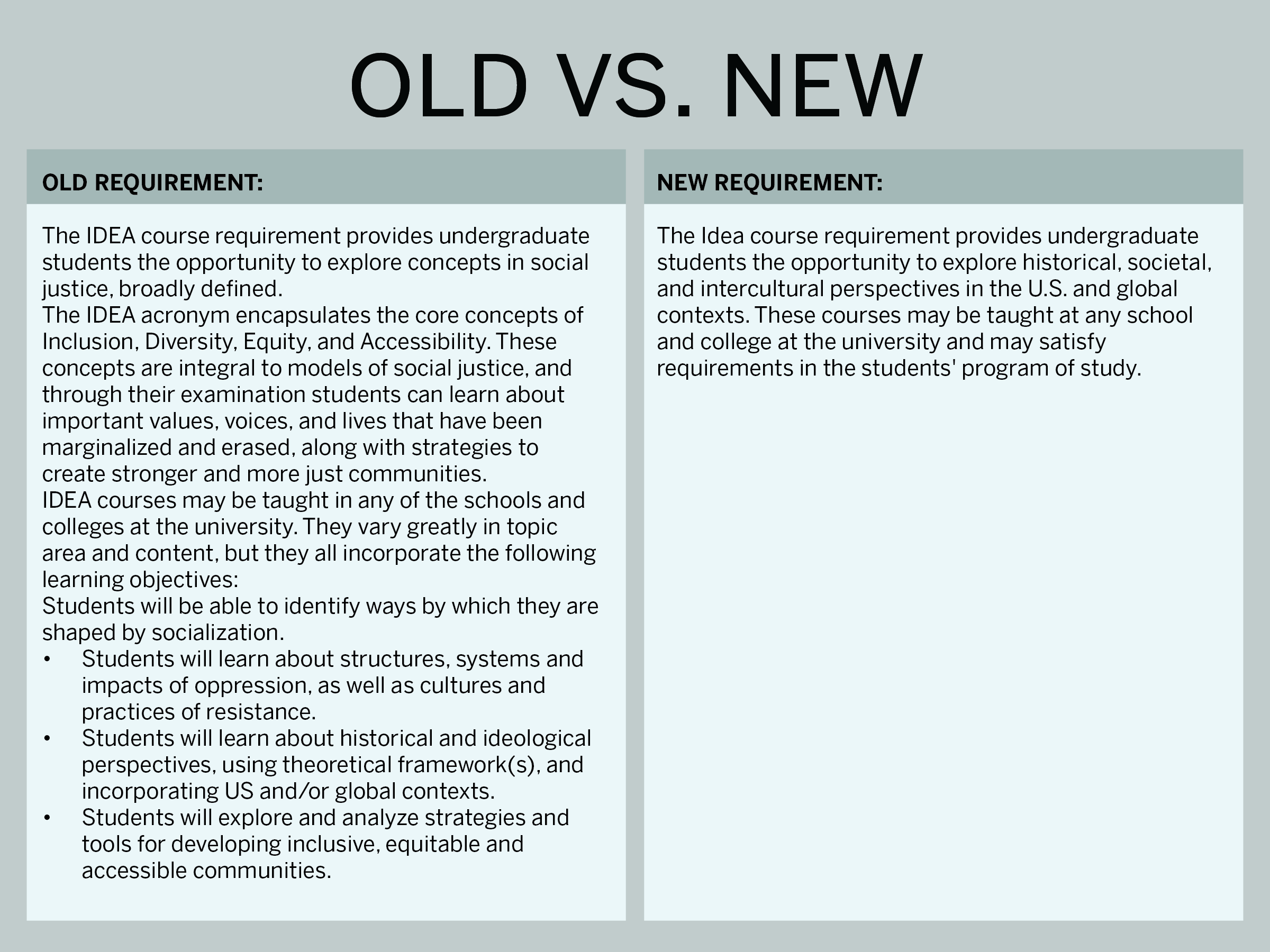
Katie Crews | Digital Design Editor
The formerly titled “IDEA” requirement was developed in 2019 by a University Senate Ad Hoc Committee following the #NotAgainSU movement and was later approved by the senate after consultation across schools and colleges, Teres said. It is embedded in more than 100 courses listed in the university’s course catalog.
Agnew urged senators to consider the Idea discussion within broader institutional pressures, citing declining international student enrollment, rising costs and increased scrutiny of higher education.
“Change is hard,” Agnew said. “We don’t need to interpret change as an existential threat. It is, in fact, part of how academic institutions have survived and flourished across centuries.”
The Wednesday discussion centered on shared governance, academic freedom and faculty authority over curriculum.
The Committee on Curriculum and Instruction moved to approve the entirety of its Feb. 25 curriculum report. The report included 204 new courses, 175 course revisions, 53 course inactivations, two new programs and 63 program revisions for the 2026-27 academic year. The senate voted to pass it.
Senator Tom Barkley, co-chair of the committee, said it is also revisiting the Idea course review process. A subcommittee is examining whether oversight of the requirement should remain within Academic Affairs or be moved elsewhere.
The group has recommended forming an ad hoc committee to conduct a five-year review of Idea and determine which unit should oversee it going forward.
Another curriculum-focused subcommittee is reviewing how schools and colleges handle program changes — including new programs, revisions, pauses and closures — to assess whether procedures are consistent across units.
Concerns about faculty authority were echoed in a report from the Academic Freedom, Tenure and Professional Ethics Committee.
Co-chair Amy Kallander said SU’s ability to address concerns amid “overall threats to academic freedom nationwide” is limited by its “weakening of shared governance.” She cited an “overly punitive approach” to allegations and ongoing coordination challenges with the Office of Equal Opportunity, Inclusion and Resolution Services.
The committee reported 13 investigations this year involving academic freedom, tenure rights and discrimination complaints. After the committee makes recommendations, the administration may accept them in full, reject them or accept portions of them, Co-chair Tom Perrault said.
Questions about faculty representation also surfaced in leadership searches.
Thompson raised concerns about the absence of faculty members on the search committee for a new athletic director and urged that faculty be included in future searches, including for a new dean of Hendricks Chapel. Chancellor Kent Syverud said SU will solicit faculty input and include faculty on the chapel search committee. He said he expects a new chancellor to be announced next month and in office no later than June.
Throughout the meeting, senators repeatedly returned to questions of shared governance and faculty input, particularly in the debate over the IDEA revisions.
“What is essential for faculty governance is that the senate weigh in on the substance of the requirement being implemented,” Teres said. “Our motion seeks faculty-administration collaboration that has unfortunately diminished these past few years. Many of us see a disturbing pattern of unilateral action by the administration — unprecedented in its scope and ambition.”
Other Business:
- In the Q&A portion of Wednesday’s meeting — weeks after senators and attendees raised concerns about Immigration and Customs Enforcement presence and campus alerts during the annual open forum — Teres again asked if the university has a policy for notifying the community if federal immigration agents are seen on campus.
- Syverud encouraged community members who see federal agents to contact the Department of Public Safety, but said Orange Alert is reserved for confirmed safety hazards and is not used to dispel rumors.