
SU faculty, students navigate possibility of ICE on campus
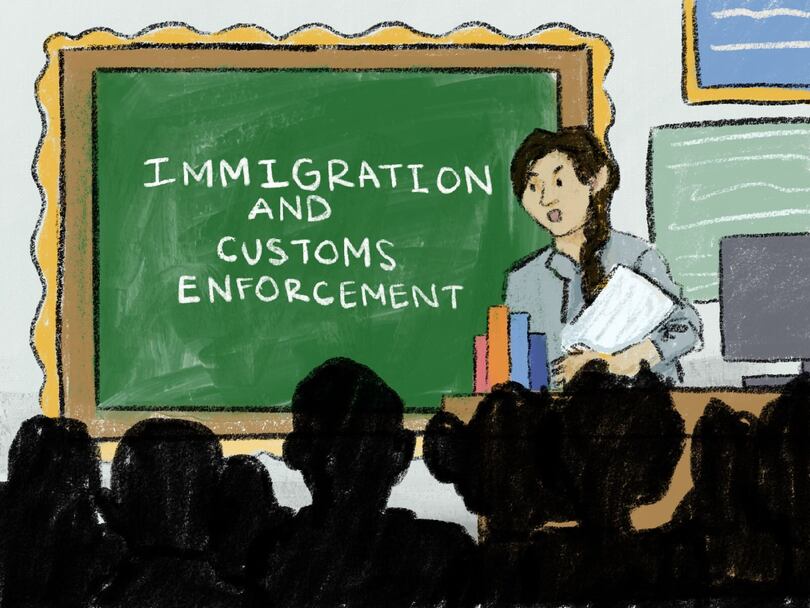
After rumors spread about the presence of officers on SU’s campus, professors and students are navigating how to address Immigration and Customs Enforcement in their classrooms. Emma Lee | Contributing Illustrator
Get the latest Syracuse news delivered right to your inbox.
Subscribe to our newsletter here.
UPDATE: This story was updated Feb. 27, 2026 at 7:03 p.m.
After rumors spread about federal law enforcement officers present on Syracuse University’s campus, several professors and students said they didn’t know how to confirm if the officers were from Immigration and Customs Enforcement.
Posts circulated on the anonymous social media site YikYak that ICE agents were on campus, leaving many confused and scared to attend class. And although the Department of Public Safety later confirmed to media outlets that the officers were U.S. Marshals, not ICE agents, some SU professors said a “lack of transparency” from the university has made campus “unsafe.”
Sarah Miraglia, a professor in the women and gender studies department, said the university should play a direct role in protecting students from ICE and proactively addressing threats and concerns. She said the incident on Feb. 9 directly elicited reactions from her students.
“It provoked a lot of fear and concern on behalf of students that I feel didn’t need to happen,” Miraglia said. “But it was, again, this lack of communication, it just makes you want the university to clarify and to take a stronger stance in its commitments to creating a safe campus experience.”
Margaret Susan Thompson, a professor of history and political science, said the Feb. 9 incident is only one example of professors’ uncertainty regarding ICE. She said one of her students reached out to her a few weeks ago, concerned about a possible interaction with agents, which was also debunked by DPS.
“I was told by the head of DPS and by the university attorney that SU was not cooperating with ICE, which, from my point of view, is good news, but what does that mean?” Thompson said. “Obviously, it’s hard to prove a negative in the case of an imposter, but there needs to be more openness.”
In a Feb. 17 statement to The Daily Orange, Sarah Scalese, SU vice president of communications, said DPS is in charge of responding to reports of federal agents on campus.
“The Department of Public Safety will respond to and manage all such engagements on campus when alerted, including verifying credentials and reviewing any legal documents presented,” Scalese said in the statement. “As always, community members with safety concerns should contact DPS directly.”
Following the Feb. 9 incident, attendees at the University Senate’s open forum voiced concerns and questions related to ICE on campus, including suggestions for campus alerts. However, DPS Chief Michael Bunker didn’t delve into specifics beyond the marshals and a handful of other false reports. .
Thompson said she agreed with a suggestion made at the forum that DPS issue campus-wide alerts verifying claims of ICE agents on campus.
Several professors said a document originating from SU’s chapter of the American Association of University Professors may have been the only — or one of very few — communications regarding SU-specific ICE guidelines and protocols.
The document titled “GENERAL ADVICE for UNIVERSITY MEMBERS confronted by ICE on campus,” obtained by The D.O., contains procedures if ICE attempts to enter university buildings, and orders university members to contact DPS with any ICE-related concerns.
It is unclear who the original recipients of the document were, and if it was originally sent out by SU faculty themselves. SU-AAUP did not respond to The D.O.’s request for comment.
The only direction professors have received in the event of ICE on campus is the single document, Klaver said, which she said was “dense” and not user-friendly. She also voiced concerns about the lack of a town hall meeting or anywhere for those given the document to discuss its content.
The document contains three sections, each referencing a different campus demographic — staff and faculty, international students and “allies and witnesses” — detailing advice and protocols for the specific groups if they are to encounter ICE agents on campus.
It advises not to engage with ICE, if possible, and reiterates an individual’s right not to answer ICE’s questions about name or citizenship.
The document also encourages readers to recognize the difference between types of possible warrants, as well as between public and private locations, in order to prevent legal open access.
The protocol calls for allies and witnesses to “legally bear witness” to public ICE interactions by recording videos or photos with identifiable landmarks and officer badge numbers.
DPS previously addressed concerns regarding ICE procedures during an October Student Government Association meeting. In the conversation, Bunker confirmed ICE had not been on campus, despite four nearby sightings, only one of which was confirmed five blocks off campus. Bunker recommended steps for navigating ICE presence on campus.
Sightings like these are something political science professor Mark Brockway said have been a point of anxiety for students he’s spoken to.
Brockway said he believes there is room for students to voice their thoughts and concerns in a classroom setting, particularly if it is relevant to the lesson. He also said creating a safe environment within the university and the classroom is critical to allowing students to fully engage with their studies.
“You’re not in learning mode, you’re in survival mode,” Brockway said. “And so if you’re waking up in the morning, watching the class, worried that you or somebody that you love might be taken by ICE and deported or detained, then that’s really gonna inhibit your ability to learn.”
As a professor, Brockway said he has become aware of his own role in protecting students and their Fourth Amendment rights, along with the high amount of stress ICE’s national presence has had on students.
“I think at least as a university, we should do everything that we can,” Brockway said. “We should do everything in our power to make them feel as safe as we possibly can.”
Meredith Bruster, a public administration graduate student who also attended the forum, said she is “astounded” at SU’s Maxwell School of Citizenship and Public Affairs’ lack of discussion regarding ICE tactics and broader initiatives.
Bruster sees advocating for peers and receiving her degree in public administration as a “dual role.” She said she has a responsibility to “leverage” her privilege and power for the well-being of her community.
“If we’re not talking about what’s going on in this country and how the federal government is treating people in this country and dismantling the very systems that we’re celebrating in our classes,” Bruster said. “If we’re not talking about this rupture in checks and balances and the targeting of free speech … If we’re not talking about these core issues in a school of citizenship, then what are we doing?”
Coran Klaver, a professor in the English department, advocates against immigration enforcement inside and outside of the classroom. She said she feels like it’s her job to connect students with resources and create a “supportive environment.”
Klaver said she has noticed graduate and Ph.D students feel particularly vulnerable. She advocates against ICE, especially for her students on visas, by protesting downtown and even crafting “melt the ICE” hats that she distributes to the Syracuse Immigrant and Refugee Defense Network.
As a former international student while in graduate school at NYU, Roger Hallas, an English department professor, said he directly related to those concerns.
“I think it creates a difficult environment for student learning and for student teaching,” Hallas said. “A lot of our graduate students are international students, and so they will have anxieties around their status.”
As professors and students continue to navigate ICE in the classroom, SU has affirmed it will keep students and staff safe.
“The University remains committed to supporting all members of our community, including our international students and employees,” Scalese said in the statement.
But Miraglia urges more action from SU, specifically regarding “tangible” changes in university policy. Although she said the university has previously issued statements of support for students, emphasizing a “welcoming” environment, Miraglia said that is not enough.
Bruster said her graduate student cohort is actively involved in envisioning a way to move forward and advocate against ICE, with a main priority to compel the administration to provide more clarity around campus safety.
“Transparency is paramount. Safety is critical,” Bruster said. “Everyone on this campus deserves to feel safe and merits appropriate response to concerns about safety from (SU) administration.”
CORRECTION: A previous version of this article stated that WGS professor Sarah Miraglia said the university “plays a direct role” in protecting students from ICE on campus. This was later rephrased as her actual sentiment, which is that SU “should play a direct role.” The Daily Orange regrets this error.