SUNY touts ESF stability plan, statewide enrollment in annual report
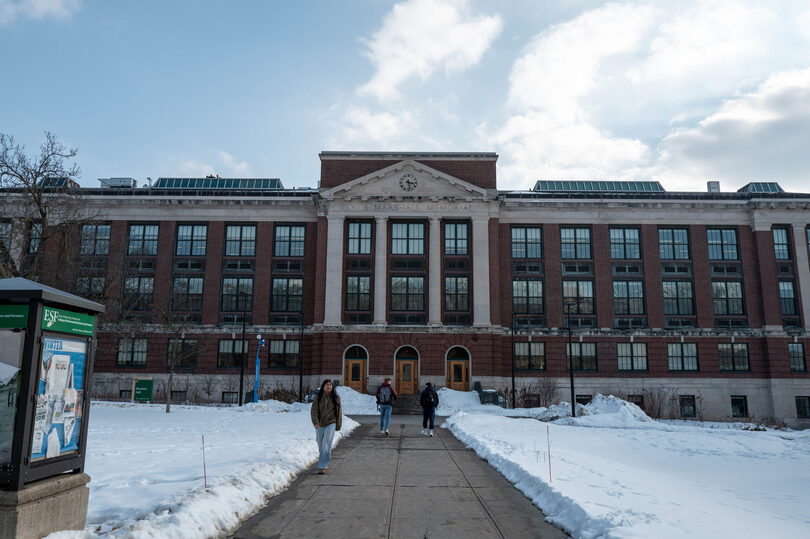
After SUNY faced a $1 billion gap between revenue and expenses in 2024, SUNY now says projects will completely balance its budget by 2034-35. For the first time since 2009, the system has seen three consecutive years of enrollment growth. Tara DeLuca | Assistant Photo Editor
Get the latest Syracuse news delivered right to your inbox.
Subscribe to our newsletter here.
The State University of New York boasted major progress in its statewide enrollment and campus stability plans, including SUNY ESF, in its 2026 Report on Long-Term Enrollment and Financial Responsibility.
The report, released Monday, highlights several areas SUNY has grown over the past three years, including enrollment and graduation rates, research and scholarships, diversity, equity and inclusion, economic development and financial sustainability. SUNY annually contributes $31 billion to the New York state economy, according to the report.
“SUNY is on the move and expanding programs and initiatives to support our students and campuses throughout New York State,” SUNY Chancellor John King Jr. said in a Monday release. “By following our comprehensive plan, and through the strong support and commitment from Governor Hochul, the State Legislature, and the SUNY Board of Trustees, SUNY is delivering on our promise of an affordable and high-quality higher education for all New Yorkers.”
After SUNY indicated the system faced a $1 billion gap between revenue and expenses in 2024, SUNY now projects it will completely balance its budget by 2034-35. The system is expected to continue on this trajectory if it maintains increasing enrollment, state bargaining agreements and maintaining “commitment to fiscal discipline,” according to the report.
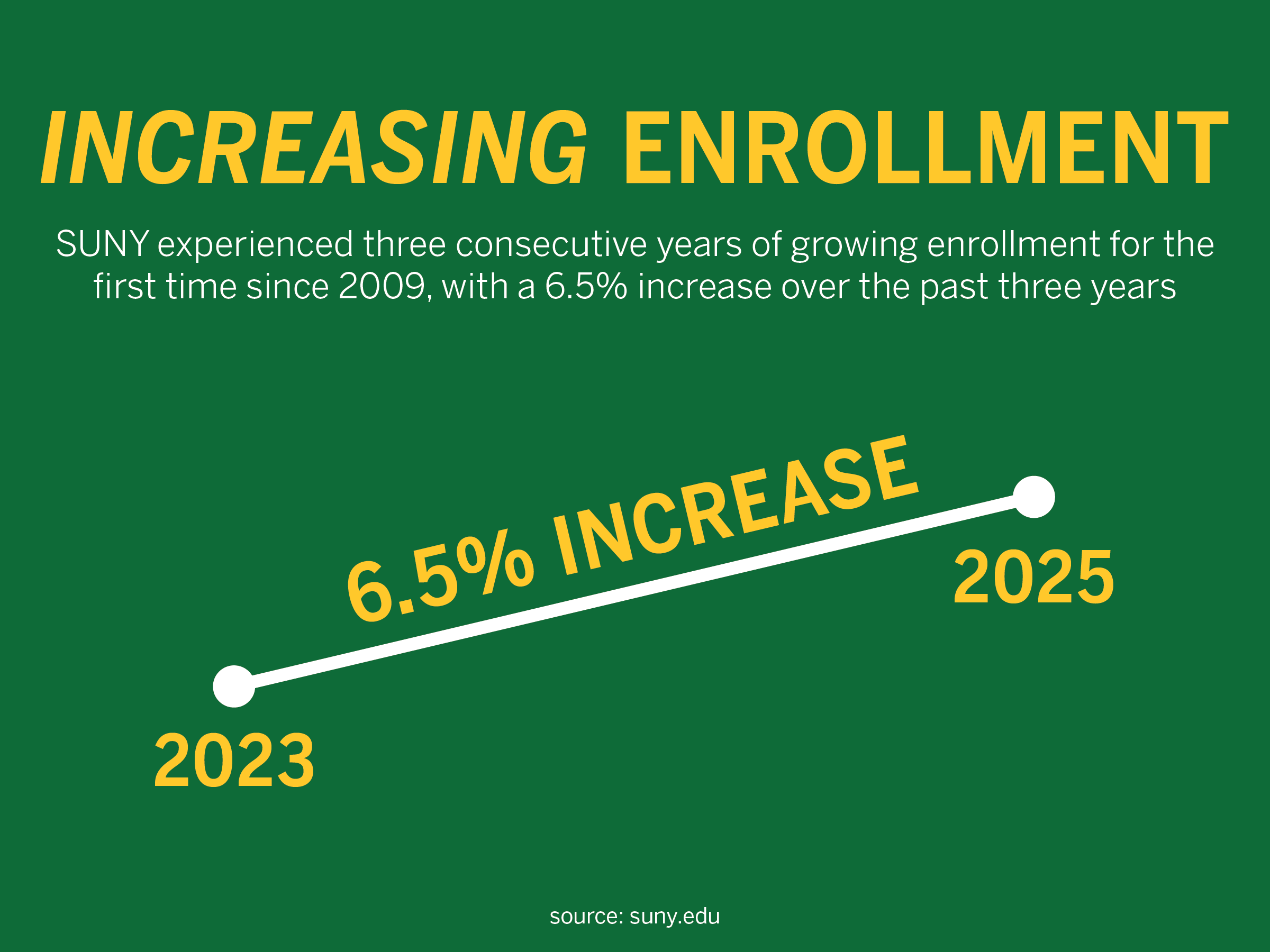
SUNY enrollment increased by almost 3% from 2024 to 2025 and 6.5% over the past three years, according to the report. This is the first time the system has seen three consecutive years of growing enrollment since 2009.
Sophia Burke| Digital Design Director
As part of its Academic Momentum Campaign — a set of goals outlining academic and financial assistance programs — SUNY aims to increase its undergraduate graduation rate. This includes increasing its graduation rate for those earning an associate degree from 19.6% historically to 29%, and its bachelor’s programs’ rate from 54.3% to 60%.
The report also includes a budgetary framework to address the system’s $10 billion critical maintenance backlog, including delayed funding for addressing costly infrastructure emergencies affecting SUNY campuses. The state-wide system owns over 1,800 buildings across all of its campuses, according to the report.
SUNY’s Board of Trustees plans to request more than $1 billion in maintenance funding, which will be allocated toward “shovel-ready” and “emergency avoidance” projects, according to the report.
To address these SUNY funding gaps, the system implemented several “fiscal stability” measures on six of its campuses, including ESF, according to the report. ESF’s fiscal stability plan, released last summer, orders ESF to cut 18.9% of full-time staff while increasing undergraduate enrollment by 16.1% by 2029.
The February 2026 report said the “campus-led” five-year plan aims to advance the college’s “unique and important mission” while also eliminating its structural budgetary deficit. The stability plan was made possible by a 33% increase in state funding by SUNY’s Board of Trustees.
The stability plan has been met with backlash from ESF students, staff and faculty pushing for more transparency in the financial planning process, leading to ESF’s administration developing a stability planning committee to help guide its decisions.
In a Monday statement to The Daily Orange, an ESF spokesperson said the college will receive more direct state aid this year than at any time in its history.
“The report tracks with ESF’s current focus areas,” the spokesperson wrote. “Despite the challenges higher education is up against, it is great to see enrollment growth and continued focus on student retention through new programs and investments.”
The report highlights a $114 million grant from SUNY in May 2025, attributed to New York Gov. Kathy Hochul and the State Assembly. The grant increased state support for “all state campuses” by at least 30%, according to the report.
In its ESF stability plan memo, the report states SUNY plans to “right-size” its graduate scholarships and master’s program stipends to reflect “national norms” while maintaining ESF’s R2 research status — an issue several graduate students voiced concerns about since the stability plan was enacted.
The report also said the stability plan aims to adjust faculty’s courseload to ensure students have “more access” to courses taught by early-career ESF professors, while also “ensuring staff levels are sustainable” by sharing services with other SUNY institutions. Part of ESF’s stability plan is the voluntary separation program, which saw the resignation of about 8% of ESF’s full-time faculty in December.
The plan also aims to reduce the cost of Syracuse University elective courses for ESF students, according to the report. In 2024, students at ESF had to start paying a $1,065 course fee to take 3-credit classes at SU, although they were previously free.
“SUNY’s report highlights the resilience of New York’s broad and diverse university system at a time when higher Ed is facing historic shifts,” the ESF spokesperson wrote. “These shifts are not a surprise, and we’ve seen them in corporate hiring, workforce development, as well as a smaller population of traditional college age students.”