Jordan Blouin’s ringette roots helped her become 1st-line forward at Syracuse
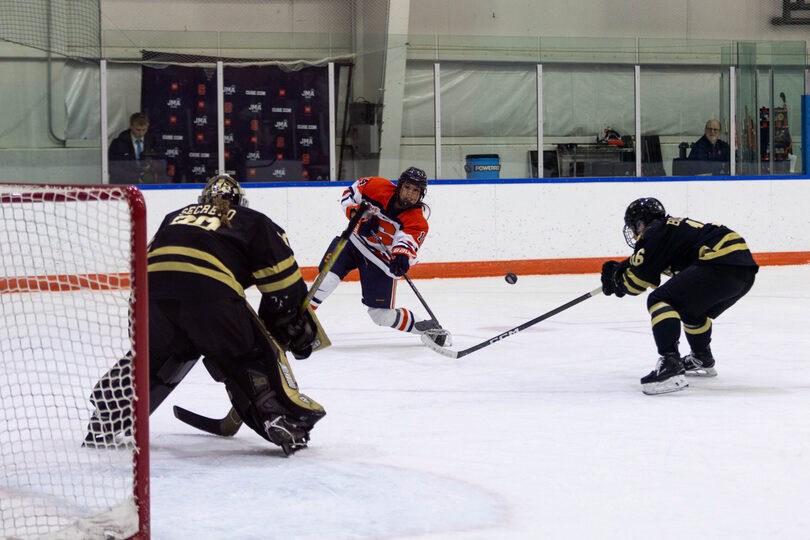
Jordan Blouin developed unparalleled speed chasing a ringette ring. Now going after a puck at Syracuse, her intense skating style hasn’t changed. Tara Deluca | Asst. Photo Editor
Get the latest Syracuse news delivered right to your inbox. Subscribe to our sports newsletter here.
A stick, a puck, skates, warm clothes, music and a headlamp. Maybe a camera, too. It wasn’t a far trip. Just a few steps outside on Arbour Lake in Calgary, Alberta.
The sun wouldn’t be out for long in the gelid biome. The floodlights shut off at 10 p.m. Time to strap on the headlamp. With the clock in her rear view, Jordan Blouin knew she’d be on the ice for a while.
There wasn’t much to do during COVID-19. Blouin’s upcoming hockey season with the Calgary Fire was in jeopardy. How could she get herself on tape? After all, colleges needed to see her development ahead of her recruitment.
Blouin remained on the pond for hours. When it was bright enough to record herself, she posted highlights to her YouTube channel, skating as fast as she could, showcasing the speed she acquired chasing a rubber ring in her ringette days.
Without ringette, Blouin doesn’t fulfill her potential. But she made an important decision to switch to hockey when she was 10, setting her up to become a first-line forward at Syracuse as a freshman. Tied as its third-leading scorer, it’s that same blazing speed that has molded her into a force in Atlantic Hockey America.
“Skating is one of my strengths in hockey, and I have to give credit to ringette,” Blouin said. “If I didn’t play ringette, I wouldn’t be as fast as a skater.”
Ringette, a non-contact version of hockey originally created for girls, is seen as a tame sport. The objective is the same — scoring goals — but instead of pucks, ringette uses rings that players must put in the net. The game allows players to develop their speed chasing rings, since there are no offsides or icing rules.
Blouin’s mother, Jamey Miles, recalls her daughter’s “fast and aggressive” playstyle for Northwest Ringette. But Blouin could only develop her skating technique with minimal focus on handling the pneumatic disk, Miles said, because of its size and increased friction.
That gave Blouin the opportunity to work on her speed. Her father, Michael Blouin, remembers her chasedowns from each end of the ice to capture the ring. She had no problem dominating the sport without icing or offsides, but her ceiling was capped.
“There wasn’t a lot of future in ringette,” Michael said. “It seemed like a good time to move on.”
No matter what Blouin played, that speed was a fixture of her game. In fact, switching to boys’ hockey with the McKnight Mustangs didn’t faze her bruising skating style.
“She definitely held her ground,” said Shannon Pearson, a childhood teammate who now plays at Cornell. “She put the boys in their place.”
Blouin wanted more, though. Ringette and boys’ hockey wouldn’t bring her game to the next level. So, she made another pivotal transition to girls’ hockey.
Zoey Grimes | Design Editor
Miles and Michael hired a personal trainer, Bryn Argue, the Director of Hockey Operations at Bandits Hockey. Blouin hopped in on one of his sessions with Liam Magnuson, her McKnight teammate, and Argue realized she could be his next project, admiring her arduous but full-bore skating approach.
“Jordan was a diamond in the rough. She was exceptionally fast,” Argue said. “She’d slam her skates down hard. It’s unique. You only see a couple guys do that in the NHL. The biggest comparable is Nathan MacKinnon.
“Ringette does lend itself to good skaters and having good speed,” he added. “I can definitely see it coming from there.”
Argue figured out the tools to take his prodigy’s game to the next level. When it was time to put Blouin’s skills to the test, COVID-19 hit. But the vacant time became a blessing in disguise for Blouin and Argue, allowing them to keep at their work.
Biweekly sessions turned into weekly ones, which then turned into three times a week. Michael jokes Argue was supposed to train Blouin for just an hour, but often stayed for three because of how much fun Blouin had.
When each session ended, Argue would skate off the pond to greet one of Blouin’s parents. They’d chat while Blouin remained on the ice, by herself. She’d be getting her headlamp and electric lanterns to prepare for the night, despite her parents’ disavowal.
“When it’s minus 20, I’m like, ‘Your feet are gonna freeze off,’” Miles said. “Otherwise, she’d come in and put her feet by the fireplace.”
Blouin always found an excuse to practice. The Blouin family garage was a jungle gym for hockey. There laid a SuperDeker — a small glow-in-the-dark setup consisting of a mat flanked by a magnetic puck — which hockey players use to train accuracy, hand-eye coordination and swift stickhandling. There was also a Snipers Edge Attack Triangle, which simulates a defender’s stick presence, for Blouin to sharpen her deking skills.
Soon, she was an unrecognizable player. The little girl who relied on her speed in a boys’ sport had unlocked a new layer to her game.
Pearson was flabbergasted when Blouin added new moves to her bag. Having played against her in boys’ hockey, Pearson was finally thankful to be on Blouin’s side when they made the move to Edge School, where future Ottawa Charge head coach Carla McLeod brought Blouin after playing a couple games with the Calgary Fire.
She’d slam her skates down hard. It’s unique. You only see a couple guys do that in the NHL.Bryn Argue, Jordan Blouin’s trainer
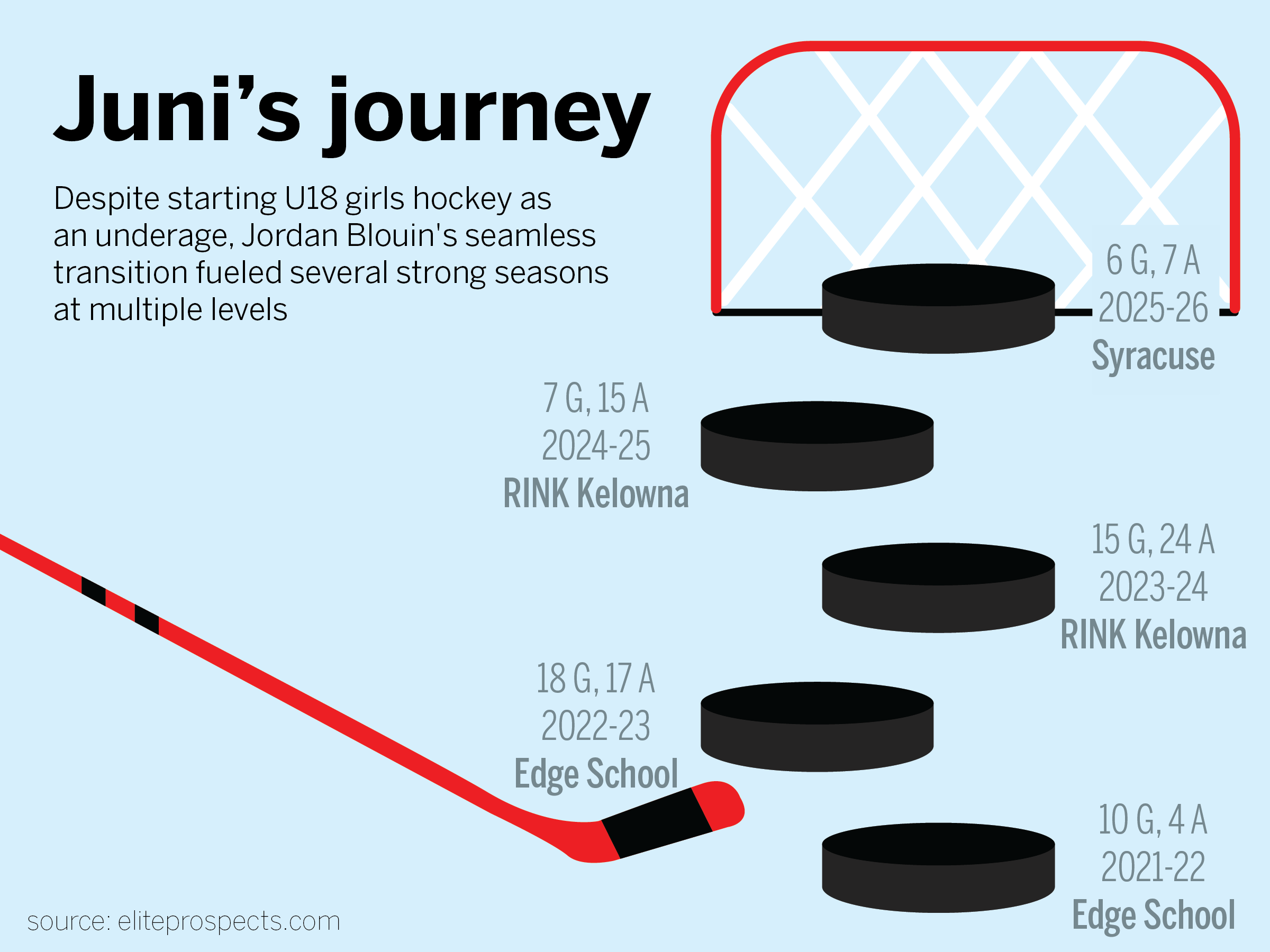
Underaged for the U18 age group in the Canadian Sport School Hockey League, Blouin was dubbed “Junior” and “Juni,” while the older Jordyn Hutt kept her forename on the ice. Blouin amassed 28 goals and 21 assists in 57 games for the Mountaineers, who had multiple future Team Canada players.
“My underage year at Edge is when I really started to put the work in,” Blouin said. “That’s when I decided I’m going to be the one to put the work in, and I’m going to do whatever I can every single day to get better.”
Since McLeod left before Blouin arrived, she decided to elevate her game by moving to RINK Kelowna, where Miles remembers her fighting for ice time with some of the best players in the country such as Chloe Primerano, Gracie Graham and Alida Korte. But before she ever laced up the skates for RINK Kelowna, she committed to Syracuse.
“Syracuse was that rebuild team with new coaches, and that could open doors for opportunity for ice time, even in her first and second year,” Miles said.
Blouin’s ringette-built speed combined with stick and coordination skills fueled her to eclipse 60 points in two seasons at RINK Kelowna.
That hasn’t changed with the Orange. Blouin’s played her freshman season on its first offensive line. Despite being a natural center, she’s enjoyed flexibility on the wing.
“She was ready to go when she entered camp and got here,” SU associate head coach Heather Farrell said. “She put herself into a really good spot physically.”
Blouin’s scored six goals and dished out seven assists alongside Emma Gnade and Peyton Armstrong, with the three combining for the most points (45) of any SU line. Farrell cites the trio’s “savviness” around the net as goal scorers with the ability to facilitate plays.
With SU aiming for a deep AHA playoff run and an NCAA Tournament berth, Blouin now approaches everything differently, relying less on her speed than she once did. She’s still the fastest player on the ice thanks to ringette. But her newfound skills have molded her into more.
When Blouin returns to Calgary for the summer, her mind will shift to shopping, tanning and playing badminton. But as she gazes yonder, across Arbour Lake, she’ll wait for the opportunity to do it over again.
No lights, but her headlamp and electric lanterns. No one else but her. Who cares if nobody’s watching? Alone and lost — like she was, years ago, fiddling with a ringette ring before she discovered herself.
“I was very skeptical at the start switching when I was 10, but I am so glad I switched,” Blouin said. “Best decision I’ve ever made.”