

International roots representing 8 countries unite Syracuse tennis

Syracuse's roster features players and a head coach from eight countries. The trend mirrors other collegiate women’s tennis programs. Charlie Hynes | Staff Photographer
Get the latest Syracuse news delivered right to your inbox. Subscribe to our sports newsletter here.
Throughout the Mays and early Junes of her childhood years, Constance Levivier spent her afternoons at Stade Roland Garros. French Open tickets were cheapest on Wednesdays, so those were the days Levivier sat at the very top of the stands with her brother, dreaming about what it would be like to one day play on the storied clay of Philippe Chatrier Court.
As the day wore on, Levivier and her brother would dart through the complex, watching matches on the outer courts and sneaking close to the clay to get a glimpse of her idols.
“It was a great motivation for me,” Levivier said. “To see stars playing right in front of you at that age makes you want to be like them and play on those courts.”
Eventually, Levivier did and made the semifinals in the Roland Garros Junior Championships in 2022. That passion sparked her tennis career, and in 2023, it led her to the United States to play Division I tennis at Syracuse.
In addition to Levivier, hundreds of other international players have followed that same path, too. There are currently 25,000 international student-athletes across all NCAA divisions. Women’s tennis has one of the highest rates of international participation, with around 60% of players coming from outside the U.S., making it one of the few truly global college sports.
Syracuse tennis’ 10 members represent seven nations, from the U.S. to France, Russia and South Korea. Each player brings their own style of play to the Orange, and it shapes their identity as a team.
“Tennis is a lot more global than a lot of other college sports,” Limam said. “We are trying to build the best roster we can, and that means looking at other parts of the world.”
Syracuse attracts global talent because of two main factors. One is the allure of playing in the Atlantic Coast Conference, a top conference in college tennis. The ACC features six of the top 25 teams in the ITA rankings.
The other factor is Limam. Hailing from Morocco, SU’s head coach uses his international background to help attract talent to the Orange. He said he can relate to the transition to American collegiate athletics, and he’s also built a multitude of connections to evaluate and recruit talent.
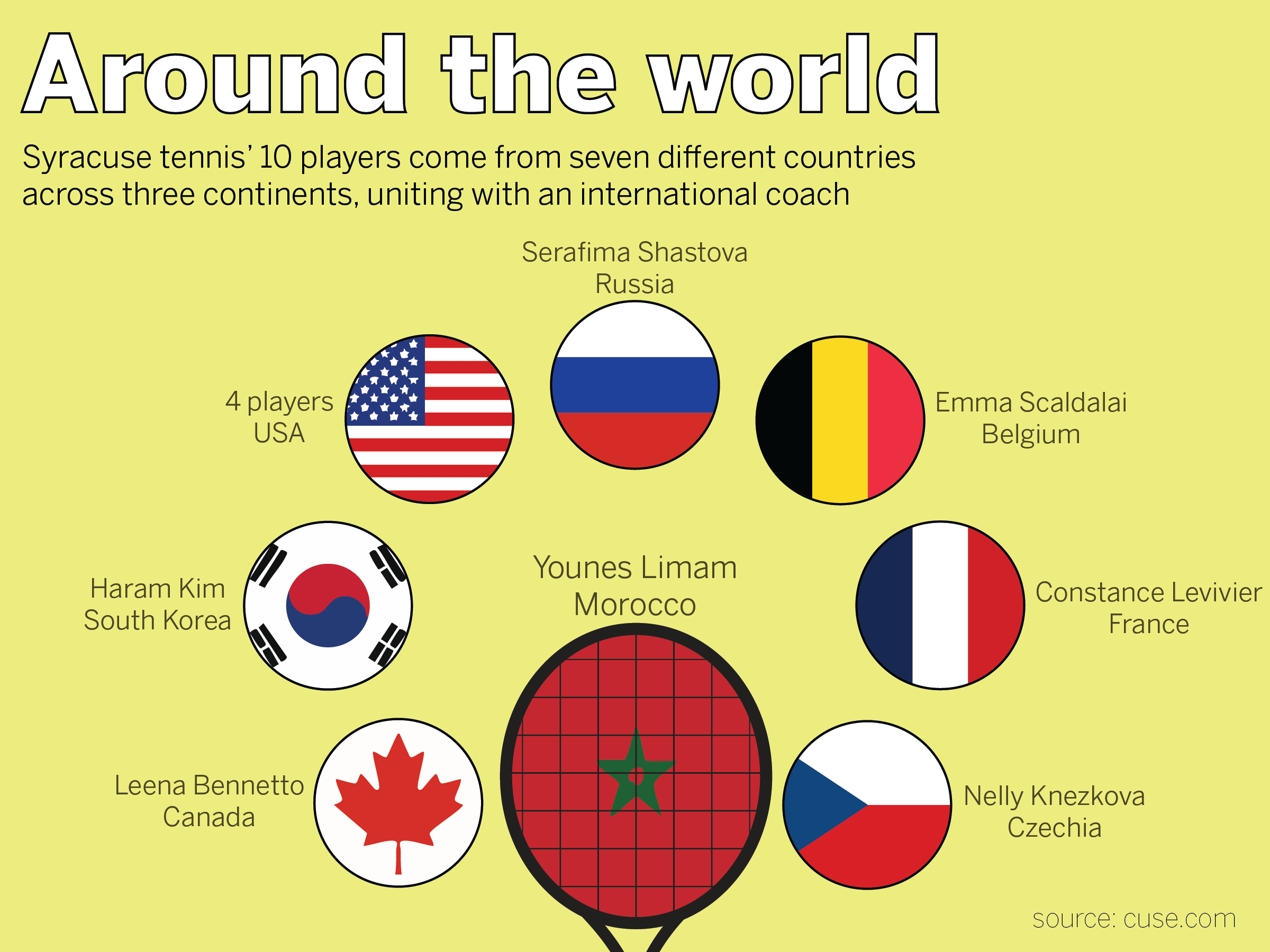
Zoey Grimes | Design Editor
“It’s getting a lot more competitive,” Limam said about global recruiting. “But we have a good foundation to compete.”
Levivier and Serafima Shastova — who hails from Russia — are two key examples of that.
After moving to the U.S. to play, Shastova was Jacksonville State’s No. 1 singles player and dominated the Atlantic Sun conference in her first season of college tennis. But she said she knew she wanted to chase the dream of playing professionally. When Limam called her about transferring to SU, she figured it’d be best to chase it with the Orange.
“It was a risk,” Shastova said. “But I wanted a more competitive atmosphere.”
Shastova has had a major impact for the Orange since joining in 2024. She has continued to thrive as Syracuse’s No. 1 singles player, with a record of 33-13 in singles play since joining Syracuse.
Shastova, like many of her teammates, has leaned into SU’s international atmosphere. She said being so far away from home has allowed the team to be a support system for each other. Shastova said the team is “a single unit.”
With all six international players being at least a seven-hour flight from home, the team has a familial atmosphere. Several players said their teammates became their chosen family.
“They spend a lot of time together off the court,” Limam said. “It really makes our jobs easier as coaches, because we don’t have to do a lot of building chemistry.”
Limam says that chemistry starts with some of the conversations the team has during dinners. Different cultures and backgrounds lead to shared experiences among the players as they transition to not just college, but the U.S. as a whole.
“They have it in common, where they’re very far from home,” Limam said. “They can relate to each other about it.”
Their diverse backgrounds also make an impact on the court. The players grew up playing different styles of tennis on different surfaces. Some players, like Levivier, spent their time on clay courts and had to adapt to playing on the hard surfaces that pervade the U.S.
“Having players that grew up playing on those different surfaces helps us, because we play all our home matches indoors, but almost all our road matches outdoors,” Limam said. “Having the ability to adjust on different surfaces makes the transition easier.”
With SU’s players having different styles of play, players often coach each other on different techniques and surfaces.
“I learn a lot from watching my teammates,” Levivier said. “We usually accept the advice they give us.”
Transitioning to college sports is difficult for everyone. Even more so when that transition entails moving across an ocean, as is the case for many of Syracuse’s players. All of them lean on each other to adjust to their new lives, and to find their footing on the courts of Drumlins Country Club.
“We know how hard it is to be far from home,” Levivier said. “That makes us a lot closer.”