Light Work’s ‘The Temple of Our Survival’ explores sanctuary, black matriarchy
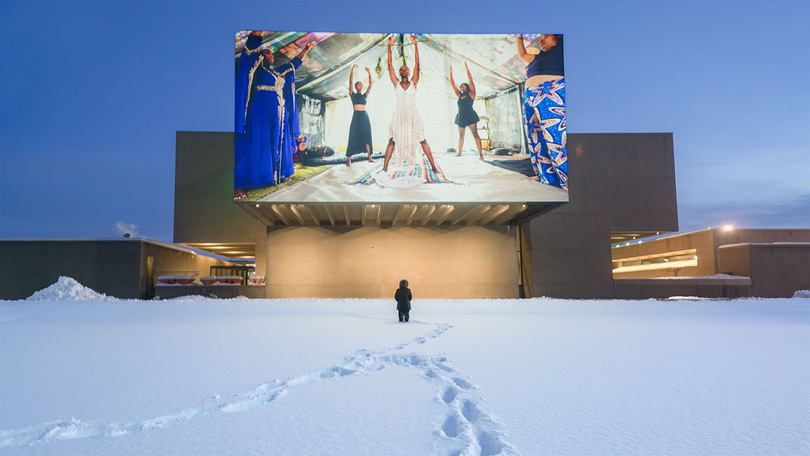
“The Temple of Our Survival” is a video-style exhibit that explores themes of survival through interviews with matriarchs, local care workers and land stewards. The exhibit will be open from Thursday through Saturday until May 30. Courtesy of Cali Banks
Get the latest Syracuse news delivered right to your inbox.
Subscribe to our newsletter here.
Downtown Syracuse glows with stories of migration, care and community as Light Work’s Urban Video Project unveiled a new projection on the facade of the Everson Museum of Art. From interviews to workshops, the project symbolized a sense of community within Syracuse.
“This set is mobile not just for convenience but as a signifier of our relationship to land and landscape. That relationship is migrant,” artist Alisha Wormsley said.
“The Temple of Our Survival,” which was created in July by Wormsley, explores themes of survival through interviews with matriarchs, local care workers and land stewards. From Feb. 19 until May 30, the video will be projected on the museum every Thursday through Saturday, from dusk to 11 p.m.
Anneka Herre, program director of Light Work’s Urban Video Project, said the large-scale projection is designed to amplify underrepresented voices, aligned with Light Work’s mission.
The Syracuse video focuses on local doulas Astier Bay, SeQuoia Kemp and other Black women who have longstanding roots in the community. They are everyday women who are leading families, helping others and making an impact, Wormsley said.
Wormsley traced the project’s beginnings to her longstanding interest in science fiction and Afrofuturism. In her previous exhibit, “Children of NAN,” she envisioned her project as a “Black matriarchal survival guide.” The project used archival videos to reference both science fiction language and “Nan,” a syllable for mother across African dialects.
“I started realizing that I was really focused on this sort of Black feminist, Black matriarchal kind of shift,” Wormsley said. “That’s the lens I wanted to structure my work through.”
After both of her grandmothers died in 2017, Wormsley began incorporating sewing, quilting, weaving and gardening into her artistic practice as a way to feel closer to them. That ancestral connection eventually became the foundation for the Temple itself.
At the center of Wormsley’s project is a large-scale traveling structure also titled “The Temple of Our Survival.” The structure is a massive tent draped in quilts sewn by the artist, incorporating symbolism and imagery that date back to the Underground Railroad and referencing ancestral histories of migration and refuge, said Herre.
While living in Syracuse last July, Wormsley partnered with Sankofa Reproductive Health and Healing Center, installing the Temple inside Cafe Sankofa, a Black-women run cafe cooperative in Syracuse. There, she conducted one-on-one interviews with around 10 Black women, which are included in the video projected on the Everson’s facade.
“That was central to the conversations because we were at a reproductive justice space,” Wormsley said. “It’s really interesting where the tent is because that’s where the conversations go.”
The tent has been in eight different cities across the U.S. before coming to Syracuse. Each video is tailored to the city’s respective communities, with interviews and videos from members of that city. But, the tent and the central message of being connected to one’s local community stay the same, Wormsley said.
Across cities, Wormsley said she’s noticed recurring themes. Everywhere she goes, she hears stories about homes that have become sanctuaries, places where neighbors provide each other meals, comfort and protection during difficult times.
“They made sure everybody felt safe no matter what was going on outside,” Wormsley said. “They took care of everybody and no one took care of them.”
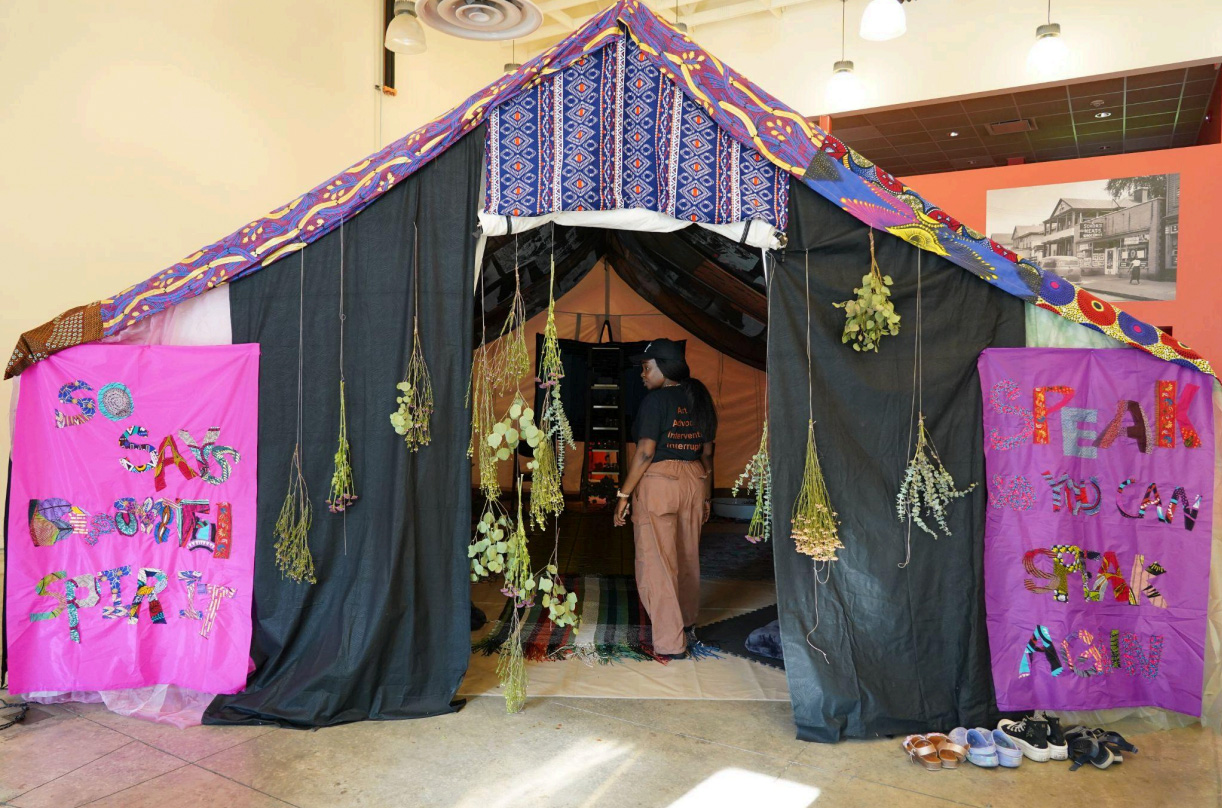
The tent is a central component of “The Temple of Our Survival.” Draped in quilts sewn by artist Alisha Wormsley, she uses the tent to interview local Syracuse doulas about their longstanding roots in the city. Courtesy of Cali Banks
Wormsley’s interviews form the foundation of the video projected onto Everson’s exterior. What began as intimate conversations inside a quilt-lined tent has expanded into the public space, asking viewers to reconsider the history of their communities.
SU sophomore Jaxen Pniewski said the scale and subject matter make the work especially impactful. In a specific scene in the video, Wormsley and another woman were discussing Harriet Tubman’s roots in central New York. Pniewski didn’t know about them before watching.
“This is the first video projection I’ve seen at the museum and it was really interesting. I had no idea that Harriet Tubman and the Underground Railroad had roots in the area,” Pniewski said.
The Temple stayed up in Cafe Sankofa for over a month, allowing it to be used for more than just the interviews and becoming more a part of the community. Now, the tent isn’t in the cafe but appears in the video.
“The tent became both a project space where Alisha conducted workshops, but it also became like a project space for Sankofa,” Herre said. “There was a really great synergy with them and their own programming.”
Wormsley said she hopes viewers leave the exhibit with a new perspective on the city and the people who care for it. She said she also hopes it garners support for Sankofa Reproductive Health and Healing Center and Cafe Sankofa.
“I just hope that they maybe cultivate a sense of respect of who the stewards of their city are and what care means and what different forms of power actually are,” Wormsley said.