ESF environmental panel tackles activism, federal budget cuts
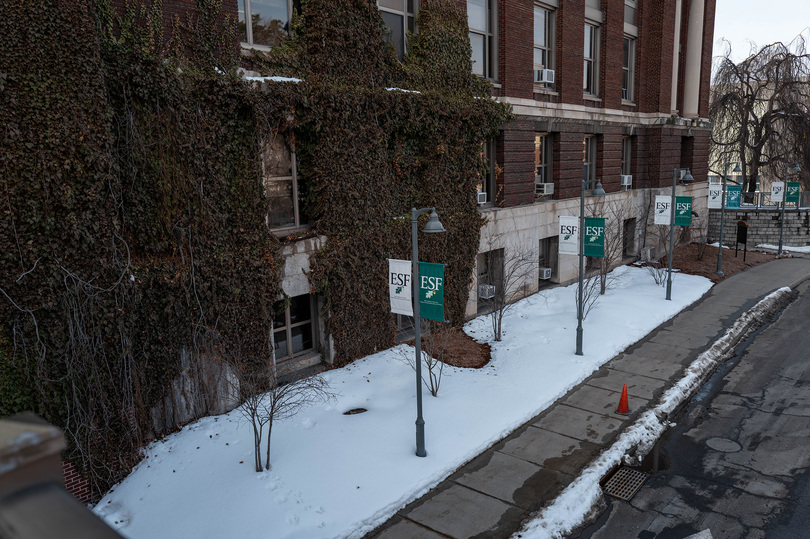
During a virtual panel, experts on environmental issues gathered to discuss SUNY ESF amid plans to cut 18.9% of the university's staff, while also increasing enrollment. Tara Deluca | Asst. Photo Editor
Student Press Freedom Day is a reminder of the vital role student journalists play in holding institutions accountable. The money raised between now and March 6 will go directly toward supporting our independent newsroom. Donate today.
Experts on current environmental issues discussed SUNY ESF’s role in environmental science and research amid budget cuts and national “anti-science” sentiments during a Tuesday virtual panel.
The panel, titled “Anti Science, The Environmental Crises, and the Crucial Role of ESF,” featured panelists who argued for the protection of ESF’s specialized studies as the university navigates SUNY’s fiscal stability plan. The plan, released by SUNY in September, aims to cut 18.9% of the university’s staff and increase undergraduate enrollment by 16.1% by 2029.
Robin Wall Kimmerer, director of the ESF Center for Native Peoples and the Environment, said ESF’s specialization in environmental science is an “endangered species” as SUNY forces “conformity” among its campuses.
“We could think about ESF as a unique species of education that is necessary for all the tasks and perspectives that we’ve been naming in our time together,” Kimmerer said. “So much of the funding landscape tends to promote uniformity, to treat all institutions as if they are the same.”
Kimmerer said ESF needs extra funding from SUNY because it isn’t the same as other institutions. She said the school’s field programs, coupled with ESF’s environmental research, is expensive but rarely provided at other universities.
SUNY’s order to increase student enrollment would worsen the financial situation of ESF, which has been operating in a budgetary deficit for over a decade, Fred Kowal, president of the United University Professions — ESF’s professor’s union — said. Most funding primarily comes from student tuition and other fees through the SUNY system.
“You bring in more students, and you’ll get more tuition revenue,” Kowal said. “But the fact of the matter is that (at) ESF those students cost money because the programs are intense and they’re expensive.”
Cuts to ESF’s staff and faculty present a whole different problem, Daniel Vera, president of the Mighty Oak Student Assembly, said. Last semester, ESF professors were given the opportunity to leave their positions as part of the university’s voluntary separation program, an element of the stability plan. The resignations accounted for 8% of the school’s full-time staff.
Vera argued ESF cannot lose the staff that makes the school’s education specialized and students’ field experiences possible.
“We cannot lose the culture, the people that make us ESF, that have that passion as forward,” Vera said. “As long as we maintain that, ESF should not be in a position where we are looking to shrink. We should be looking to expand.”
Panelists also discussed how ESF would respond to the federal government’s increasing anti-science rhetoric.
Vera said uncertainty about the federal government’s budget cuts to programs working on environmental issues, such as the Environmental Protection Agency, has permeated among ESF students.
“When you’re looking to plan your career, when you’re thinking of the future, you may be scared of going into an environmental field because of all this anti-science rhetoric,” Vera said. “But I think ESF students are resilient. We don’t let that dissuade us from continuing the work.”
Another panelist, Rita Hite, an ESF alum and CEO of the American Forest Foundation, also spoke to not being deterred by budget cuts. She mentioned her struggles with federal grant funds allocated for conservation efforts, and the AFF turning to the private sector for help.
There has been an increasing number of people and businesses over the past 20 years investing in nature and conservation, Hite said. The AFF uses scientific research to gain private sector investments.
“We need that critical science to unlock private finance to actually invest in the kind of conservation outcomes that all of us have hoped and dreamed of for years,” Hite said.
However, Kimmerer said in addition to resilience, resistance is necessary. Collin O’Mara, CEO of the National Wildlife Federation, followed that philosophy by taking legal action. O’Mara said he plans to win his court battles with scientific research.
O’Mara noted the assistance of ESF students and graduates will be paramount to finding success.
“We (will) have the academic community speak (about) their incredible research into the space in a way that’s accessible and helps win these battles is going to be incredibly important,” O’Mara said.
However, O’Mara said he realizes the importance of federal funding. The personal and financial effects of not funding scientific research outweigh the costs, he said, citing floods in Texas and rising insurance costs as the consequences of not funding science.
The panelists said they remain optimistic about the far future, however they noted there are still environmental and budgetary issues ESF has to contend with.
“This is a fight in which failure is not an option, and therefore we will continue to fight and work to make ESF stronger and better in the long run for all of us,” Kowal said.