

Green over red: Tipp Hill’s upside-down traffic light glows with Irish pride

While the upside-down traffic light in Tipperary Hill has become a defining symbol for the neighborhood, it's origin story is only confirmed in fragments. What can be confirmed is, in 1928, the city of Syracuse changed the red-over-green to green-over-red. Charlie Hynes | Staff Photographer
Get the latest Syracuse news delivered right to your inbox.
Subscribe to our newsletter here.
At the intersection of Tompkins Street and Milton Avenue in Tipperary Hill, an otherwise ordinary looking traffic light blinks green at the top and red at the bottom, the only one like it in the United States. For the families who have considered Tipp Hill a home for generations past, the traffic light represents their Irish ancestral and cultural pride.
“It’s not just about the Irish pub,” Alex Ladstatter said, who grew up in Tipp Hill and now lives in Washington D.C. “There are families that are raised there, and there are generations that have stayed in that neighborhood and have really made it a community.”
Ladstatter’s Tipp Hill roots trace back to his great-grandfather, who settled in the neighborhood after immigrating from Ireland.The upside-down traffic light is the defining symbol of Tipp Hill, a neighborhood on Syracuse’s west side named after County Tipperary in Ireland.
Its origin story is equal parts history and legend, passed down through families, confirmed only in fragments by the historical record and fiercely claimed by nearly every family on the Hill, Ladstatter said.
Every St. Patrick’s Day, it’s tradition to paint a green shamrock on the road beneath the light at 12:01 a.m., before the crowds descend on Coleman’s Authentic Irish Pub for green beer. The ritual has repeated for nearly a century, with new generations arriving at the same corner, looking up at the same light.
The city of Syracuse installed a standard traffic light at the corner of Tompkins Street and Milton Avenue in 1925, according to neighborhood lore and historical accounts. By then, Irish families had already been settled in Tipp Hill nearly a century.
When residents saw the light — red above green — they took it as a symbol of British domination over Ireland: the English red sitting above the Irish green, Ladstatter and other residents said.
To protest this, some threw stones. A group of Irish American youth, who came to be known as the “Stone Throwers,” repeatedly smashed the red bulb every time the city replaced it.
The kids, aged roughly 11 to 17, included Jocko Behan, Richie Britt, James “Duke” Coffee, Kenny Davis, George Dorsey, Mikis Murphy, Stubbs Shortt, Patrick “Packy” Corbett and Eugene Thompson, according to the Tipperary Hill Heritage Memorial. However, many additional Tipp Hill residents claim their ancestors were also a part of the historic event.
A local alderman named John “Huckle” Ryan proposed a solution to appease the Stone Throwers: flip the light so green sat on top. The city agreed, but New York state intervened and ordered it to be corrected. The vandalism resumed immediately.
On March 17, 1928, St. Patrick’s Day, residents met with city officials and made their position clear: They would keep throwing stones. City officials relented, and the green-over-red configuration has remained since.
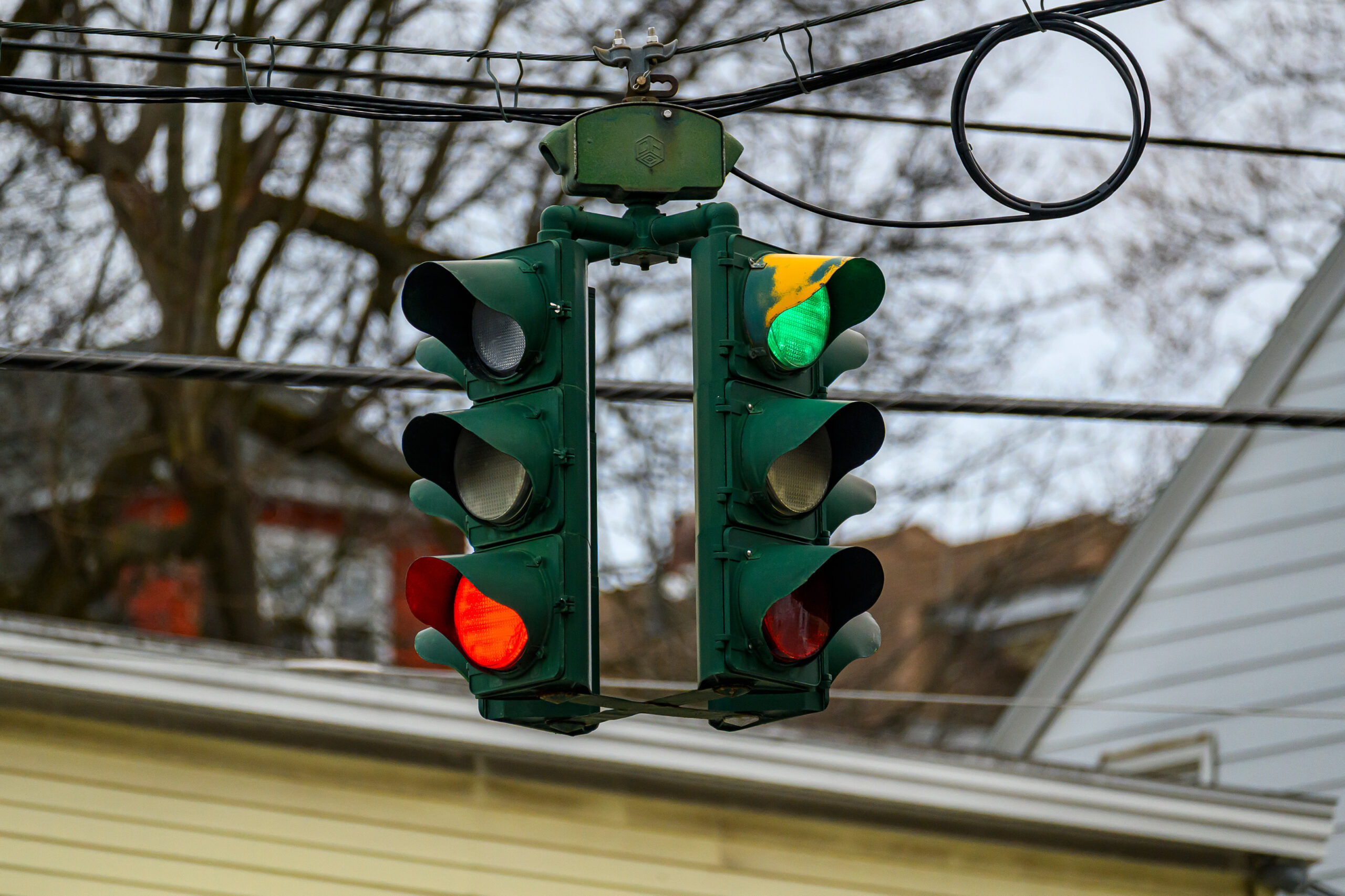
To protest a Tipperary Hill traffic light that residents saw as a symbol of British domination over Ireland, some threw stones. The vandalism continued and eventually led to the upside-down light. Charlie Hynes | Staff Photographer
The connection between Tipp Hill and Ireland runs deeper than the light itself. Irish immigrants made up a large portion of the Erie Canal’s labor force, and because Syracuse sits at the canal’s midpoint, many settled there after the project was complete in 1825.
“Everywhere you turn when you’re on Tipperary Hill, there is either something that resembles a shamrock or something Celtic,” Ladstatter said. “You’re reminded of exactly who settled there when the neighborhood was formed.”
Part of that Irish heritage shows in Coleman’s, established in 1933. It has become the social center of Irish life in central New York.
“Our pride in Celtic heritage even extends to the neighborhood traffic light,” Coleman’s website says. “It’s the only one of its kind with the green light above the red.”
For many Tipp Hill families, the Stone Throwers are not distant historical figures; they are grandfathers and great-grandfathers.
Bryan Poppe, a 24-year-old Liverpool resident, said he used ancestry records to trace his great-grandfather John Dorsey to 501 Tompkins St., two houses from the intersection where the light still hangs. John isn’t in the records, though his brother George is, but Poppe still claims John was a Stone Thrower.
“It’s pretty cool that we were very involved with early Syracuse’s history,” Poppe said. “I know we had a lot of family who migrated here and set up in Tipperary Hill, and it’s pretty cool that we have some connection to where we all came from.”
That sense of pride is complicated by the limits of memory. When the Syracuse Post-Standard combed its archives in 2005, it could not find documentation of the traffic light before 1945. However, the reporters did find widows of men who claimed to be among the original Stone Throwers; oral history standing in for paper trails.
Like many other Tipp Hill residents, the Ladstatter family has passed down Stone Thrower family lore. For them, the question is not whether their great-grandfather was present at the light; it’s whether he was throwing stones or just watching.
“My uncle believes he was a Stone Thrower himself,” Ladstatter said. “And my mom does not believe that because he was a very gentle soul. But I think it would be more fun if he was.”
That’s how his family’s story lives on Tipp Hill, not as settled fact but as living oral tradition, with every family holding its own version and its own claim to the corner, Ladstatter said.
In 1997, a neighborhood group convinced the city to build Tipperary Hill Memorial Park at the intersection, erecting a bronze, life-size statue of a 1920s Irish immigrant family. The father points toward the light and his son has a slingshot tucked in his back pocket.
When Ireland’s prime minister visited the U.S. in 2005, he made a trip specifically to Tipp Hill to see the light. The Stone Thrower legend has even followed the neighborhood’s descendants to Washington, D.C., where a bar called the Dubliner, run by Peter Coleman’s brother, has a photo of the upside-down traffic light on its wall alongside photographs of Coleman’s and Tipp Hill.
“To have a little piece of home and a little piece of Tipperary Hill right here in Washington, D.C., is really phenomenal,” Ladstatter said, who discovered the bar after moving to the city.
For the Poppe family, showing up to that corner each year is an act of memory as much as celebration. His father, David, 56, said he regrets not asking more questions when he had the chance.
“As you grow up, you figure out that maybe you should have talked to your grandparents and figured out more about your history,” David said. “It’s good to know your background.”