

Local director’s political thriller ‘PH-1’ tackles media, civic engagement
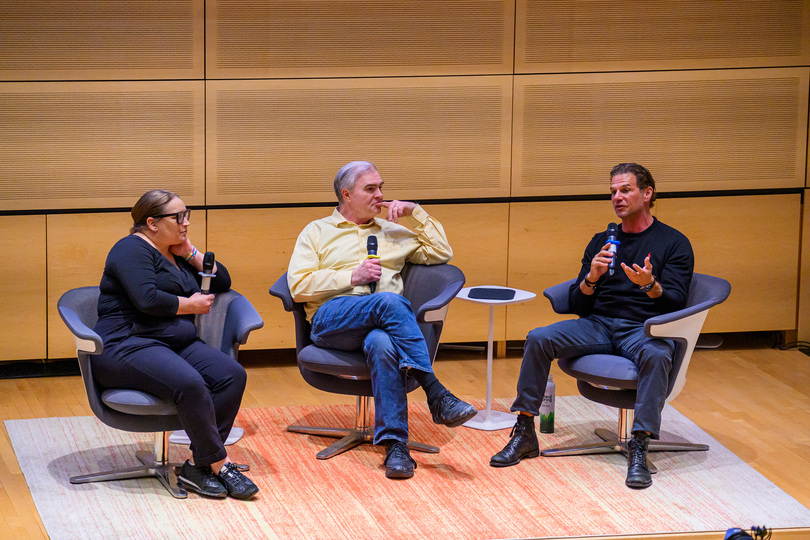
In Mark Kassen's upcoming movie "PH-1," he plays a politician whose political ascent is derailed by false media scandals. The film explores how social media turns elected officials into caricatures. Charlie Hynes | Staff Photographer
Get the latest Syracuse news delivered right to your inbox.
Subscribe to our newsletter here.
UPDATE: This story was updated at 9:38 a.m. on Wed, March 4, 2026.
Social media in America is practically run by four people — Mark Zuckerberg, Elon Musk, Larry Page and Sergey Brin.
Facebook, Instagram, X and YouTube control news for more and more Americans, and news algorithms act as traffic cops for information.
Plus, 70% of people between 18 and 29 get their political news incidentally or when they come across it (usually on social media). A lot of power’s vested in four people.
Filmmaker Mark Kassen is worried about the risks this poses for democracy. So he made a movie about it — “PH-1.”
“We don’t value information anymore, because we just get a bunch of things sent to us,” Kassen said. “But I find that young people do not enjoy being told what to think.”
While “PH-1” doesn’t release in theaters until this spring, it was screened Tuesday at the Newhouse School of Public Communications’ Joyce Hergenhan Auditorium. The event was hosted in collaboration with Syracuse University’s Institute for Democracy, Journalism and Citizenship. After the film, IDJC Director Margaret Talev and SU professor Bob Thompson hosted a Q&A with Kassen.
“PH-1” follows a politician, played by Kassen, whose political ascent is derailed by malicious media scandals. The thriller explores how elected officials are influenced by social media and public opinion, often rendered powerless to control their own narratives.
“They become more characters of themselves than what they started out to be working in service of,” Kassen said. “To be fair to elected officials, it’s a tough f—ing job.”
Kassen, a Fayetteville native, studied acting at Ithaca College. After graduation, he moved around — including London, New York City and Los Angeles — taking different jobs along the way, from writing plays to acting in karaoke videos.
Later, he began directing. Kassen and his brother, Adam, directed 2011’s “Puncture,” which starred Chris Evans. The same year Evans became Captain America, he also became Kassen’s friend and eventual business partner.
In 2020, Kassen and Evans launched A Starting Point, a civic engagement platform. The website and app presents elected officials’ perspectives focused on policy or related issues.
Kassen admits A Starting Point might not be as engaging as cable news commentary or social media influencers. But, it’s better than the “rage-baiting” seen on social media — Kassen said A Starting Point gives his audience reliable information.
Big media’s always had an influence in American politics. Look at William Randolph Hearst and the “yellow journalism” of his papers, which influenced public support for America to go to war with Spain. Or Rupert Murdoch’s Fox News, which is a big reason President Donald Trump rose to power 10 years ago.
But media consumption isn’t a choice in the social media age, Kassen said. You could boycott Hearst’s papers if you opposed war with Spain 100 years ago or turn Fox News off 10 years ago. But unless you’ve been living under a rock since 2004, you probably know how seductive social media is — Zuckerberg’s being sued in federal court for allegedly making social media algorithms addictive for children.
“You’re just turning on Instagram or you’re turning on X, you’re turning on TikTok and it’s giving you what it thinks you want,” Kassen said. “Based on how much you pay attention, it’ll give you more of that.”
This model is by design. Tony Smith, a graduate student in the media studies program who attended the event, worked in advertising before he came to SU. When he was in the industry, he saw how advertisers used social media’s retention for constant engagement, so the film’s depiction of social media was pretty on the nose for him.
Smith has now divorced himself from socials, he said. He’s disconnected from what his friends are talking about online, but his mental health is better for it.
But Smith is “in the minority.” Most young people are more like Ava Santor and see misinformation on social media all the time.
Santor, a junior studying management and television, radio and film, saw a post saying Erika Kirk was written out of Charlie Kirk’s will on social media a few months ago. But once she did a Google search about it, she saw that it was patently false.
“So many theories, so many conspiracies,” Santor said. “Rumors pop up and they circulate so easily online to the point where you can’t tell if it’s true or not.”
There’s a lot of skepticism about truth on social media. But Santor’s also applied a similar level of skepticism to CBS News after the Paramount acquisition or what might happen to CNN after Paramount’s acquisition of Warner Bros. Discovery. She asked Kassen about it during the Q&A.
Though Kassen believes that Bari Weiss’ tenure isn’t worth dismissing CBS News altogether, he does agree that the level of consolidation in media is bad for business — especially his business as a filmmaker. Jobs are dwindling with every subsequent merger, and the studios have less diverse perspectives in what they decide to produce, he said.
If politics was a stage, the media would play a central role. And Kassen’s been writing about the media for years.
“Media is a pervasive character in our lives,” Kassen said. “I’m obsessed with media as a character.”