Minister blends nonbinary identity, faith to lead Syracuse church
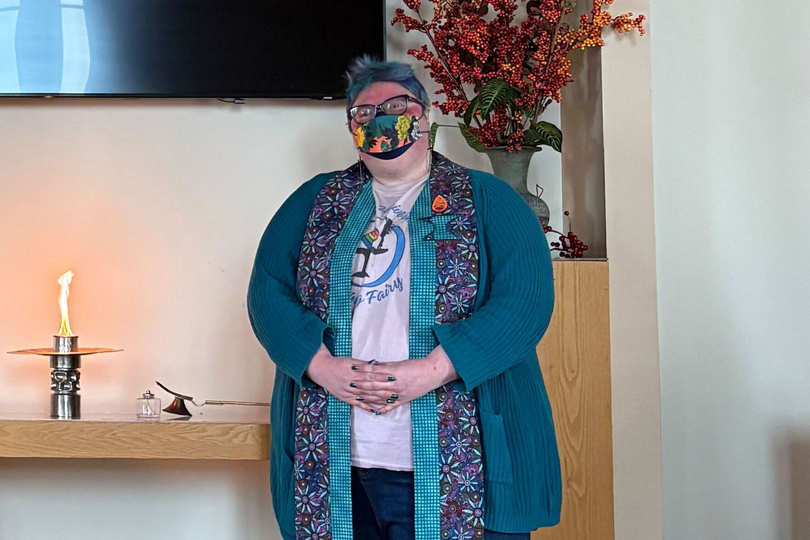
Molly Hamerhand went to college for illustration. But singing in a church choir led Hammerhand to enroll in a Master of Divinity program. Now, they help promote inclusivity as minister of First Unitarian Universalist Society of Syracuse. Lillie Kochis | Contributing Writer
Get the latest Syracuse news delivered right to your inbox.
Subscribe to our newsletter here.
Molly Hammerhand entered a church for the first time as an adult, looking for a choir to sing in.
Welcoming people of all different religious beliefs, Hammerhand thought the Allen Avenue Unitarian Universalist Church in Portland, Maine, sounded like a good choice. Singing in the church’s choir led to involvement on the board, social justice team and lay preaching and their enrollment in a Master of Divinity program.
It was in seminary that Hammerhand came to realize they are nonbinary. To them, being nonbinary means they “don’t experience (themself) as either a man or a woman.”
In 2022, the First Unitarian Universalist Society of Syracuse hired Hammerhand, 39, as a minister. Since then, they have left a legacy that makes LGBTQ+ identities visible within the Unitarian Universalist faith.
While many state legislators attempt to pass laws limiting rights for transgender people, authenticity remains at the forefront of Hammerhand’s work, as well as the inclusion of LGBTQ+ identities, they said.
“All of these things are at the front of my ministry, not because they’re my only concern, but
because they shape the way I am received in the world to such a degree that I can’t not talk about them,” Hammerhand said.
For someone not raised in a religious household, Hammerhand is effusive when it comes to religious topics. As a child, they were interested in mythology and Wicca, a neo-pagan religion.
The more Hammerhand participated in church life at Allen Avenue UU, the more inescapable their thought of a new career path became. The work is something they said was intensely fulfilling, but they remained skeptical of being a Unitarian Universalist minister as a legitimate career path.
“I was kind of in the middle of that quarter-life crisis that you kind of get when you’re about 26
or 27 and you don’t know what you’re doing with your life,” they said.
Despite going to college for illustration, Hammerhand said they wanted a more justice-focused career, so they followed their hunch to Meadville Lombard Theological School — one of two historically Unitarian Universalist seminaries in the United States.
Openly identifying as nonbinary was a much slower process, they said. Hammerhand found that when thinking of themself as nonbinary, certain events in their life made more sense.
“Becoming an adult woman was never something that I vibed with,” Hammerhand said. “I can be an adult, but being a woman does not sound even a little bit right.”
While Hammerhand said they did not feel they “were in the wrong body,” they felt uncomfortable with others seeing them as a woman.
“The process of becoming a minister was radical self-acceptance all the way down for me, and it
was life-changing,” Hammerhand said.
Hammerhand said they were welcomed by FUUSS and that they see FUUSS as being “ahead” of the “average” Unitarian Universalist congregation, after they had interviews with churches that were reluctant to hire them.
“It’s not a given that our churches will be able to accept nonbinary identity on the part of
somebody who is in their leadership,” Hammerhand said.
The Unitarian Universalist Association was founded in 1961, merging two liberal Protestant Christian traditions: Unitarianism and Universalism. While the tradition has Christian roots, it’s developed into a religion that is more expansive in its theological beliefs. Practitioners of the religion have no shared creed and hold all sorts of religious beliefs.
While Hammerhand identifies as a polytheist and pagan, their goal is to minister to people of all
different beliefs. This is one of their favorite parts of the job.
“Being able to witness people being real and being authentic,” Hammerhand said, “that’s uniquely wonderful.”
Coran Claver, an associate professor at Syracuse University, has been a member of FUUSS for more than 20 years and leads a monthly queer and trans knitting group, which she said Hammerhand is very supportive of. Seeking guidance on supporting her nonbinary child through transition, Claver approached Hammerhand, who shared their own experiences of being parented as a nonbinary person.
“They are really committed to having ministry not just be top-down,” Claver said. “It’s not just about them,” Claver said. “It was one of those moments where I just felt there was deep compassion and deep understanding.”
Spencer Dean, Claver’s child, was raised attending church at FUUSS. While their busy schedule prevents them from attending church often, they’ve remained close to the community.
In 2025, Spencer said they and their partner Kristen Dean became increasingly worried about their legal rights as an unmarried couple. With some encouragement from Hammerhand, the two decided to legally marry.
Hammerhand acted as the legal officiant at the wedding, quickly throwing together a ceremony
at FUUSS. Spencer’s parents attended in person, and Kristen’s parents over Zoom.
Kristen, who was raised Catholic, has become a member of FUUSS and assists with the church’s coffee hour and attends Claver’s knitting group.
Spencer and Kristen described FUUSS as an affirming congregation, amplified by Hammerhand’s leadership.
“Reverend Molly will fight with us,” Kristen said.
To Hammerhand, bridging LGBTQ+ and religious communities is an extension of their
signature authenticity.
“Our experience is not an outlier. It’s a fully human one,” Hammerhand said. “It’s a fully human one, and it has always existed as a fully human experience.”