Latest edition of Project Mend explores themes of grieving, surviving
Get the latest Syracuse news delivered right to your inbox.
Subscribe to our newsletter here.
While working as a receptionist at the Center for Community Alternatives, Sheela Grant was introduced to a platform that would finally allow her to share the story of her late sister, Cheryl, who was incarcerated for some of her life.
Sheela’s late sister put those experiences into an outlet: art. To honor Cheryl, Sheela chose paintings, poems and more of her sister’s work to share with the Syracuse community in this year’s edition of Project Mend.
“She had mental health issues, she was disabled and she was poor,” Sheela said. “And I’m looking at this, and I’m like, ‘Wow, this is not poor, this is wealthy.’ It’s just not transferring to funds.”
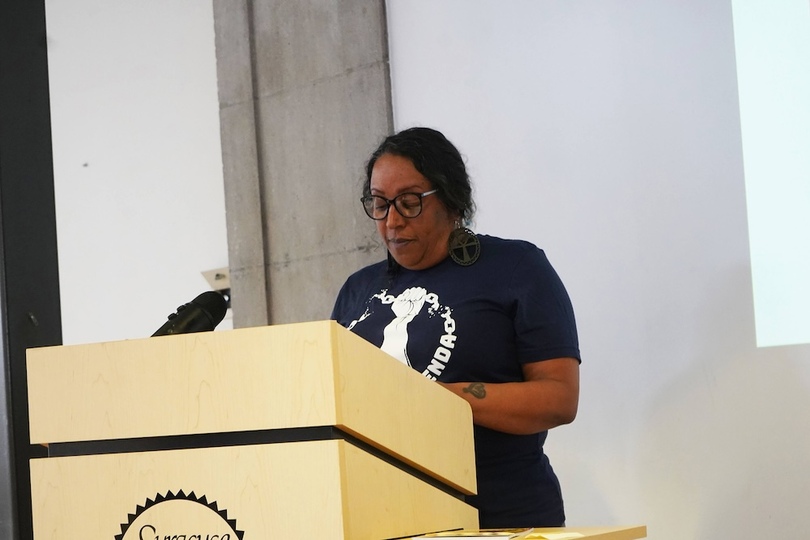
Founded four years ago, Project Mend was started by Patrick Berry, associate professor of writing and rhetoric at Syracuse University. Project Mend is a multimedia archive of scholarly and creative work that shares the stories of people who are currently or formerly incarcerated. On Saturday, Project Mend hosted a launch party for the fourth edition of the magazine at CNY Arts’ Art in the Atrium.
This year’s magazine received roughly 200 submissions from around the world, Berry said. But instead of just written pieces like poems, nonfiction and fiction works, this year’s edition included multimedia elements like the project’s first podcast, “Mend Fences,” and short films like “Prison and Time,” “Why Aren’t You Angry?” and “And How Are the Children?”
“What’s happened now is that we realize that there’s a real value in building an archive, building a large collection and also shifting modalities of storytelling,” Berry said.
Berry and the editors of this year’s edition of “Mend,” the project’s journal, chose to use one of Cheryl’s paintings as the magazine’s cover art. Composed of three sections, this year’s selection of pieces explored the following themes: to grieve, to learn and to survive. Project Mend’s editors spent the past year compiling this year’s edition.
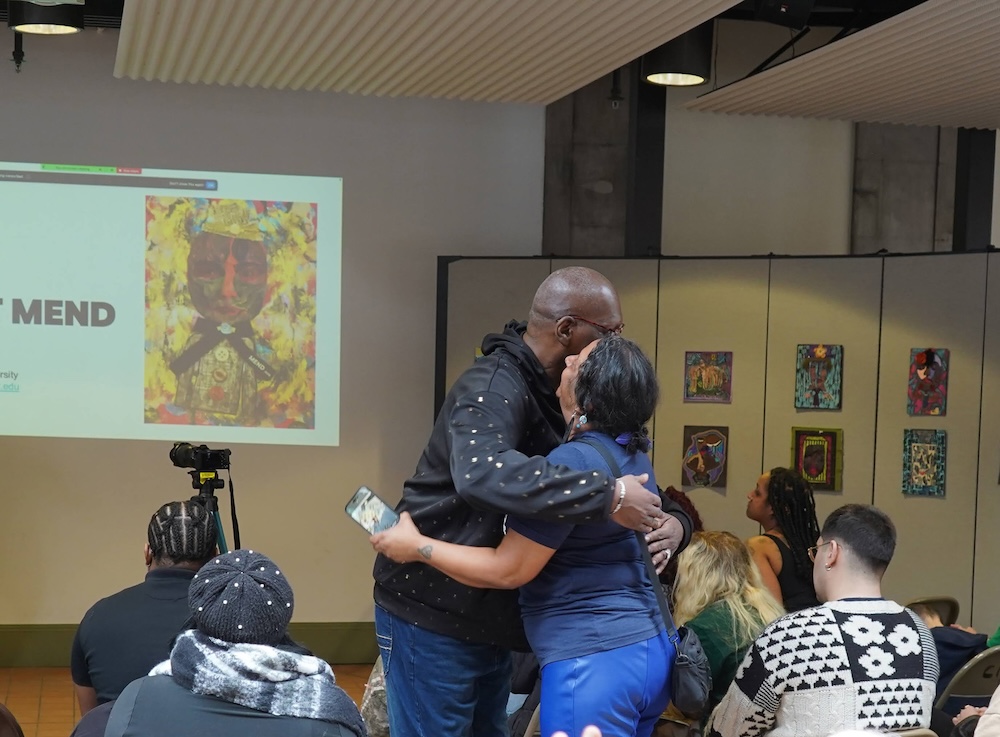
The launch party featured an exhibition of 12 different paintings Cheryl painted before she died in 2022, as well as one of her poems, “Freedom’s Child” — a story about overcoming struggle without losing dignity.
In “Cheryl Means ‘Beloved’ in French,” a narrative piece which appears before her sister’s poem in the magazine, Sheela recounted who her sister was. Sheela describes Cheryl as someone who welcomed everyone with a smile and cared about everyone, even strangers.
Rebekah Nilsen, who is currently incarcerated at Bedford Hills Correctional Facility in Westchester County, contributed to the issue from within the justice system. In “Permission to Grieve,” Nilsen writes about her battle with grief after the suicide of a fellow inmate — the second suicide at the prison in the last few weeks.
Working with Project Mend has allowed editor Marion Rodriguez to reflect on her own incarceration experience. Rodriguez hopes her work with Project Mend will allow incarcerated women to feel safer in the justice system. Courtesy of Project Mend
The first episode of “Mend Fences” was inspired by recent events, particularly the deaths of female inmates at the Bedford Hills Correctional Facility, Berry said. It explores mental health and solidarity in prison, beginning with an excerpt read aloud from Nilsen’s piece.
Nilsen’s account is just one of the many pieces selected for this issue that was chosen to illustrate a bigger message: to uplift the voices of women who are in jail or have been, editor Marion Rodriguez said.
Rodriguez, who was formerly incarcerated, said she is working to interrupt cycles of incarceration and help women feel safer.
“The conditions of confinement have been muted for so long,” Rodriguez said. “The voices of those women have always been muted. It’s imperative that we lift the voices of women.”
Rodriguez said that through working on this year’s issue, she has been able to reflect on her own incarceration experience — especially after hearing Marvin Wade’s story through the short film “Prison and Time.”
Before hearing Wade’s reflection on the 25 years he spent in incarceration in Project Mend, Rodriguez would say prison changed her life, she said. But, Wade changed the way Rodriguez thought about it, she said.
Wade taught Rodriguez that being in prison didn’t change her — it was the duration of her incarceration and the time that passed that did.
Even four years after her sister’s death, time is always relevant for Sheela. It’s better late than never to showcase Cheryl’s work, she said.
Sheela always knew that her late sister dabbled in jewelry making, writing, painting and more. But she didn’t know the extent to which Cheryl used different artistic mediums to cope with her trauma until her death.
“It’s really giving her a voice. Because a lot of times, you have people that go to prison, they’re invisible. People want to just label them as bad people,” Sheela said. “But this is giving them a voice and helping people to see that they’re a human being just like everybody else.”