Students react to SU’s 3rd consecutive ‘C’ on Campus Antisemitism Report Card
Get the latest Syracuse news delivered right to your inbox.
Subscribe to our newsletter here.
For Ivy Daitch, Jewish campus life was a priority when considering different options for college. That’s why she chose Syracuse University.
Now a junior at SU, Daitch said she was disappointed but “not surprised” to find out that the Anti-Defamation League’s Campus Antisemitism Report Card graded the university a “C” for a third year in a row.
“It’s concerning how people are letting history repeat itself and don’t understand what antisemitism can do on this campus, the effect it can have and the problems it can cause,” Daitch said.
Ronit Hizgiaev, an SU sophomore, said she wasn’t aware of the report card before its release this year, but found the result “shocking.” She thinks SU doesn’t experience much antisemitism on campus, she said, but thought the incident at SU’s chapter of Zeta Beta Tau in the fall most likely was the largest factor affecting the score.
“There are other campuses that experience much more (antisemitism) than we do,” Hizgiaev, a multi-faith chair and hospitality assistant for Syracuse’s Hillel Jewish Student Union, said. “A lot of my friends and students don’t really feel unsafe here.”
ADL’s 2026 report card, released March 10, assesses over 100 different universities by tracking reported antisemitism incidents, surveys and an analysis of campus policies, according to its website.
Campus climate is one of the three main categories the report focuses on, in addition to administrative actions and Jewish student life. ADL deemed that SU’s publicly disclosed administrative actions “above expectations,” Jewish life on campus is “excellent” and campus conduct and climate concerns are a “medium,” according to the 2026 report card.
The ADL determines grades by considering antisemitic events that have not only happened over the past year, but also in previous years.
The “C” score SU received in 2025 included the same feedback for the Jewish life and campus conduct and climate concerns categories. This year, SU did see an improvement in administrative response, which was previously labeled as “meeting expectations” in 2025.
“A ‘C’ does not mean that Syracuse hasn’t made progress,” ADL New York and New Jersey Regional Director Scott Richman wrote in a statement to The Daily Orange. “The score remains unchanged largely because incident-rate metrics are evaluated in relative context.”
The 2026 report follows two major instances of antisemitism that occurred on SU’s campus during the 2025-2026 academic year. In September, two SU students entered the ZBT fraternity house during Rosh Hashanah and threw pork at a wall, resulting in their arrest. That same month, someone threatened a student with a knife and said anitsemitic remarks, according to the report.
“The safety and well-being of our students is our top priority,” an SU spokesperson wrote in a Monday statement to The D.O. “We value all members of the community and hate, of any kind, including antisemitism, has no place at Syracuse University.”
Half of the assessed institutions earned higher grades this year compared to previous years, including several New York schools such as Barnard College, New York University and Vassar College. But student survey data revealed persistent anti-Jewish attitudes and ongoing exposure to antisemitic behavior at various U.S. colleges, according to ADL’s website.
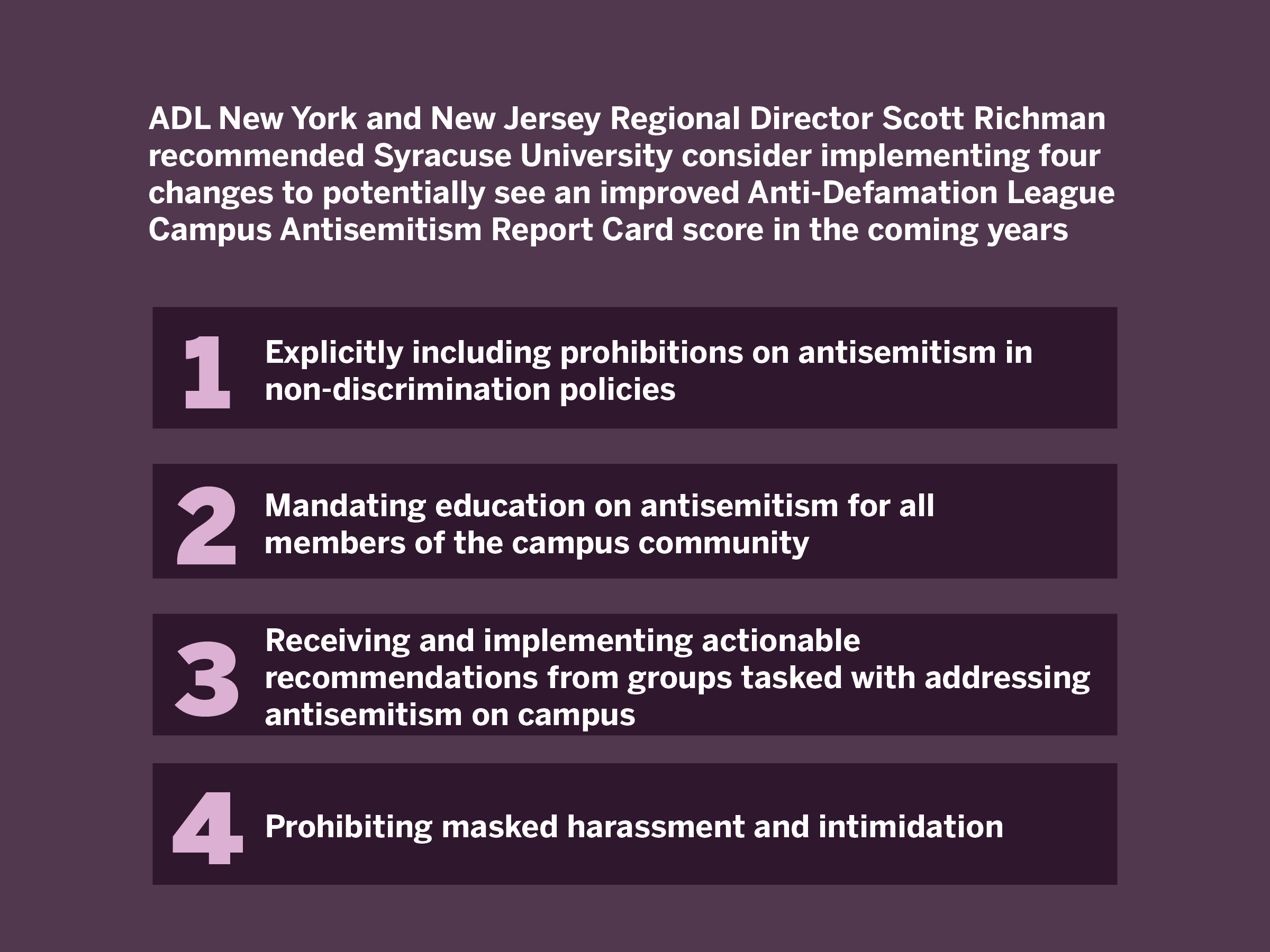
Richman recommended SU consider implementing the following to potentially see an improved score in the coming years:
- Explicitly including prohibitions on antisemitism in non-discrimination policies
- Mandating education on antisemitism for all members of the campus community
- Receiving and implementing actionable recommendations from groups tasked with addressing antisemitism on campus
- Prohibiting masked harassment and intimidation
The SU spokesperson said the university is “constantly reviewing” and “strengthening” policies, education and training, in part by working with campus Jewish organizations like Hillel and Chabad Jewish Student Center, to ensure the campus “remains truly welcoming to all.”
Jewish students at SU shared different reactions to the results. Some students said most Jewish students still face bias on campus, while others said they feel “seen and cared for” by the university, which has an undergraduate population of 2,500 Jewish students, according to Hillel International.
Daitch, who said she was the victim of a 2024 incident mentioned in the report, said she didn’t find the result surprising due to microaggressions she has heard about and personally experienced on campus and while she was abroad in London. Daitch said that she is in therapy currently because of the trauma from these experiences.
“The microaggressions are, in my opinion, more concerning than the big ones because the big ones get condemned by the school,” Daitch said. “But the micro ones most of the time get swept under the rug. Nothing happens.”
Daitch said her anonymous mention in the report referred to when an SU student harassed her while she was walking on campus in August 2024. She said the student told her, “Look behind you, it’s Hamas,” while she was walking.
In a 2026 ADL survey of over 1,000 non-Jewish undergraduates from universities across all 50 states and Washington, D.C., almost 50% reported visibility of anti-Jewish behavior on campus or in digital campus-related spaces in the past year. Only around 5% reported receiving antisemitism-specific training.
Sophia Burke | Digital Design Director
Daitch and other SU students, including Daniella Jacob, have leadership experience in Jewish activism in hopes of combating antisemitism on and off campus.
Jacob serves as SU’s Emerson Fellow for StandWithUs, a non-partisan Israel education organization against antisemitism. Daitch received the fellowship the year before, which entails attending student conferences, hosting events and participating in immersive learning experiences to connect Christian and Jewish leaders.
Hizgiaev said Jewish culture is “thriving” at SU, and she looks forward to Hillel’s Passover Seder celebration at the JMA Wireless Dome on April 1, which she said expects to see 700 attendees.
“We’re not scared to practice,” Hizgiaev said. “(The Dome) is the center of Syracuse University life. It’s a huge deal.”
Some Jewish students said SU should develop more formal antisemitism prevention and education on campus. Jacob said she would like to see SU adopt mandatory antisemitism education, such as during First Year Seminar courses, or explicit language in the code of conduct condemning antisemitism.
“It gives us this path or a guide to work with when those sorts of things happen,” Jacob said. “And would help educate students on antisemitism who aren’t.”
For Daitch, improvements need to start in the classroom. She said that she’s had professors and teaching assistants who were “plain out antisemitic.”
Some Jewish students at SU, like Jacob, said they are committed to helping make improvements in Jewish culture and imposing accountability for antisemitism on campus.
“I would love to continue to work to help Jewish life on campus flourish, to help make sure Jewish students know that they have a safe place on campus and know that when these instances happen, we have methods in place to handle them,” Jacob said. “I think we’ve done a lot of work on that, but I do think we still have a long way to go.”