
SU faculty workforce decreased last year, annual census finds
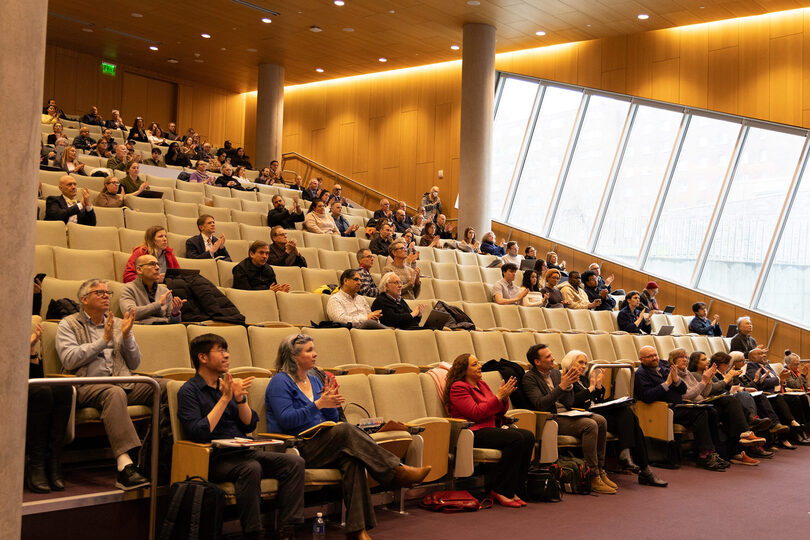
SU’s 24-25 faculty workforce decreased by 44 positions, while tenured professors increased, according to the annual Faculty Census. Solange Jain | Senior Staff Photographer
Get the latest Syracuse news delivered right to your inbox.
Subscribe to our newsletter here.
Syracuse University’s total faculty decreased by 44 positions from 2024 to 2025, while the share of tenured and tenure-track professors increased, according to data presented at Wednesday’s University Senate meeting.
The annual Faculty Census, compiled by the senate’s Academic Affairs Committee, found that tenured and tenure-track faculty made up a little over 50% of faculty in 2025, up from 49.6% the previous year. The number of those tenured positions still fell from 922 to 919, while the university’s total faculty count decreased by 44.
“The big trend that we talked about and noticed is that pretty sizable decrease in the overall faculty workforce in the last year,” Academic Affairs Co-Chair Matthew Huber said. “Even though we got over the symbolic 50% category in 2025, the overall number of tenured and tenure-track faculty actually declined.”
The share of tenured and tenure-track faculty has hovered around the 50% mark over the past four years, with only minor fluctuations, the committee reported.
Tenure is the “indefinite appointment that can be terminated only for cause or under extraordinary circumstances such as financial exigency and program discontinuation,” according to the American Association of University Professors.
National debates over tenure have intensified as universities rely more heavily on non-tenure-track and part-time faculty. At SU, faculty leaders have previously framed tenure as a key protection for academic freedom and shared governance, arguing it allows professors to teach and research controversial issues without fear of discipline or censorship.
Since 2016, the Academic Affairs Committee has collected faculty data annually and compiled it into the Faculty Census, which tracks changes in tenure status, instructional roles and demographics across the university.
The latest data showed continued shifts in who’s teaching classes at SU. Part-time instructional faculty decreased slightly by over 30 positions, while full-time instructional faculty outside the tenure track — including teaching professors and professors of practice — increased by 10.
According to the data, tenured and tenure-track faculty accounted for 45.6% of credit hours taught in 2025. Full-time and non-tenure-track faculty accounted for about one-third of credit hours, while part-time faculty taught 21.4%, down from 30.6% the year before.
The census compared SU with 16 other peer institutions using 2024 data. SU reported 49% tenured and tenure-track faculty that year, placing it near the middle of the group — behind Carnegie Mellon University and ahead of Boston University and George Washington University.
The census also included demographic data. In 2025, about 53.9% of faculty identified as male and 46.1% as female, with the percentage of female faculty increasing by 0.2% from the previous year.
This was the first year since the committee began tracking the data that the faculty became “more white” rather than less, Huber said. A race and ethnicity breakdown presented at the meeting showed that 65.4% of faculty identified as white, followed by smaller shares identifying as Asian (12.0%), Black or African American (5.6%) and Hispanic or Latino (4%).
The census showed differences across faculty categories, including substantial numbers of teaching professors and professors of practice, positions typically not on the tenure track. In 2025, the university reported 115 assistant teaching professors, 79 associate teaching professors, 35 teaching professors and 93 professors of practice.
Later in the meeting, Provost Lois Agnew addressed a February faculty resolution from the College of Arts and Sciences and Maxwell School of Citizenship and Public Affairs calling for faculty approval over program closures and pauses. The resolution follows months of frustration over SU’s ongoing academic portfolio review and concerns over limited faculty input.
Senator Harvey Teres, a member of the Curriculum and Instruction Committee, said an “overwhelming” majority of Arts and Sciences faculty, 188-51, voted in favor of requiring program closure decisions to be submitted to faculty for approval. He asked if university leaders would follow that process.
Agnew said faculty votes are not part of the university’s standard process for program closures, adding that administrators have access to broader financial information.
“This is an area where administrators have information about the overall financial picture of the university that faculty don’t have,” Agnew said.
Final decisions on programs under the ongoing portfolio review are expected to be finalized this month.
Senators also heard a final report from the Parking and Transportation Advisory Committee, convened in summer 2025 to review campus parking policies.
The council recommended creating a new reduced-cost parking tier for part-time, temporary, adjunct and limited-appointment employees, as well as more flexible permit options such as semesterly and daily rates.
The report also proposed an accessible parking pilot, allowing those with government-issued disability placards and a valid university permit to use accessible parking spaces across campus, regardless of their assigned lot.
Additional recommendations included creating a formal intake process for parking concerns, publishing a comprehensive FAQ and establishing a permanent, chancellor-appointed parking and transportation advisory council. The senate is expected to vote on the recommendations at its April meeting.
If approved, Chancellor Kent Syverud said he intends to “move forward” with the council’s recommendations.
Other Business:
The Agenda Committee announced Wednesday it will form an ad hoc committee for the upcoming year to review the university’s Idea, formerly IDEA, course requirement, following discussion at the senate’s February meeting and a request from the Committee on Curriculum and Instruction.
The committee will review the current criteria of the requirement, evaluate recent changes to its language and conduct a five-year review of the program, as well as make a recommendation to the senate on those changes, Agenda Committee Chair Heather Coleman said.
The committee’s formal charge will be presented at the senate’s April meeting, Coleman added.