
SU to ‘sunset’ 9 majors, reimagine others after A&S portfolio review
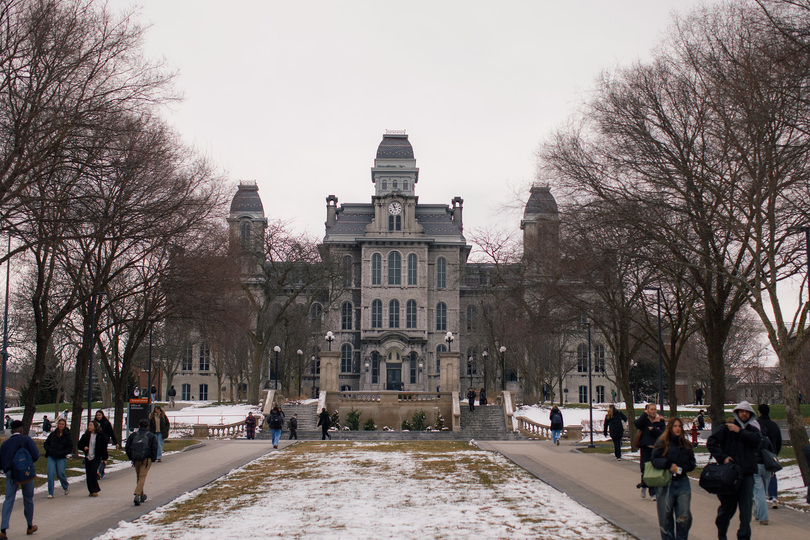
SU will “sunset” nine majors and reimagine others in the College of Arts and Sciences as a result of the university’s portfolio review, according to an email the A&S dean sent to department chairs, which was obtained by The Daily Orange. Avery Magee | Photo Editor
Get the latest Syracuse news delivered right to your inbox.
Subscribe to our newsletter here.
Syracuse University will “sunset” nine majors in the College of Arts and Sciences as a result of its portfolio review, according to an email Dean Behzad Mortazavi sent to department chairs, which was obtained by The Daily Orange.
Mortazavi’s email outlined outcomes to a handful of paused Arts and Sciences majors, including three majors that will be “re-envisioned” and five that will be merged or rebranded. A university spokesperson did not provide any additional comment.
Provost Lois Agnew ordered the Arts and Sciences academic portfolio review last fall as part of a university-wide assessment. As faculty called for more involvement, university leaders emphasized it was a common higher education practice enacted to improve SU’s academic offerings.
Nine majors are “sunsetting,” meaning students cannot declare these majors beginning this fall. Courses in the majors will continue as “minors, general education and/or interdisciplinary programs,” according to the email.
Three majors are being “re-envisioned.” Five majors are “merging, consolidating or rebranding.”
Nine majors “sunsetting”:
- Classical civilization
- Classics (Greek and Latin)
- Digital humanities
- Fine arts
- German
- Latino-Latin American studies
- Middle Eastern studies
- Modern Jewish studies
- Russian
Three majors “being re-envisioned”:
- African American studies
- Music history and cultures
- Religion
Five majors “merging, consolidating or rebranding”:
- Art history B.A. is merging with history of architecture B.A
- Modern foreign language B.A., now the world languages and cultures major, is absorbing Italian B.A. and French B.A.
- Applied mathematics B.A. and B.S. are absorbing statistics B.A. and B.S. by adding statistics tracks
“The majority of these decisions aligned with the preferences of the department chair or program director, given the circumstances,” Mortazavi wrote in the email. “In the cases where perspectives differed, the majors in question had averaged fewer than four students who declared the major in a 10-year period.”
Each department chair and program director received nine years of program data and met with associate deans to discuss their majors, according to the email. Cohorts of majors, which were sorted based on the number of declared students, held virtual meetings with chairs, directors, student invitees and associate deans.
After these meetings, associate deans met individually with program leaders, with a focus on “low-declared majors,” to discuss future pathways. A humanities town hall in November — which Mortazavi wrote had “excellent” student turnout — gathered input on “barriers to declaring humanities majors.”
The review also identified departments that had difficulty “implementing experiential learning” due to class size, and Arts and Sciences has been communicating with them about “potential pathways,” according to the email.
Another outcome of the review is a focus on “strengthened portfolio management.” Mortazavi wrote that “engaged learning” in STEM disciplines, “transparency around intra-University partnerships” and “humanities-focused” student engagement — like last semester’s town hall — have begun as a result of the review.
“Students are intellectually engaged with humanities content but are not seeing themselves in the majors,” Mortazavi wrote.
The dean highlighted “two immediate priorities” which will carry the review into its next phase: establishing timelines with faculty and chairs of re-envisioned majors and ensuring a “clear path to degree completion” for students enrolled in sunsetting majors.
Mortazavi encouraged those with questions about a specific program or next steps to reach out to department chairs or the associate deans’ office.
“I want to reiterate that sunsetting a major does not mean closing a program or abandoning an intellectual tradition—it means sustaining that tradition in the form that best serves our students today,” Mortazavi wrote. “We will continue to serve students’ intellectual interests through courses, minors and interdisciplinary pathways.”