Syracuse hosts 1st international esports tournament amid industry challenges
Get the latest Syracuse news delivered right to your inbox.
Subscribe to our newsletter here.
The Atrium building at 100 S. Salina St. in downtown Syracuse is usually quiet on the weekends. The office spaces are regularly vacant. However, on Saturday, cheers filled the basement.
An esports tournament was taking place.
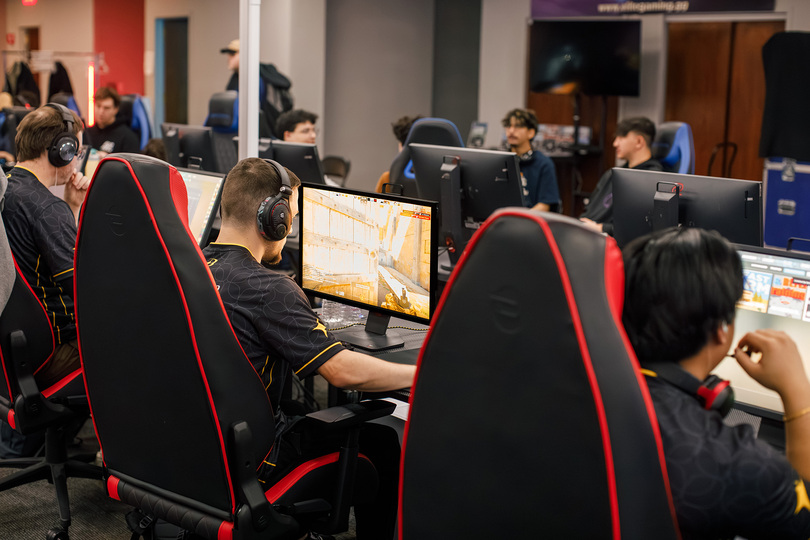
FRAG York, Syracuse’s first international esports competition, ran from Friday to Sunday with participants from 15 countries. Forty-eight teams, including Syracuse University, participated in the “elite-level” Counter-Strike 2 tournament.
Counter-Strike 2 is a first-person shooter game that pits two teams — the “Terrorists” and “Counter-Terrorists” — against each other. The game features many unique modes, including planting and diffusing a bomb and defending and rescuing hostages.
Tyler Poulin, a captain for NuTorious, said the esports field is crowded due to the possibility of qualifying for events like the national championship in May.
“The reason why these are so popular is because this is a really rare event where anyone can play,” Poulin said. “But, if you make it to a certain spot, you get points and you can move up the leaderboards.”
The basement where the tournament took place added a bar, spectator seating and a stage for the weekend event. Rooms were transformed for CS2, with a Kick livestream broadcasting the action from the player’s point of view. Under bright neon lights, teams and spectators erupted each time a round or game was won.
Two opposing teams took the stage wearing soundproof headphones to avoid hearing the two broadcasters in a nearby booth calling the game.
One player, Aaron Baldwin — who goes by aaronsfury — said he practices online five days a week before his team, AURA, competes. Yet, he argued no amount of preparation can ready someone for the pressure-filled environment.
“Playing in person, it’s a lot different,” Baldwin said.
Zach Lippe, who goes by DrLejos, admitted that traditional sports are more physical, but esports offer a more strategic approach and are more accessible.
“It’s far more of a mental game than a physical game,” Lippe said. “You’re not relying on any physical ability.”
Poulin, Baldwin and Lippe all agreed the future of esports is bright. When many were stuck at home during the COVID-19 pandemic, esports livestreams and gaming grew in popularity. The uptick gave the industry a record $47.6 billion in revenue during 2020 and doubled the usual video game playtime, according to Statista.

Lily Wilkin | Design Editor
Poulin said esports players and teams received large sums of money, but they failed to understand and sustain those investments during the pandemic.
“What happened in 2020 was a bunch of these guys in suits decided to throw millions of dollars in esports,” he added. “It created a bubble. A lot of teams and players got paid money that those investors were never going to make back.”
Ever since the end of the pandemic, overinvestment in esports and gaming has led to financial challenges. Layoffs, studio closures and struggling esports leagues have since been commonplace.
As newer generations, such as Gen Alpha and Beta, become more technologically advanced, Baldwin said gaming streaming platforms and video games will grow in popularity.
“It’s a higher level of play, but I think things will become more localized if the newer generations are going to continue to be more into esports,” Baldwin said. “I’m not saying traditional sports are phased out at all, but it’s going to become more part of the norm.”
Leepe agreed that esports will gradually grow with upcoming generations shaping the medium. But the financial potential isn’t the reason he participates in esports.
“It’s an excuse to just go hang out with the guys, but it’s also productive in the sense of working towards something,” Poulin said. “We’re just trying to have fun while doing it.”