



S
ix Final Four banners loomed behind Adrian Autry. To his left, pennants commemorating postseason runs filled nearly the entire wall. To his right, program legends are immortalized with pictures.
And in the middle of it all stood Autry. SU’s history and pedigree, collapsing on him. Questions about how Autry would return the Orange to the standard set around him flew one after another.
“I want to make the tournament every year. I’m not here just to be mediocre,” Autry said during Syracuse’s media day in October. “That’s not why I’m here. This place is where I grew up at. I learned a lot, I raised my family here, so I know how much this program means to the community and my family.”
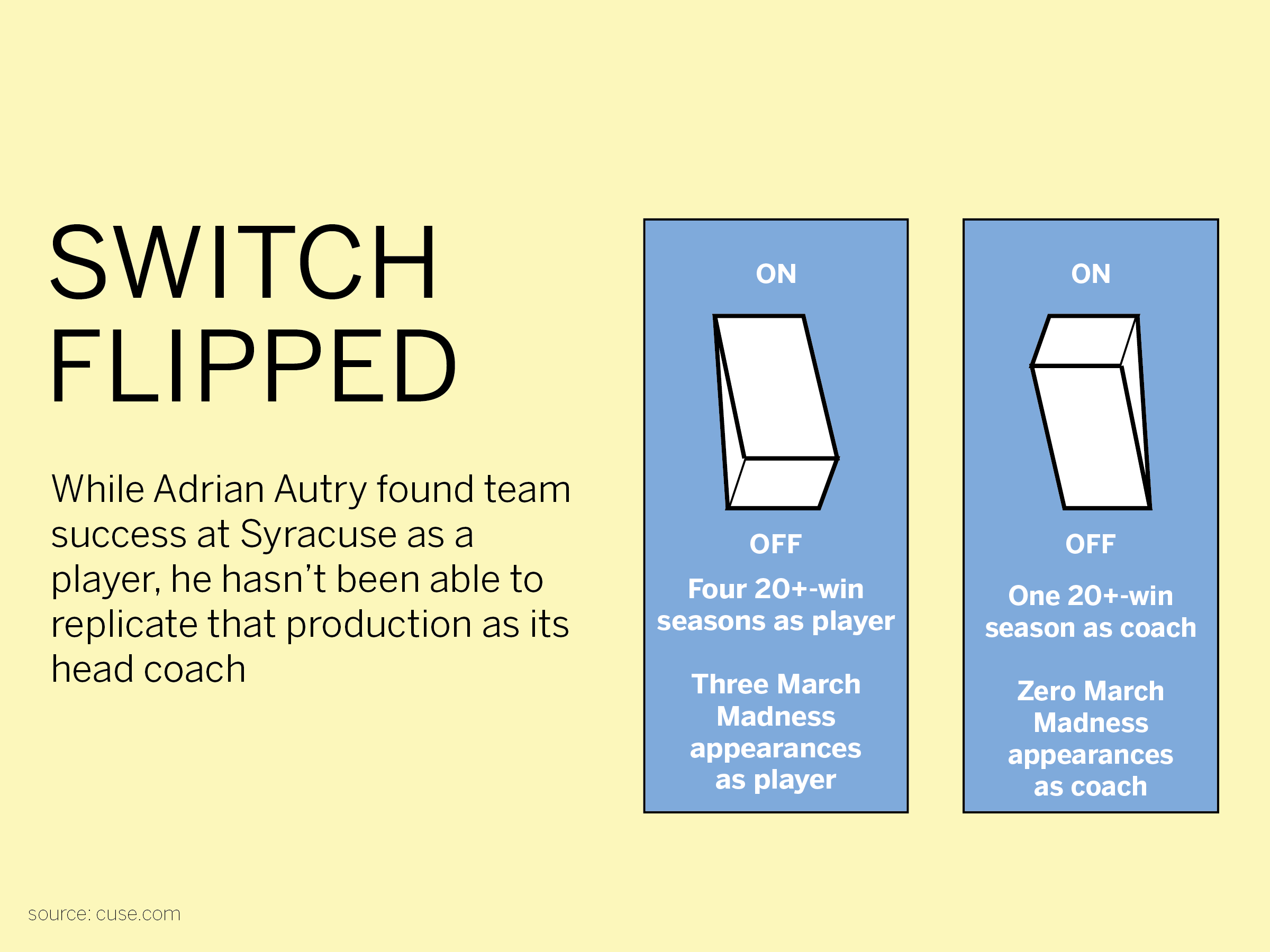
The sad reality for Autry, working a job he calls “a dream come true,” is that the results haven’t met the expectations. In his third season at the helm, the Orange (15-15, 6-11 Atlantic Coast) are on the brink of missing their fifth consecutive NCAA Tournament — something the program hasn’t endured in more than five decades.
Following his stout playing career before climbing the coaching staff’s ladder, Autry was entrusted to succeed Jim Boeheim and restore the “Orange Standard.” Now, barring an improbable ACC Tournament title, SU faces a defining question: Is the man who embodies Syracuse basketball still the right person to lead it?
Patience, something Boeheim pleaded for in December, is required for new head coaches. But in college basketball’s new landscape, there’s more urgency than ever.
“I knew the challenges ahead, and knew it wouldn’t be easy,” Autry said during the ACC Coaches call on Feb. 23. “But this is my alma mater. I have nothing but love for this place and want the best for the place.”
• • •
The mild-mannered Autry had to break character. It was that frustrating.
“We get another chance, and we walk under the f—king basketball, under the rim and we don’t get the rebound,” he said after hitting the side of the podium with each of his hands.
This is about as angry as I’ve ever seen Adrian Autry to start his press conference: pic.twitter.com/xPVDQytt5v
— Justin Girshon (@JustinGirshon) January 22, 2026
Syracuse just fell to .500 in ACC play after a 76-74 home loss to Virginia Tech in January. A game later, Autry was barraged with “fire Autry” chants during the Orange’s loss to Miami.
“Just give him a chance,” point guard Naithan George pleaded postgame. “It’s just always bashing and bashing, but they don’t see what goes on behind the scenes.
“I feel like that’s very disrespectful, the way they treat (Autry). I’m just very disappointed. I thought it was a very respected fanbase.”
But frustrations were still boiling. Five days later, a caller on Autry’s radio show asked him who his best replacements would be.
“We got to get back to where we’re at least in the tournament, and it’s a foregone conclusion that we’re going to be in the tournament. And I can assure you, that’s what Red wants more than anyone,” said John Wallace, who played with Autry at SU.
Following a 14-19 campaign last season, the program’s worst since 1968-69, Syracuse significantly increased its financial investment and transfer portal preparation to build a new-look roster capable of returning to the NCAA Tournament for the first time since 2021.
A source familiar with the program’s thinking, who was granted anonymity to speak freely, told The Daily Orange that SU spent just under $8 million on its roster this season. They said the figure was triple the cost of the Orange’s 2024-25 roster, and guessed it was seventh-to-ninth spending-wise in the ACC this year.
With one regular-season game remaining, SU sits 13th in the conference. Eight ACC teams are projected to make the NCAA Tournament, per ESPN’s latest bracketology.
“Obviously, the results speak, but I think it’s really been a challenge because college has changed,” Autry said on the March 2 ACC Coaches Call about how he’d define his tenure thus far.
“Whether it’s the rosters and the rules, or the financial piece of it, everything just changed so fast. That’s a bigger impact on results than more people give credit to.”
Since losing their first Quad 1 game of the season to then-No. 3 Houston in overtime during the Players Era Festival, possibly the biggest what-if of the Autry era, the Orange are 11-15, and their KenPom ranking has dwindled from No. 51 to No. 79 as of Tuesday night.
Throughout SU’s slide, porous offense and lack of an offensive identity have been at the forefront. Additionally, a once-stout defense — which was seen as Syracuse’s new identity — has crumbled as the season has gone awry.
The investment and talent were improved, and early results suggested Syracuse could snap its four-year March Madness skid. Instead, it’s become a season worthy of frustration.
Ilyan Sarech | Design Editor
• • •
Autry grew up with his mother and sister in the Martin Luther King Jr. Towers on 115th Street, between Fifth Avenue and Lenox Avenue in Harlem. For younger kids in the neighborhood who developed a reputation, there were always people trying to pull them in the wrong direction, said John Sarandrea, Autry’s first varsity head coach.
Beginning in middle school, Autry joined the historic Riverside Church AAU program, helping him earn a respected status. But it also helped lay a foundation.
“Riverside’s gym was open a lot of the time and made available for kids like a Red Autry to have some place to go, someplace to hone their craft and keep them off the street, which is what Riverside is all about,” said Tony Hargraves, a former Riverside Hawk and its current program director.
Eventually, Riverside paid Autry’s tuition to attend St. Nicholas of Tolentine High School instead of enrolling in a public high school, Sarandrea said. Tolentine competed in the Catholic High School Athletic Association, then widely regarded as the nation’s top league before national circuits like the EYBL Scholastic Conference existed.
Alongside Malik Sealy and Brian Reese — among several future Division I players — Autry helped Tolentine win the 1988 CHSAA championship, becoming one of the most sought-after prospects in the 1990 class.
In the mind of Sarandrea — who left Tolentine after the championship season to become an assistant coach at Pitt, where he tried to earn Autry’s commitment — Syracuse was always the clear favorite.
Sarandrea said Autry grew up watching SU and really liked the program. It also helped the Orange that Autry’s recruitment, which included interest from Kentucky, Louisville and St. John’s, came just after fellow New York City point guard Pearl Washington starred at Syracuse.
“Red comes from humble beginnings and has been a real success story, and will continue to be, because he used (basketball) the way it’s supposed to be used, as opposed to letting the game use him,” Sarandrea said.
Autry took over SU’s reins at point guard in 1990. Forward Billy Owens said Autry quickly worked his way into the starting role, instantly becoming a leader and motivator. Over time, Owens added that Autry became an “extension of the head coach.”
During Autry’s playing career, in which he was a four-year starter, SU won at least 20 games each season and reached three NCAA Tournaments — only missing the 1993 tournament due to sanctions. Looking back, Owens calls Autry one of the top five point guards he’s seen play for the Orange.
But now, the program that helped shape Autry is weighing whether he’s the right person to lead it.
I want to make the tournament every year. I’m not here just to be mediocre.Adrian Autry, SU head coach
• • •
In 2011, when Rob Murphy left Boeheim’s staff, Autry returned to Syracuse instead of going to Dayton.
Following three seasons at Virginia Tech, Autry began coaching SU’s forwards. His playing background and grassroots basketball coaching experience helped him become one of Syracuse’s top recruiters. Alongside his coaching, he helped recruit and develop Jerami Grant, Chris McCullough and Tyler Lydon into NBA Draft picks.
Former walk-on guard Ky Feldman, who was Lydon’s roommate before the forward became the Orange’s most recent first-round draft pick (2017), said Autry did an “awesome job” developing the forwards and that everyone in the position group “loved him.” To Feldman, Autry’s investment in the relationships he built stood out most.
Once Mike Hopkins departed for Washington in 2017, Autry earned the Orange’s associate head coach title. Six years later, following Boeheim’s retirement, Autry became the heir apparent.
Like Hopkins, Autry could’ve jumped ship to lead a program earlier. But that was never his end goal.
“He had other opportunities to become a head coach, but he really wanted to coach at his alma mater,” Reese, now an assistant at Monmouth, said.
But once Autry became the head coach in 2023, Syracuse wasn’t Syracuse.
Across Boeheim’s final five seasons, SU reached just two NCAA Tournaments while averaging 17.8 wins per season. That five-year stretch includes the worst two-year stretch of the Boeheim era (winning just 33 games across his final two campaigns, including his only losing season in 2021-22).
“Let’s face it, let’s be honest here,” Sarandrea said. “Red didn’t bring this program down. It was down when he got it.”
The start of the downfall depends on who you ask. But one thing is clear: Syracuse hasn’t built itself back up during Autry’s tenure.
Year 1 under Autry, a 20-win season, temporarily showed growth, but the Orange again missed March Madness.
A year later, SU reached a new low it’s yet to recover from.
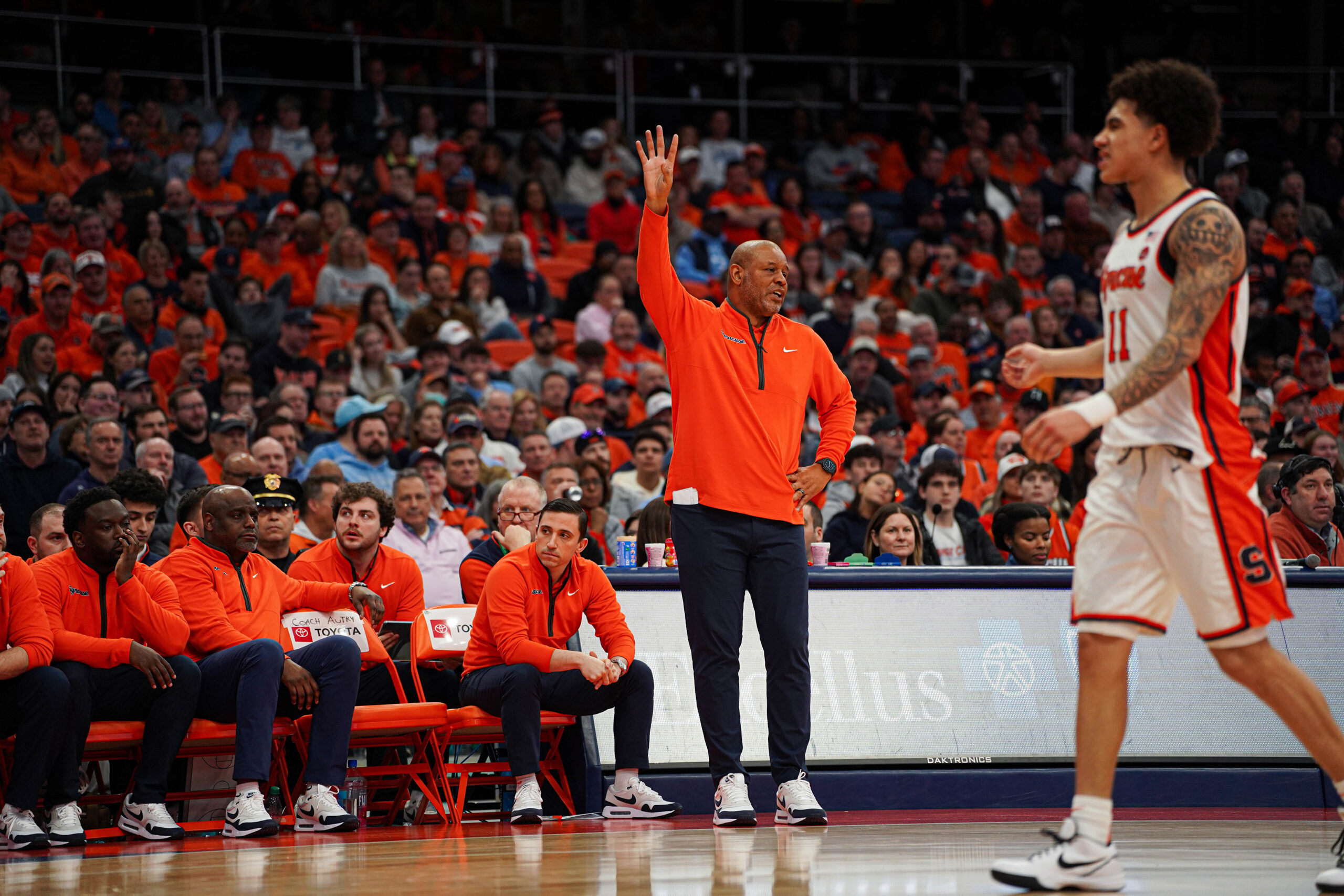
Adrian Autry grew up with dreams of playing for Syracuse. After finally becoming his alma mater’s head coach, Autry’s job in on the line after another disappointing season. Zoe Xixis | Asst. Photo Editor
• • •
Owens feels Syracuse is currently a hard sell because “kids don’t care about history.” The same banners, pennants and pictures of players that surrounded Autry during his media day press conference don’t hold the same weight they used to.
It used to help the Orange build a pipeline. “Great players wore the orange; that’s for freaking sure,” Sarandrea said while reminiscing about Pitt’s matchups with SU.
But name, image and likeness and the transfer portal have tilted the scale. While SU wasn’t ahead of the curve, it had players early in the Autry era to eventually get the program back to March Madness.
And then, within weeks of Autry’s first season concluding, Quadir Copeland and Maliq Brown, now respectively two of the best players in the ACC at NC State and Duke, entered the portal with two years of eligibility remaining. Meanwhile, Judah Mintz, an All-ACC Second Team Selection, forwent his final two years of college to play professionally.
All of a sudden, the budding core was gone. Autry and the Orange — albeit with limited money — failed to replace the departed production, and injuries led to the program’s worst season of the modern era.
After the season, John Wildhack, SU’s director of athletics, said, “the goal of this program is we should be playing meaningful games in March.” It set the expectation for Autry’s third season.
With Alex Kline settled into his general manager role and SU operating with a more detailed, structured process, the program entered the 2025 offseason far better equipped than it was a year earlier. The pressure was on.
“Right now, I feel sorry for college coaches, because you got to build just for one year, to win one year, because you never know what your roster is going to look like the following year,” Owens said.
Autry said SU built its roster with the “best ideas in mind that you get the best versions” of each player. But with a middling campaign nearing the end, it’s clear Autry never got everything to click.
In today’s college basketball landscape, patience is a luxury few programs afford. Turnarounds are expected immediately, and the possibility of a new hire sparking one looms over every struggling tenure.
• • •
The situation Autry finds himself in is unusually complicated. With Chancellor Kent Syverud departing for Michigan and Wildhack scheduled to retire on July 1, the university is approaching one of its most consequential athletic decisions amid an administrative transition.
Complications help define Autry’s three-year run at the helm. When Autry became the Orange’s head coach, the NIL and portal era was just beginning. Each day, the college basketball he played and previously coached in became different.
“It’s a crazy situation that Adrian came in on,” Owens said. “If it was a perfect world and we had money, I actually feel we’d be winning.”
Given where Syracuse’s program stood and college basketball’s direction, Autry inherited instability. But above all, he inherited expectations.
The Final Four banners, pennants and pictures in the Carmelo K. Anthony Basketball Center show success isn’t asked for at Syracuse — it’s demanded.
Autry saw that as a kid in New York who dreamed of playing for SU. He saw it again as a player and later as Boeheim’s understudy.
As head coach, he hasn’t matched it.
At Syracuse, that matters.
Photo by Tara Deluca | Asst. Photo Editor
Published on March 5, 2026 at 12:00 am