Stepansky: The Autry era brought sad results. It’s an uncomfortable reality.
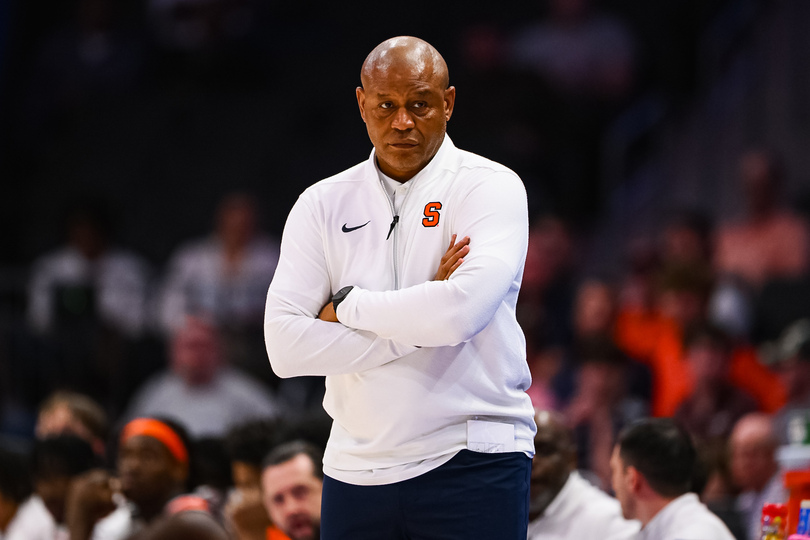
Adrian Autry grew up in Syracuse’s men’s basketball program, and the context adds to the sadness of SU's uncomfortable reality. Courtesy of The Atlantic Coast Conference
Get the latest Syracuse news delivered right to your inbox. Subscribe to our sports newsletter here.
CHARLOTTE, N.C. — Adrian Autry is 54 years old. He’s spent 19 of those years as a part of Syracuse’s basketball program.
He grew up in Syracuse as a player, becoming a top Big East point guard. After a professional career overseas, Autry jumped into coaching before landing back at SU as an assistant and associate head coach under Jim Boeheim.
Becoming Syracuse’s head coach was Autry’s lifelong goal, one he waited years for. The context makes the inevitable that much crueler.
The results of the Autry era are sad. But they’re an uncomfortable reality. The Orange went just 49-48 under Autry, extending a two-year NCAA Tournament drought into five and producing the program’s first back-to-back losing seasons since the late 1960s.
Change must be made for Syracuse to return to the “Orange Standard,” an expression coined by Boeheim and used by Autry in his opening press conference to punctuate the rich tradition of the program. Change at the top, specifically, must be made.
After Syracuse fell to SMU 86-69 in the ACC Tournament First Round Tuesday, Autry said he will think about his future, no different than last year. He added that he knew the expectations that come with taking SU’s head coaching job and tried to honor them. Autry will meet with the Syracuse administration Wednesday, where his future will be decided if it’s not before then.
Imagine working your whole life for an opportunity. After you earn the opportunity, you fail. It’s a hypothetical in most people’s lives.
But for Autry, it’s materialized into a real-world nightmare.
“It’s a dream come true,” Autry said on Feb. 23 of being SU’s head coach. “I knew the challenges that I had, and knew it wouldn’t be easy, but again, this is my alma mater. I have nothing but love for this place and want the best for this place.”
Autry’s wife, sons and father sat just a few feet behind Syracuse’s bench as it suffered a season-ending loss to the Mustangs. All were there to support the head coach until the very end.
Following a 20-win season and then a losing one, the pressure to improve was apparent before Year 3 even began. Syracuse Director of Athletics John Wildhack’s use of the term “meaningful games in March” only added fuel to the fire.
But the phrase kept a crack in the door, proving a season closer to the March Madness bubble, even missing the tournament, wouldn’t be a definitive end for Autry. His squad didn’t come close.
However, the faults aren’t all on Autry. While taking over for a legendary coach, he also took over a program in decline. Autry’s first year featured SU’s best win total since the 2018-19 season. The Orange made the Sweet 16 as a No. 11 seed in the 2020-21 season. Across Boeheim’s last two years, the Orange went a combined 33-32.
Autry’s diatribe on Syracuse’s lack of progress was warranted to an extent. SU’s administration didn’t properly invest in Autry’s second year, as proven by multiple mid-major transfer portal acquisitions playing key roles. In today’s college basketball world, money often is the answer to most issues.
“Getting back to the standard is going to be a little more challenging than we all thought it would be, or it is, because everything has changed,” Autry said after SU’s loss to Pitt on March 7.
He’s right. With a new coach, whether with Syracuse ties or not, they’ll be tasked with restoring a pedigree that hasn’t been consistently in tack for a few years now.
Nonetheless, the Orange tripled their investment heading into Year 3, making the lack of wins the final nail in the coffin. Adjusting to the new world isn’t all on Autry. But he still has plenty of blame on his shoulders.
Known as a star recruiter before acquiring the head coaching job, Autry failed to retain Maliq Brown and Quadir Copeland after his first year. Brown turned into the ACC’s top defender at Duke, and Copeland has become an all-conference player with NC State, one year after leading McNeese State to the NCAA Tournament.
Instead, Autry built around J.J. Starling. Adding the Baldwinsville native was a key piece to Autry’s first offseason, though Starling wasn’t surrounded by enough talent in his second year. This season, he’s drastically reduced his production, falling from almost 18 points per game to 11 while sporting a hitch. Down the stretch, Starling wasn’t even in the closing lineups in one-possession games.
Recent blunders only further proved Autry no longer possessed a meaningful grasp of his program.
After SU’s loss to Wake Forest on Feb. 28, Autry used his postgame press conference to rip into his squad’s lack of toughness. He said the word “tough,” or a version of it, a dozen times. When asked about Syracuse’s horrid road record over the last two years — it went 4-16 — Autry pointed to its lack of toughness. When asked about Starling’s offensive mishaps, he reiterated the message.
A lack of toughness falls on the head coach. Anything less shouldn’t be tolerated and will result in lineup changes.
After the Orange’s March 2 loss to Louisville, Autry mentioned his team’s inability to follow the scouting report. Louisville entered as one of the best 3-point shooting teams in the nation and the ACC’s top offense, yet SU still failed to get over screens and stop the explosive threat. When asked postgame about following the scouting report, Autry said, “The whole team is struggling in certain situations.”
Adapt or die. If a team can’t follow a scouting report, you make them follow it. If they still can’t, you adjust the scouting report to their needs. Again, it falls on the man in charge.
Syracuse is now at an intersection point. The Orange could resurrect their prosperity in the sport. Or they can continue down this path, falling further into the forgotten tier of college basketball for good.
Either way, this was a fairy tale story of a star player coming back and rising up the ranks to lead a place he grew up in. His legacy, no matter his accomplishments as a player, will be altered forever in Syracuse lore. When you put it like that, the result is demoralizing.
Aiden Stepansky is a Senior Staff Writer for The Daily Orange, where his column appears occasionally. He can be reached at amstepan@syr.edu or on X @AidenStepansky.