Adrian Autry takes responsibility after Syracuse’s season ends
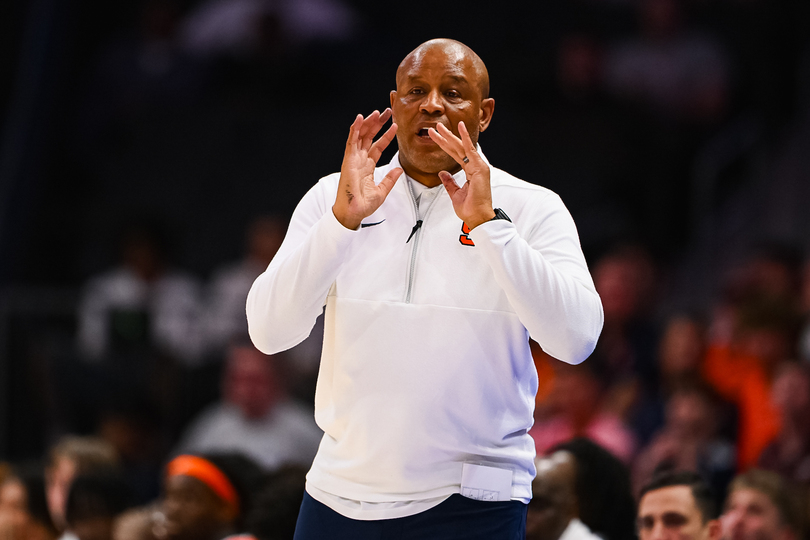
After Year 3 of the Adrian Autry era ended with a first-round ACC Tournament loss to SMU, the head coach took responsibility. Courtesy of The Atlantic Coast Conference
Get the latest Syracuse news delivered right to your inbox. Subscribe to our sports newsletter here.
CHARLOTTE, N.C. — Adrian Autry sat at the podium and, as he has throughout his three-year tenure, took responsibility.
But with a 49-48 record and three missed NCAA Tournaments, his time as Syracuse’s head coach is likely numbered.
Here’s the best of what Autry said after the Orange’s season ended with a first-round exit in the ACC Tournament:
On what his future holds
“You always think about (it) when the season is over with, about your future. No different than last year. I’ll have more thoughts again, like I always do. Right when a game is over with, there’s a lot of emotions, there’s a lot of feelings. That’s what we’ll do, I’ll continue to do as we move forward.”
On Donnie Freeman and J.J. Starling
“Donnie coming back, J.J. returning for his senior year, I thought that was a good building block and foundation to have some people that have been here that kind of understand it.”
“You don’t know how the development will go, and in Donnie’s situation, he only played 13 or 14 games. So he was excited to get back. But he was still technically like a freshman.”
“I thought J.J., for the most part, a lot of the stuff that he did for most of the year was really more of him growing himself and being a complete player … We knew the numbers would go down because of the players we were bringing in.”
“And I think especially towards the end, players go through those types of slumps. But unfortunately, it happened at the end of the season.”
On what he learned about himself and SU’s standard
“When I took this job, and obviously I went here, and I know the expectations that this job comes with. I was a player and part of it. And every day that was what I tried to do, honoring that, with my players, with my staff, the way I coached.”
“The thing about what I’ve learned is that it’s a lot of different variables in today’s world that to get to that standard again, you just can’t overlook. It’s just the reality.”
“To be able to be relevant, top 25 and compete for tournaments and be in championships, the investment has to be there from top to bottom. There’s no way around it.”
“But still, I don’t shy away from the job that I did. I’m harder on myself than anybody. I didn’t get the results that we wanted. So I don’t shy away from coaching.”
On if he’s supposed to meet with anyone and if there are any plans in the immediate future
“Yeah, we’ll have all our meetings tomorrow.”
On what he’d do differently
“I don’t know if we have enough time for that.”
“I think the biggest thing is the amount of work and the amount of — so many good programs, so many good teams. But the amount of work that you really have to every day put in with your staff, really with your staff and trying to really articulate the vision, the culture, really hammering that in every day.”
On college basketball’s new landscape
“Again, I own up to everything. But to be able to operate and to be able to do things — the NIL is a real thing. The transfer portal is a real thing.”
“Those are the variables that I was referring to. Those are always going to be challenging. If you fall a little short in those things, it makes it that much more difficult.”
“Probably before I took the job, I probably didn’t put that much emphasis into it. But now sitting here, and especially in the last three years, the way it has progressed, I don’t know if anyone knew it was going to progress to this extent.”